
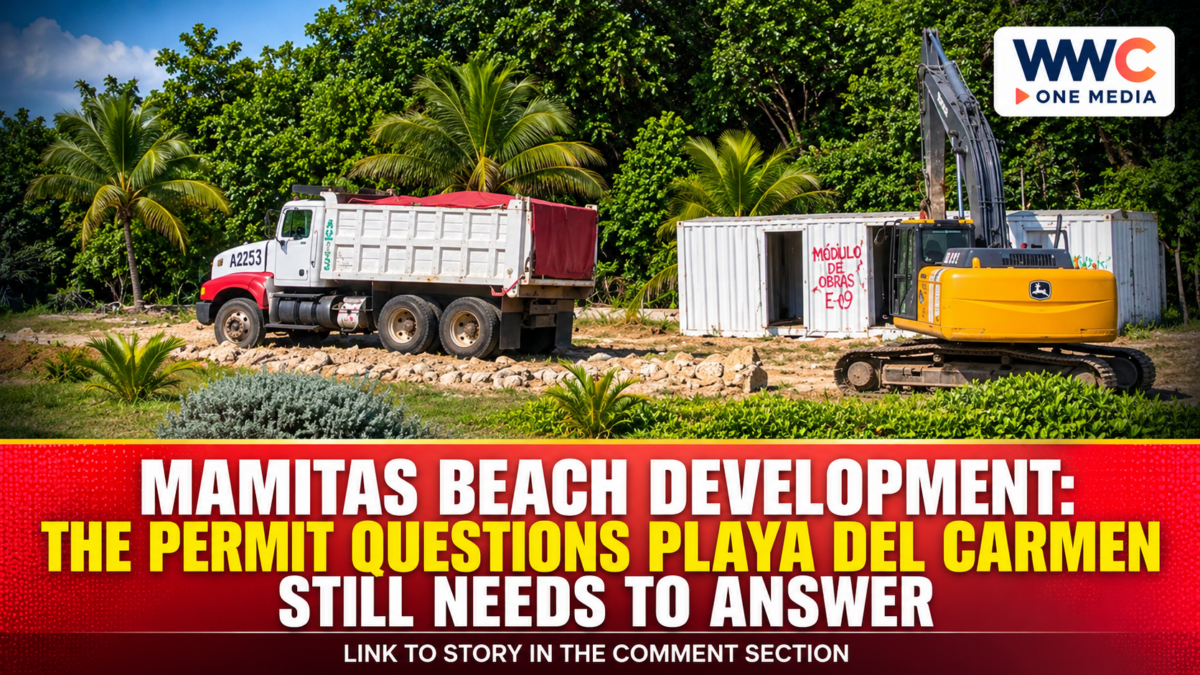
PLAYA DEL CARMEN, Mexico — The municipal government of Playa del Carmen said in May 2025 that it had not issued a construction licence for a proposed development at the Playa Mamitas property and that federal environmental authorisation had not been granted at that time. The statement placed the project under a clear regulatory question: whether any development activity could lawfully proceed before the required environmental and construction approvals were secured.
The issue matters beyond a single beachfront property. Playa Mamitas is part of a heavily visited coastal area where decisions about construction, public access and environmental safeguards can affect the relationship between tourism investment and the natural systems that support the shoreline.
The official statement is not a current permit search, however. It records the municipality’s position in May 2025; it does not establish whether applications were filed, approvals were later granted, or enforcement action took place after that date. Those questions remain important for any current assessment of the property.
What Playa del Carmen officially said about the Mamitas project
In a statement published on May 7, 2025, the Playa del Carmen municipal government said it had not issued a construction licence for the property in the Playa Mamitas area. It also said there was no environmental authorisation from Mexico’s Secretariat of Environment and Natural Resources, known as SEMARNAT, at that time. H. Ayuntamiento de Playa del Carmen
The statement followed public complaints about possible mangrove removal in the area. The municipality said it had not detected people cutting mangroves with machetes, while reiterating that no authorisation for works at the site had been issued.
That distinction is important. The municipal statement did not establish that mangroves had been removed, nor did it determine that a specific party had committed an environmental offence. It documented the government’s position on permits and its response to public concerns at that point in time.
A separate municipal communication published on April 15, 2025, also said the proposed development was subject to environmental and urban-planning evaluation by other authorities. It stated that the municipality had not authorised or granted a construction permit for the project. H. Ayuntamiento de Playa del Carmen
Taken together, the two statements establish a historical permit position. They do not replace a fresh check of the property’s current file.
Why mangrove protection carries legal weight
Mexico’s environmental framework gives particular attention to coastal ecosystems. Article 28 of the General Law of Ecological Balance and Environmental Protection identifies certain coastal developments and activities in wetlands and coastal ecosystems as works that may require prior federal environmental impact authorisation.
The law’s purpose is to allow the competent authority to assess potential environmental effects and set conditions intended to prevent or reduce damage. The requirement is not simply a paperwork exercise: it is part of the process through which authorities assess whether a proposed activity can proceed and under what conditions. ordenjuridico.gob.mx
Mangroves also have a specific protection under Article 60 TER of Mexico’s General Wildlife Law. The provision prohibits removal, filling, transplantation, pruning and other activities that affect the integrity of mangrove hydrology, the ecosystem and its area of influence, natural productivity, or ecological relationships with nearby rivers, dunes, coastal waters and coral systems. It provides an exception for activities intended to protect, restore, research or conserve mangrove areas. Diario Oficial de la Federación
For a coastal development proposal, the legal question is therefore broader than whether a building permit exists. Authorities may need to examine the location, the ecosystem involved, the nature of the proposed work and the environmental effects that could follow.
The permit process is not the same as a finding of wrongdoing
The absence of a municipal construction licence, as reported by the municipality in 2025, should not automatically be described as proof that illegal construction occurred. Nor does the absence of an environmental authorisation in that statement establish that a particular developer carried out prohibited work.
Those conclusions require evidence about actual activity, the relevant property boundaries, the permits applicable to the work and any inspection or enforcement findings.
This distinction is especially important in environmental reporting. A public complaint can trigger scrutiny, but a complaint is not an official finding. An agency inspection may document conditions at a site, but any allegation of a violation must be described in the terms of the inspection record and the agency’s resulting action.
For comparison, mangrove restoration work in the Philippines has shown how environmental protection can involve both public authorities and local communities. WWC’s report on Alaminos fisherfolk helping restore a damaged mangrove forest examined the role of restoration in strengthening coastal ecosystems. The circumstances differ from Playa Mamitas, but both illustrate why coastal vegetation has significance beyond its immediate location.
Why the current status needs a fresh public-record check
The key limitation in the available Mamitas documentation is its date. The municipal statements describe the position in April and May 2025. They do not answer whether the developer or property owner subsequently submitted an environmental impact statement, whether SEMARNAT issued a decision, or whether the municipality later received a construction application.
A current assessment would require the relevant federal environmental file and the municipality’s updated construction-permit records. It would also need to establish whether the property being discussed is the same parcel identified in any complaint or inspection.
That level of precision matters because environmental authorisations are tied to particular projects, locations and conditions. A permit for one parcel or activity cannot simply be assumed to cover another. Equally, a lack of information in an older public statement should not be treated as proof that no later approval exists.
WWC has also reported on mangrove species documented on Lawak Island, where continued scientific assessment is part of understanding and protecting a coastal habitat. In another Philippine report, Samar’s mangroves and the risks facing coastal communities highlighted the wider relationship between environmental safeguards and resilience.
The wider question: how coastal growth is supervised
Playa del Carmen’s challenge is not unique to one development proposal. Coastal municipalities must manage investment, land-use rules, public access and environmental protection within a system where responsibilities are divided among local and federal authorities.
The municipality’s 2025 statements made clear that environmental evaluation by federal authorities was a necessary part of the process for the Mamitas proposal. That division of responsibility means the public needs clear information from both levels of government: whether an application exists, which authority is reviewing it, what conditions apply and whether any work has been authorised.
The issue also has a public-access dimension. In its April 2025 communication, the municipality said access to beaches was guaranteed by law and that it would not permit the privatisation of the coastline. That position is relevant to the public debate, although it does not by itself resolve questions about ownership of the adjoining property or the environmental status of a proposed project. H. Ayuntamiento de Playa del Carmen
The strongest accountability test is therefore documentary: the current permit file, the environmental assessment and any inspection or enforcement records should be available for scrutiny. Without those records, claims about the present condition of the site or the legality of recent activity should remain unconfirmed.
What happens next
The next step is an updated review of the Mamitas property’s records. SEMARNAT’s environmental impact authorisation file, if one exists, would help establish whether the federal government has assessed the proposal and what conditions it may have imposed. The municipal government’s current construction-permit register would clarify whether a local licence has since been requested or issued.
If authorities have inspected the site, the inspection report and any resulting administrative order would be essential to determining what was observed and what action, if any, was taken.
Until those records are checked, the May 2025 statements remain the clearest official evidence in this review. They establish what the municipality said then—not what the complete permit or enforcement status is today.
Frequently asked questions
1. Did Playa del Carmen approve construction at the Mamitas property?
In a statement dated May 7, 2025, the municipality said it had not issued a construction licence for the property. That statement does not establish whether the status changed afterward.
2. Did SEMARNAT authorise the Mamitas development?
The municipality said in May 2025 that no SEMARNAT environmental authorisation existed at that time. A current federal permit search is needed to establish whether a later decision was issued.
3. Does Mexican law protect mangroves from filling or removal?
Yes. Article 60 TER of the General Wildlife Law prohibits removal and filling, among other activities, when they affect mangrove ecosystems and their ecological functions, subject to the provision’s stated conservation-related exception.
4. Does a missing construction licence prove that mangrove damage occurred?
No. Permit status and proof of environmental damage are separate questions. Establishing damage or a violation requires site-specific evidence and the relevant authority’s findings.
5. Which authority handles environmental approval for coastal developments in Mexico?
SEMARNAT is the federal environmental authority responsible for the environmental impact assessment process covered by the applicable provisions of Mexico’s environmental law. Other authorities may have separate responsibilities for local construction and land-use permits.










