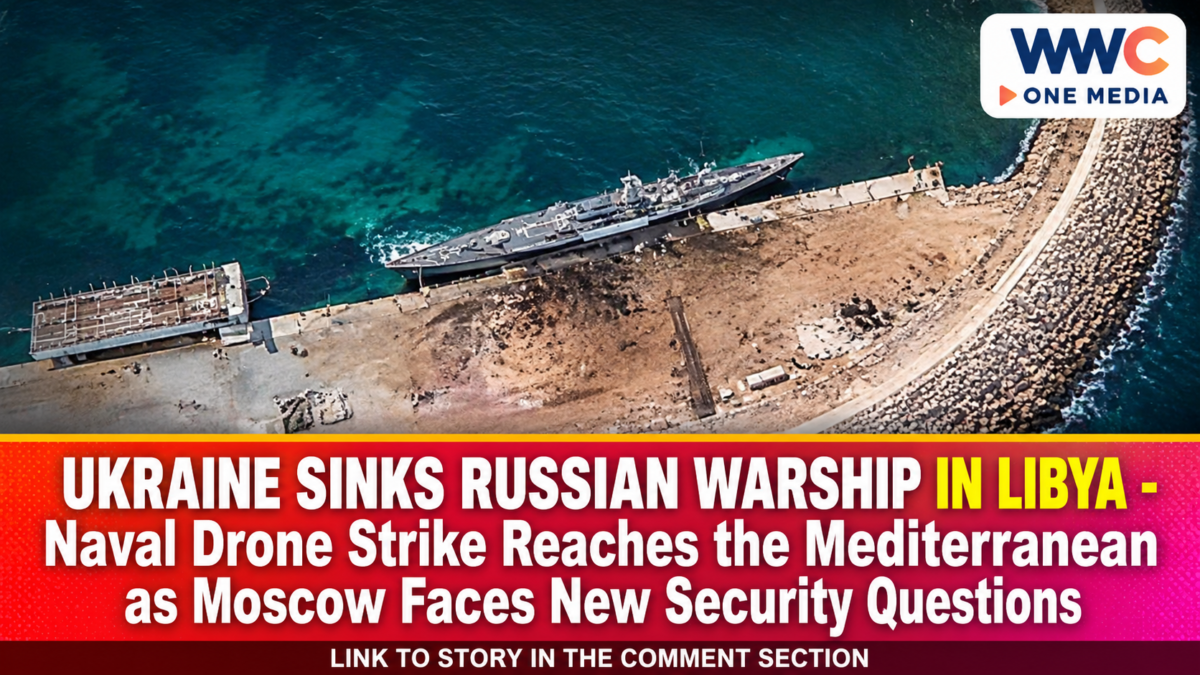
BENGHAZI, Libya — November 25, 2026 — Ukraine has taken its naval-drone campaign far beyond the Black Sea, publicly acknowledging an operation that destroyed a Russian naval corvette and struck a Russian cargo vessel near Benghazi, Libya, on November 22.
The operation targeted two vessels identified by Ukraine’s Security Service as the Russian corvette Merkury and the dry-cargo ship MV Angara. Ukrainian authorities said seven Ukrainian-made unmanned surface vessels were deployed, transported to the designated area aboard a larger vessel and launched against the targets.
Ukraine says the Merkury was destroyed and a Ka-27 helicopter aboard it sank with the warship. The MV Angara, which Kyiv says was used to transport Russian military equipment, was also struck. The Ukrainian announcement did not provide a complete independent damage assessment of the cargo vessel.
The incident is significant for two reasons. Militarily, it demonstrates the reach of Ukraine’s maritime-drone operations against Russian naval and logistics assets. Diplomatically, it has placed Libya’s sovereignty and maritime security at the centre of a conflict that has already spread across the Black Sea and into other European waters.
The United Nations Support Mission in Libya has called for an immediate, independent and transparent investigation, warning against actions that could draw the country into wider international confrontations.
Russian warship destroyed in Benghazi: What Ukraine confirmed
Ukraine’s Security Service announced on November 23 that the operation involved the Ukrainian Defence Forces and the Security Service of Ukraine, commonly known as the SBU.
The agency identified the first target as the Russian Project 20380 corvette Merkury. It said the vessel had been commissioned in 2023 and assigned to Russia’s Black Sea Fleet.
The SBU said the corvette regularly escorted Russian naval convoys and provided protection for the MV Angara.
The second target was the Russian dry-cargo vessel MV Angara, identified in the Ukrainian statement by IMO number 9179842. The SBU described the vessel as part of Russian military logistics, including transport activity associated with what it called the Syrian Express and Libyan Express.
Ukraine said seven unmanned boats manufactured in Ukraine were used. They were transported to the designated location and launched from a so-called mother ship.
The SBU claimed Russian forces attempted to intercept the drones from the air, sea and land, but the unmanned vessels reached their targets.
In his November 23 address, Ukrainian President Volodymyr Zelenskyy publicly acknowledged the operation and credited the SBU and supporting Defence Forces.
The Ukrainian account establishes Kyiv’s responsibility for the operation. It does not, by itself, independently verify every operational detail or establish the full extent of damage to both vessels.
Why the Mediterranean strike matters to Russia’s navy
The Benghazi operation is particularly notable because the target was not in the immediate Black Sea theatre.
Ukraine has repeatedly used unmanned systems to challenge Russian naval assets and maritime logistics. The latest operation shows that Kyiv is prepared to pursue targets in waters much farther from the Ukrainian coastline.
For Russia, the problem is not limited to the loss of an individual vessel. Naval forces depend on a network of ports, logistics ships, escorts, maintenance facilities and supply routes. Disrupting one part of that network can create operational difficulties beyond the location of the strike.
The Merkury was identified by Ukraine as a corvette assigned to the Black Sea Fleet. Its stated role in escorting Russian naval convoys makes the reported loss relevant to the protection of other vessels involved in maritime logistics.
The MV Angara is also important to the Ukrainian account because Kyiv says it was used to transport Russian military equipment.
However, the cargo ship’s reported role should remain attributed to Ukrainian authorities. The public announcement does not provide a detailed manifest of what the vessel was carrying during the Benghazi incident.
The broader question for Moscow is whether its surface fleet and support vessels can maintain reliable protection when operating far from established defensive positions.
Seven naval drones and a mother ship: How Ukraine described the operation
The SBU’s account provides an important detail about how the attack was organised.
Rather than describing the unmanned boats as having travelled independently from Ukraine, the agency said they were transported to the designated location aboard a mother ship before being launched.
This distinction matters because unmanned surface vessels have limitations involving range, endurance, navigation, communications and payload capacity. A support vessel can provide a way to position them closer to an intended operating area.
The SBU said the seven Ukrainian-made boats tracked and struck the Russian targets despite interception attempts.
The public statement does not disclose the mother ship’s identity, its departure point, the precise route taken or the exact launch location.
Those operational details should not be filled in through speculation. The confirmed public account establishes the method Ukraine says it used, but not every stage of the mission.
The development nevertheless illustrates how maritime warfare is changing. Smaller unmanned systems can create serious risks for larger vessels, particularly when ships are stationary, operating in confined waters or relying on conventional security arrangements.
For naval planners, the challenge is increasingly about detecting, identifying and stopping low-profile threats before they reach a vessel.
Libya rejects foreign military operations in its waters
The operation has created a diplomatic problem for Libya, a country whose political and security institutions remain divided.
The Russian vessel was struck at or near Benghazi, a major port city in eastern Libya. The eastern-based administration said the Russian ship had stopped to refuel and take on supplies while returning to Russia under existing maritime cooperation arrangements.
In its initial statement on November 22, the eastern-based government said preliminary findings pointed to a possible unmanned-vehicle attack aboard a Russian vessel. It announced a comprehensive investigation and coordination with Russian authorities.
The internationally recognised Government of National Unity, based in Tripoli, took a separate public position.
On November 23, its Ministry of Foreign Affairs and International Cooperation rejected foreign military operations inside Libyan territory or territorial waters and requested official clarification from Kyiv.
On November 24, the government’s Foreign Media Department went further, denying allegations that it had reached military understandings with Ukraine concerning the Benghazi events.
That distinction is essential. Ukraine’s acknowledgement of the operation does not establish that Libya’s internationally recognised government authorised, coordinated or supported it.
The two Libyan political authorities have issued separate statements, reflecting the country’s divided institutional environment. Their positions should not be treated as a single unified account.
United Nations calls for an independent Benghazi investigation
The United Nations Support Mission in Libya expressed serious concern on November 22 over the attacks at Benghazi Seaport and off the city’s coast.
The mission stressed that Libya’s sovereignty, territorial integrity and the security of its citizens and assets must be respected.
It called for an immediate, independent and transparent investigation to establish the facts and hold those responsible to account. It also offered assistance to Libyan authorities in the investigation.
The UN mission urged all parties to exercise maximum restraint and avoid putting unverified information into the public domain while the inquiry is underway.
Its warning carries wider significance because Libya is not a party to the Russia-Ukraine war. An attack involving foreign military assets on Libyan territory or in its territorial waters risks creating a new security problem for a country already struggling with political fragmentation.
The mission specifically warned against actions or rhetoric that could fuel tensions within Libya or draw the country into wider regional and international confrontations.
A second maritime incident adds to concerns around Benghazi
The Benghazi Naval Forces General Staff also issued a statement on November 22 describing security threats directed at the naval base.
It said naval and air units responded under established military protocols and that naval units launched rescue operations for the crew of a commercial vessel that had been targeted.
The statement did not identify that commercial vessel as the MV Angara. It also did not provide a detailed account connecting the rescue operation to the Ukrainian announcement about the Russian cargo ship.
That distinction matters because the Russian corvette, the Russian dry-cargo vessel and the commercial vessel mentioned by Libyan naval authorities should not automatically be treated as one ship or one incident.
The available public statements establish that maritime security activity occurred around Benghazi on November 22. They do not provide a complete, independently verified reconstruction of every event at the port and offshore.
For the shipping industry, the incident reinforces the importance of accurate vessel identification, reliable maritime reporting and clear security information for commercial operators.
Russia’s naval challenge extends beyond the Black Sea
The Black Sea has been one of the most important theatres of Russia’s naval difficulties since its full-scale invasion of Ukraine in February 2022.
Ukraine has developed a range of unmanned maritime systems designed to threaten Russian vessels and military infrastructure. These systems have changed the risk calculations for ships operating close to Ukrainian-controlled waters.
The Benghazi operation introduces another geographical dimension: Russian naval and logistics assets can face threats even when they are operating far from the immediate front line.
That does not mean every Russian naval formation is equally vulnerable. Surface ships, support vessels and nuclear-powered submarines have different roles, operating environments and defensive requirements.
Nor does the loss of one corvette establish that Russia has lost its overall naval capability.
The more precise conclusion is that the operation demonstrates a potential vulnerability in the protection of Russian surface vessels and maritime logistics when they operate in locations where Ukraine can position unmanned systems.
WWC ONE MEDIA has previously examined Ukraine’s acknowledgement of the Russian ship strikes near Libya and the questions they raise for Mediterranean security. The latest developments make the Libyan response and the UN’s call for an investigation central to understanding the wider consequences.
The incident also follows Libya’s decision to seek a joint investigation with Russia after the Benghazi ship attack, an issue that goes beyond the military damage to the vessels.
The diplomatic dispute has since widened, with the Tripoli-based government denying any military understanding with Ukraine. WWC’s report on Libya’s rejection of claims of a military deal with Kyiv explains why that clarification matters.
The risks to civilian shipping are also part of a wider maritime security problem. In the Black Sea, Bulgaria has warned about the worsening security environment after drone attacks affected commercial vessels.
What the Benghazi attack means for Mediterranean maritime security
The Mediterranean is an important route for international trade, energy shipments and commercial shipping. The presence of military vessels and foreign security arrangements around Libyan ports makes maritime incidents particularly sensitive.
The Benghazi operation raises several questions for regional governments and shipping operators.
Can ports hosting foreign military vessels adequately protect them from unmanned surface threats? What procedures should apply when a foreign military vessel is attacked inside a country’s port facilities? How should governments investigate incidents when the countries involved in the wider conflict offer competing political and legal interpretations?
These questions cannot be answered by the military claims alone.
The UN’s call for an independent investigation is therefore important. Establishing the location of the attack, the vessels involved, the damage caused and the circumstances under which the operation took place will be essential to determining the wider consequences.
The issue is also relevant to freedom of navigation and the protection of civilian maritime traffic. Commercial vessels operating near areas of military activity need clear warnings and reliable information to assess risk.
What happens next?
Three developments will shape the next stage of the Benghazi incident.
First, investigators will need to establish the circumstances of the attack, including how the unmanned vessels reached the port area and whether any additional commercial shipping was affected.
Second, Libya’s competing political and military authorities will face pressure to clarify their positions and demonstrate that national territory and maritime facilities are not being used without proper authority.
Third, Russia and Ukraine may face further diplomatic and security consequences as the incident becomes part of the wider debate over maritime operations beyond the Black Sea.
For now, Ukraine has acknowledged the operation, Libya has objected to foreign military action in its sovereign space, and the United Nations has called for an independent investigation.
The sinking of the Merkury is a significant naval development. But the larger question may be whether the Mediterranean becomes another arena where the Russia-Ukraine conflict threatens the security of countries and commercial shipping far beyond the original battlefield.
Frequently Asked Questions
Which Russian warship was sunk in Libya?
Ukraine’s Security Service identified the Russian Project 20380 corvette Merkury as the vessel destroyed during the November 22, 2026 operation near Benghazi.
Where was the Russian warship attacked?
The incident occurred at or near Benghazi, a port city in eastern Libya on the Mediterranean coast.
How many naval drones did Ukraine say it used?
Ukraine’s Security Service said seven Ukrainian-made unmanned surface vessels were deployed. It said they were transported to the designated location aboard a mother ship before being launched.
What happened to the Russian cargo ship MV Angara?
Ukraine said the MV Angara, a dry-cargo vessel it described as supporting Russian military logistics, was struck during the operation. The public announcement did not provide a complete independent damage assessment.
Was a Russian helicopter also destroyed?
Ukraine’s Security Service said a Ka-27 multipurpose helicopter aboard the Merkury sank with the corvette.
Did Libya approve Ukraine’s military operation?
The public records reviewed do not establish that Libya’s internationally recognised Government of National Unity authorised the operation. Its Foreign Ministry rejected foreign military operations in Libyan territory and territorial waters, while its Foreign Media Department later denied any military understandings with Ukraine concerning the Benghazi events.
What did the United Nations say about the attack?
The UN Support Mission in Libya called for an immediate, independent and transparent investigation, urged restraint and stressed that Libya’s sovereignty and territorial integrity must be respected.
Does the attack mean Russia has lost control of the Mediterranean?
No. The destruction of one corvette does not establish that Russia has lost its broader naval presence or capability in the Mediterranean. It does, however, demonstrate a vulnerability affecting the surface fleet and maritime logistics.