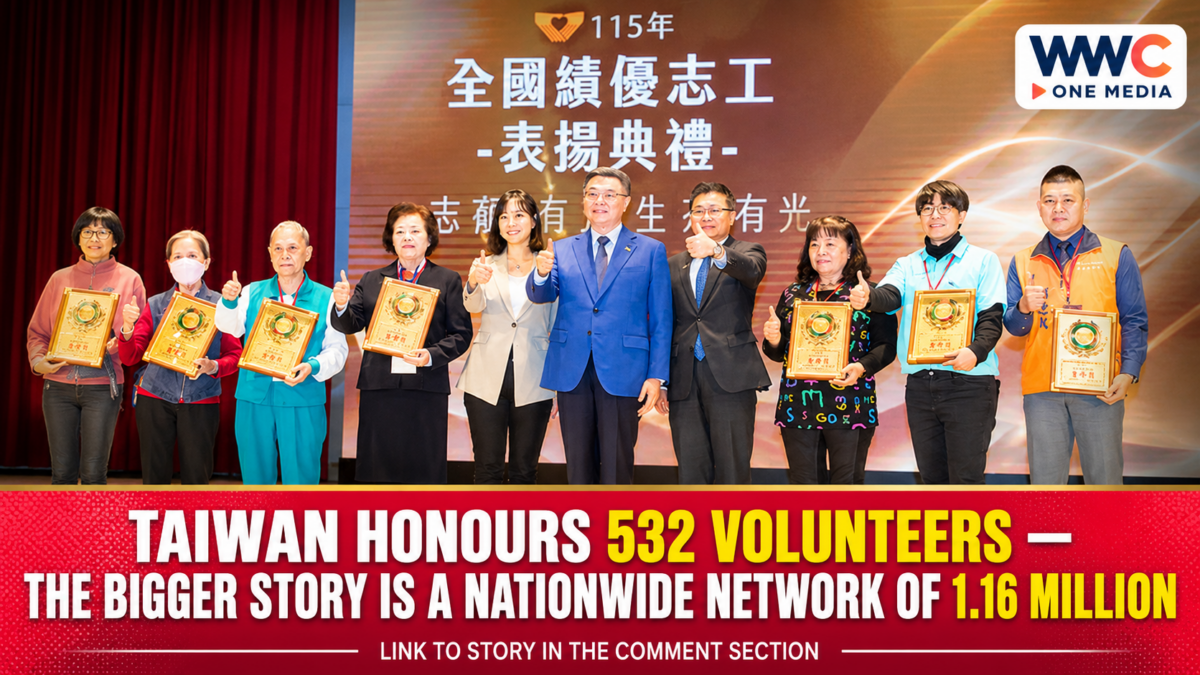
Taiwan recognised hundreds of long-serving volunteers at a national awards ceremony on November 25, honouring 532 people who had each completed at least 8,000 hours of service and 25 outstanding volunteer teams. The event also placed a renewed spotlight on the country’s wider volunteer network, which counted more than 1.16 million registered volunteers at the end of 2025.
The recognition comes after volunteers played a major role in helping communities recover from the deadly September 2025 flooding in Hualien County. Taiwan’s government has described the effort as an example of how community participation can support recovery when public agencies and affected residents face an enormous cleanup task.
But the figures behind the ceremony point to something larger than a single disaster response: volunteer work has become a substantial part of Taiwan’s social-support structure, spanning healthcare, education, environmental protection, cultural activities and neighbourhood services.
Taiwan volunteers receive national recognition
The 2026 National Outstanding Volunteer Awards ceremony was held on November 25, with Premier Cho Jung-tai and Deputy Minister of Health and Welfare Lu Chien-te attending.
The Ministry of Health and Welfare said 532 volunteers received gold awards for completing at least 8,000 service hours. Another 1,230 received silver awards for at least 5,000 hours, while 2,687 received bronze awards for at least 3,000 hours.
The ceremony also recognised 25 outstanding volunteer teams working across different fields.
The ministry said the gold-award recipient with the highest recorded service total had accumulated 39,083 hours. The oldest gold-award recipient was 90 years old, while the youngest was 41.
These thresholds show that the awards are not simply popularity recognitions. They are tied to accumulated service hours under Taiwan’s Volunteer Service Award Regulations.
For readers, the numbers provide a sense of how much sustained work can sit behind activities that are often treated as informal community assistance.
Hualien flood recovery brought volunteer work into focus
The awards ceremony also drew attention to the response after the Matai’an Creek barrier lake overflowed in Hualien County on September 23, 2025.
The resulting disaster inundated parts of Guangfu Township with floodwater, mud and debris. The Highway Bureau’s 2025 annual report records that the Matai’an River Bridge on Provincial Highway No. 9 was washed away by debris flow following the barrier lake’s overflow.
At the November 25 ceremony, Cho said as many as 500,000 volunteers, widely referred to as “shovel heroes,” had helped affected households rebuild and clean their homes.
That figure was cited in the premier’s remarks and should be understood as the government’s stated estimate, rather than a separately audited count of unique volunteers.
The response nevertheless illustrates the scale of public participation described by the government. Volunteers helped clear mud and debris and supported residents facing the difficult process of restoring damaged homes.
The work also demonstrated why recovery is not limited to engineering repairs or government-funded reconstruction. Roads and bridges may require formal contractors and public budgets, but household recovery can also depend on people willing to provide time and practical assistance.
The numbers reveal how extensive Taiwan’s volunteer network has become
The Ministry of Health and Welfare reported that Taiwan had 1,164,629 volunteers and 20,000 volunteer teams at the end of 2025.
Those volunteers collectively recorded 110.27 million service hours. The ministry estimated that this amount of work was equivalent to the contribution of 53,017 full-time workers and assigned it an estimated value of more than NT$20.9 billion.
These figures offer a useful way to understand the scale of volunteer activity, although the estimated monetary value should not be confused with government spending saved or income earned by volunteers.
The ministry said volunteer participation extends across social welfare, healthcare, education, environmental protection, cultural activities and community services.
That range matters because the contribution of volunteers is not limited to emergency situations. People also assist patients and families in hospitals, visit older residents living alone, help protect children near schools and support the maintenance of natural and cultural spaces.
The network therefore operates both during major emergencies and in everyday situations that may receive less public attention.
Why long-term service matters beyond award ceremonies
The award system is based on accumulated hours. According to the Executive Yuan, Taiwan established its Volunteer Service Act in 2001 and introduced the Volunteer Service Award Regulations to recognise long-term participation.
The Cabinet said 7,125 gold awards had been presented since 2001 through the system.
The 2026 ceremony recognised 532 new gold-award recipients, along with silver and bronze awardees. The ministry’s figures indicate that thousands of people have continued volunteering long enough to reach substantial service-hour milestones.
However, hours alone do not measure every aspect of volunteer work. The quality of assistance, the needs of the communities being served, the suitability of training and the ability to coordinate with professional agencies also matter.
For disaster response in particular, volunteers can help with cleanup and community support, but dangerous rescue operations, structural assessments and other specialised tasks require appropriately trained personnel.
The distinction is important for any society that wants to encourage participation without exposing volunteers or affected residents to unnecessary risks.
WWC has previously examined how Filipino volunteers can support disaster readiness through relief-pack preparation. The same principle applies across countries: community participation can strengthen the response system when it is organised around clear responsibilities.
What the recognition means for Taiwan’s communities
The ceremony took place in a year designated by the United Nations as the International Year of Volunteers for Sustainable Development.
Taiwan’s Cabinet said it wanted to encourage wider participation and connect volunteer service with the Sustainable Development Goals.
The broader policy challenge is sustaining that participation. Volunteer networks need coordination, training, support and clear links with public agencies. Without those structures, goodwill alone may not be enough to ensure that assistance reaches the right people at the right time.
The issue is relevant beyond Taiwan. In Southeast Asia, communities regularly face floods, storms and other emergencies that require cooperation between government agencies, local organisations and residents.
WWC’s reporting on the Philippines’ disaster-resilience agenda has examined why preparation must extend beyond emergency response and include local capacity.
The question is not whether volunteers can replace public institutions. They cannot. The more useful question is how institutions can make it easier and safer for people to contribute where their efforts are most needed.
What happens next
Taiwan’s November 25 ceremony recognised long-serving volunteers and teams, but the government’s wider challenge is maintaining the network that supports communities throughout the year.
The Ministry of Health and Welfare said it hopes award recipients will encourage more people to participate in volunteer work. The Cabinet also said public agencies would continue improving the laws, policies, budgets and systems that support volunteer service.
For communities recovering from disasters, the lasting measure of the effort will be whether assistance can continue beyond the initial cleanup and whether residents can rebuild stable lives.
The awards recognise years of service. The larger test is whether that commitment can remain organised, supported and available when communities need it most.
Frequently asked questions
How many volunteers received gold awards in Taiwan in 2026?
The Ministry of Health and Welfare said 532 volunteers received gold awards for completing at least 8,000 service hours.
How many volunteers does Taiwan have?
Taiwan had 1,164,629 volunteers and 20,000 volunteer teams at the end of 2025, according to the Ministry of Health and Welfare.
How many volunteers helped after the Hualien floods?
Premier Cho cited an estimate of as many as 500,000 volunteers who helped affected households after the Matai’an Creek barrier lake disaster. This was the figure stated in his November 25 speech.
What are the service-hour requirements for Taiwan’s volunteer awards?
The gold award requires at least 8,000 service hours, the silver award at least 5,000 hours and the bronze award at least 3,000 hours.
What kinds of work do volunteers perform in Taiwan?
Volunteer activities include social welfare, healthcare, education, environmental protection, cultural services and community support.