
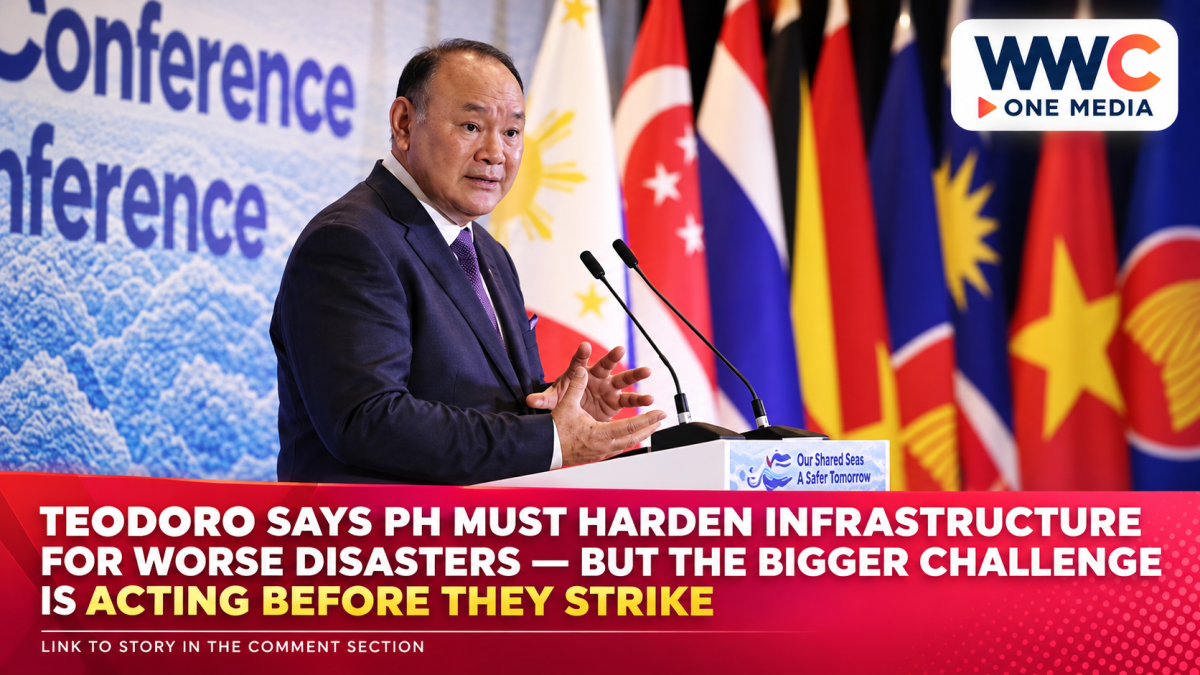
MANILA, Philippines — The Philippines needs to invest more aggressively in infrastructure and disaster-adaptation systems as increasingly complex emergencies threaten communities, Defense Secretary Gilberto Teodoro Jr. said, arguing that the country can no longer depend mainly on responding after catastrophe has already struck.
Speaking after the ASEAN Ministerial Conference on Disaster Resilience in Pasay City on September 16, Teodoro called for renewed investment in physical infrastructure, government mechanisms and adaptation systems capable of dealing with what he described as more unpredictable and potentially more severe disasters.
His remarks came as Southeast Asian governments formally adopted the Manila Declaration on Advancing ASEAN’s Disaster Resilience Agenda Towards 2030 and Beyond, a regional framework intended to accelerate preparedness, early action and long-term resilience.
The policy direction sounds straightforward.
The harder question is whether national and local governments can turn forecasts, hazard maps and disaster plans into protective action before roads are submerged, power is lost, ports are damaged and families are forced from their homes.
Teodoro warns disasters are becoming more complicated
Teodoro said the country must prepare not simply for familiar typhoons and floods but for emergencies in which several hazards interact.
He cited scenarios including volcanic degassing combined with southwest monsoon rains that can contribute to lahar risks, as well as situations in which one part of the Philippines experiences intense rainfall while another faces drought.
That is important because disasters increasingly cannot be managed as isolated events.
A severe typhoon, for example, can damage roads and bridges, interrupt electricity, disrupt telecommunications, close ports, affect food distribution and create health risks simultaneously.
An earthquake can create another chain of disruptions involving hospitals, airports, water systems, schools and communications.
Teodoro’s argument is essentially that infrastructure built for normal conditions must increasingly be designed to keep functioning when normal conditions disappear.
The Philippines has enormous exposure to natural hazards
The urgency is supported by broader risk data.
A 2026 World Bank assessment says more than 20 tropical storms form near the Philippines each year, with roughly eight making landfall. Between 2012 and 2023, disasters killed around 11,000 people, affected about 130 million and caused approximately $9 billion in recorded economic losses.
Over the longer term, the World Bank estimates annual losses from typhoons and earthquakes at more than $3.3 billion.
And climate change could make the economic consequences substantially larger.
The Bank’s Philippine climate analysis estimates that, without sufficient adaptation and mitigation, climate-related impacts could reduce economic output by as much as 13.6% by 2040 compared with a scenario without those impacts. That is a modeled long-term estimate rather than a prediction that 13.6% of GDP will suddenly disappear in a single disaster.
Older World Bank catastrophe modeling likewise estimated average annual Philippine losses of roughly ₱133.2 billion from typhoons and ₱43.5 billion from earthquakes.
Those figures help explain why resilience is increasingly being treated not simply as an emergency-management concern, but as an infrastructure and economic-development issue.
ASEAN is trying to move from response to prevention
The ASEAN conference hosted by the Philippines put that shift at the center of regional policy.
The newly adopted Manila Declaration identifies three broad priorities: accelerating implementation of the ASEAN Agreement on Disaster Management and Emergency Response Work Programme 2026–2030, strengthening monitoring and accountability, and shaping the region’s disaster-resilience agenda beyond 2030.
Teodoro described the declaration as a “living document”, meaning ASEAN members intend to adjust their approach as risks and technologies change.
The declaration is expected to be presented to ASEAN leaders at the 49th ASEAN Summit in November, subject to member-state concurrence.
Perhaps the more significant change, however, is philosophical.
Disaster policy has traditionally concentrated heavily on what happens after a storm, earthquake or eruption—rescue operations, relief goods, evacuation centers and reconstruction.
ASEAN officials are now placing greater emphasis on acting before impact.
Indonesia’s Deputy Minister for Prevention at its disaster-management authority, Abdul Muhari, told the Manila conference that warning systems are insufficient unless forecasts are connected to decision-making authority, financing, local capacity and specific actions.
In other words:
Knowing that a disaster is coming is only useful if somebody has the authority, resources and infrastructure to do something about it.
The Philippines already changed its law to act before disaster strikes
That concept is no longer merely a conference proposal in the Philippines.
In September 2025, the government enacted Republic Act No. 12287, or the Declaration of State of Imminent Disaster Act, which formally created a mechanism for acting on credible disaster forecasts before catastrophic impacts occur.
The law allows national and local disaster authorities, under specified conditions, to implement anticipatory measures during the available lead time.
Those measures can include prepositioning response teams and relief supplies, issuing public advisories, mobilizing trained volunteers and conducting pre-emptive or forced evacuations when warranted.
The law generally requires a pre-disaster risk assessment identifying a severe projected impact and sufficient lead time for action.
That creates a legal bridge between forecasting and actual government spending and mobilization.
The next test is implementation.
Hazard maps are also being pushed closer to infrastructure planning
There are signs that disaster-risk information is becoming more integrated into public works.
The Department of Public Works and Highways said this month that it is updating flood-management master plans nationwide in coordination with the University of the Philippines’ Project NOAH, local governments and other agencies. The plans are intended to incorporate detailed hazard mapping and scientific data rather than relying on isolated flood-control projects.
The government has also released ₱1 billion to expand Project NOAH’s work on flood management, hazard monitoring and disaster-risk reduction, according to recent reporting.
This matters because one of the recurring weaknesses in disaster management is the gap between knowing where hazards exist and using that information to decide where—and how—roads, drainage systems, schools, hospitals and other public assets should be built.
Ports are being treated as disaster lifelines
Other government agencies are applying the same resilience argument to critical infrastructure.
The Philippine Ports Authority said this month that it is upgrading ports to withstand typhoons, earthquakes, liquefaction, storm surges, strong waves and sea-level rise.
Ports have a special role during major disasters.
They do not simply move passengers and commercial cargo during ordinary times. If roads or airports become unusable, ports can become critical routes for food, fuel, medical supplies, heavy equipment and relief goods.
That means engineering standards for infrastructure can affect how quickly communities recover after a disaster.
A port that remains operational after an earthquake is not merely a stronger building.
It is a functioning supply line.
Disaster resilience is increasingly becoming an infrastructure question
That helps explain the emphasis in Teodoro’s remarks.
A country’s disaster-response capability is normally associated with rescue teams, helicopters, emergency shelters and relief supplies.
But survivability can also depend on less visible investments made years before a disaster occurs:
Stronger bridges.
Redundant power connections.
Flood-resistant telecommunications facilities.
Earthquake-resistant hospitals.
Reliable water infrastructure.
Drainage systems designed around updated rainfall projections.
Ports that can remain operational after extreme weather.
Roads that provide alternative routes when another corridor is destroyed.
The World Bank has repeatedly argued that disasters damage not only buildings and property but also economic activity, public finances and development prospects.
That makes resilience partly a question of how the government evaluates infrastructure investment itself.
The cheapest project to build initially is not necessarily the least expensive project over several decades if it repeatedly requires reconstruction.
AI could help—but Teodoro says it also creates a risk
Technology was another major theme at the ASEAN conference.
Artificial intelligence can potentially improve forecasting, analyze hazard information and help authorities process large volumes of data more quickly.
But Teodoro warned that AI systems could create serious problems if the information entering them is manipulated or unreliable.
He said AI should assist authorities in making faster decisions rather than become the final decision-maker during disasters.
That warning becomes particularly relevant as governments increasingly rely on automated models for weather forecasting, flood prediction and public alerts.
Speed is valuable during an emergency.
But a rapidly distributed false warning—or manipulated information circulating during an evacuation—can create a different kind of crisis.
The challenge is therefore not simply adopting more technology.
It is building systems whose data, communications networks and decision-making processes remain trustworthy when the pressure is highest.
Community capacity remains part of the equation
Physical infrastructure is only one component.
Days before the ASEAN conference, Teodoro also discussed the possibility of expanding community-based disaster-response capabilities, including greater use of trained reservists and local responders who can provide critical services immediately after an emergency.
That reflects another reality of Philippine geography.
A national disaster-response force cannot instantly reach every barangay across more than 7,000 islands.
In the first minutes or hours after an earthquake, flash flood or landslide, the people already inside a community are often the first available responders.
That makes local training, communications, evacuation planning and continuity of essential services an important part of resilience alongside major national infrastructure.
The Manila Declaration sets the direction—the test comes outside the conference hall
ASEAN’s Manila meeting produced a regional declaration.
The Philippines has enacted an anticipatory-action law.
Government agencies are improving hazard mapping.
Ports are being hardened.
Project NOAH is receiving additional resources.
Those are measurable policy steps.
But disaster resilience ultimately cannot be measured by the number of strategies adopted.
It is measured when the hazard arrives.
Does the warning reach people early enough?
Can they evacuate safely?
Does the hospital still have electricity?
Can relief trucks cross the bridge?
Can telecommunications stay online?
Can ports continue receiving supplies?
And can families return to functioning communities without waiting years for damaged infrastructure to be rebuilt?
Teodoro’s message therefore goes beyond preparing government agencies to respond more quickly.
It is about designing communities and infrastructure so there is less catastrophe to respond to in the first place.
And for one of the world’s most disaster-exposed countries, the real deadline is not 2030.
It is the next major typhoon, earthquake, eruption or flood.




Leave a Reply