
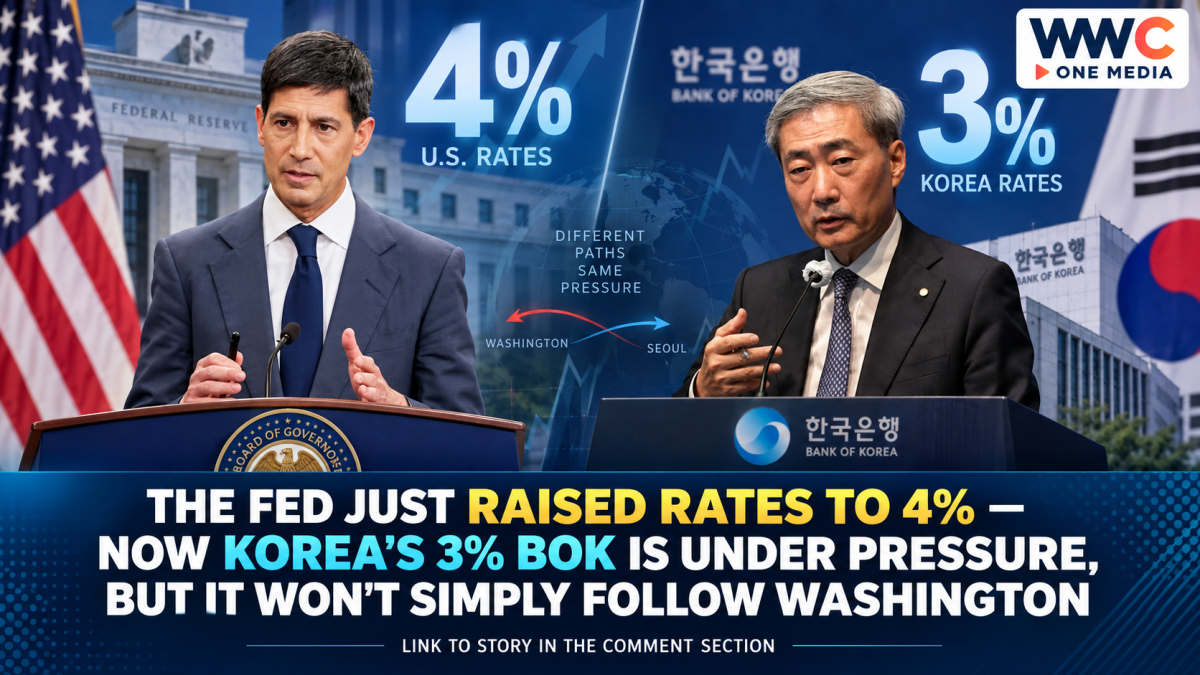
SEOUL — South Korea’s central bank has already raised interest rates twice in two months. Now the U.S. Federal Reserve has made the Bank of Korea’s next decision even more complicated.
The Federal Reserve lifted its benchmark rate by 25 basis points to 3.75%–4.00% on September 16, its first increase since 2023, and signalled that another hike could follow before the year ends as U.S. inflation remains stubbornly above target.
South Korea’s benchmark rate, meanwhile, stands at 3.00% after the Bank of Korea raised it by a quarter point in July and again on August 27.
That leaves a maximum U.S.-Korea interest-rate gap of 1 percentage point.
If the Fed raises rates again while the BOK stands still, the gap could widen further.
But that does not mean Seoul will automatically follow Washington.
For Korea, the decision is increasingly about something bigger than the Fed:
inflation above target, a powerful semiconductor boom, expensive Seoul housing and household debt that has already climbed above 2,000 trillion won.
First, the Fed has reopened a tightening cycle
The Fed’s decision matters because the U.S. central bank had not raised rates in more than three years.
Its unanimous September move pushed the federal funds target range to 3.75%–4.00%. Most policymakers also projected at least one additional increase in 2026.
The Fed’s concern is straightforward.
Inflation has not fallen quickly enough.
U.S. consumer prices rose 3.4% year on year in August, while the Fed’s updated forecasts put 2026 PCE inflation at around 3.7%, well above its 2% objective.
That pushed the Fed under Chair Kevin Warsh toward tighter policy even as higher rates create more pressure for borrowers.
The dollar reacted immediately.
It climbed to a seven-week high after the announcement as higher U.S. yields increased the attractiveness of dollar assets.
And that matters directly to Korea.
A stronger dollar can become Korea’s problem
When U.S. rates rise relative to Korean rates, dollar-denominated assets can become more attractive.
That does not automatically cause money to flee Korea.
Capital flows depend on many factors, including corporate earnings, stock valuations, currency expectations and global risk appetite.
But a wider rate gap can put additional pressure on the Korean won—particularly when investors are already nervous.
A weaker won makes imported goods more expensive.
That is especially important for South Korea because the country depends heavily on overseas energy supplies.
Oil priced in dollars becomes more expensive when the won weakens.
Those costs can feed into:
transport,
manufacturing,
electricity,
food distribution,
and eventually consumer prices.
So the Fed can indirectly complicate Korea’s inflation problem even though the BOK controls only Korean monetary policy.
Korea has already been moving in the same direction
The BOK did not wait for the Fed.
On August 27, its Monetary Policy Board raised the base rate from 2.75% to 3.00%, following another 25-basis-point increase in July.
Those were Korea’s first back-to-back rate hikes since early 2023.
The central bank gave three broad reasons.
Growth was stronger than expected.
Inflation looked more persistent.
And financial-stability risks—particularly housing and household borrowing—were increasing.
Its September Monetary Policy Report made the direction explicit:
the BOK said inflation was likely to stay above target for a prolonged period and that it would determine the timing and pace of additional rate increases while watching growth and financial stability.
So another increase was already on the table before the Fed acted.
August inflation climbed back above 3%
Korea’s inflation data provide one reason.
Consumer prices rose 3.1% in August from a year earlier, accelerating from 2.8% in July.
Petroleum prices increased 14.2%, including a 19.6% rise in diesel and an 11.5% increase in gasoline.
But the headline number needs context.
Part of August’s increase came from an unusual base effect in mobile-phone bills.
A year earlier, SK Telecom had offered unusually large discounts following a data breach, meaning this year’s prices were being compared against an artificially low base.
The government estimated that inflation would have been closer to 2.5% without that telecommunications effect.
That sounds reassuring.
The core number is less comfortable.
Core inflation hit its fastest rate since 2023
Core consumer inflation, excluding food and energy, rose 3.4% year on year in August.
That was its strongest reading since May 2023.
That distinction is important for the BOK.
Central banks can usually look through a temporary spike in oil if they believe it will fade.
They become more concerned when price increases spread into services, durable goods and other domestically driven categories.
The BOK therefore expects inflation to remain above its 2% target for some time even if September’s headline rate eases from August.
Its August economic outlook forecasts full-year CPI inflation of 2.7% in 2026 and 2.3% in 2027, with core inflation expected to remain around 2.5% in both years.
That is a very different backdrop from one in which a central bank would normally rush to cut rates.
Korea’s economy is also growing too strongly for easy money
The BOK has another problem:
the Korean economy is not obviously weak enough to justify keeping borrowing costs low.
The central bank sharply upgraded its 2026 GDP growth forecast to 3.3%, from 2.6% previously.
It expects another 2.9% expansion in 2027.
The driver is familiar.
Semiconductors.
Global investment in artificial intelligence is creating extraordinary demand for memory chips, advanced processors and related equipment.
That has been particularly beneficial to South Korea, home to Samsung Electronics and SK Hynix.
Exports and capital investment have surged while stronger corporate income is gradually feeding into domestic consumption.
For the BOK, strong growth gives it more room to fight inflation.
But one spectacular GDP number needs explaining
Recent headlines said Korea’s nominal GDP recorded its fastest growth in 47 years during the second quarter.
That is true.
But it should not be mistaken for 47-year-high real economic growth.
Nominal GDP surged 26.4% from a year earlier, boosted heavily by semiconductor prices and improving terms of trade.
Real GDP—the inflation-adjusted measure used to assess actual production growth—rose a much more moderate 3.7% year on year and 0.6% quarter on quarter.
That distinction matters.
Korea is growing strongly.
It is not experiencing a 26% real economic boom.
Still, the strength of semiconductor earnings gives the BOK less reason to fear that another modest rate increase would immediately push the economy into recession.
Then there is Seoul housing
If inflation were the BOK’s only concern, the debate would already be difficult.
Housing makes it harder.
The central bank says home prices in Seoul and its surrounding metropolitan region have continued rising rapidly, while household borrowing has accelerated.
Higher interest rates are one tool for cooling that cycle.
They make mortgages more expensive.
That can reduce how much households can borrow.
And in theory, it can curb speculative demand.
The BOK explicitly said in August that pre-emptive tightening could help moderate both home-price increases and household-debt growth.
But that cure creates its own problem.
Millions of borrowers have to pay those higher rates.
Household credit already exceeds 2,000 trillion won
South Korean household credit reached a record 2,019.8 trillion won at the end of June, rising 25.9 trillion won in just three months.
It was the largest quarterly increase in nearly five years.
Household loans alone stood at 1,891.3 trillion won.
Mortgage borrowing increased by 12.2 trillion won during the quarter, while non-mortgage lending rose another 12.8 trillion won.
The pace moderated somewhat in August, but mortgage borrowing continued rising.
Bank household loans reached about 1,198 trillion won in August, up 3.4 trillion won from July, while mortgage loans increased by 4 trillion won to 952.5 trillion won.
That gives the BOK a painful trade-off.
Keeping rates too low can feed housing and debt.
Raising them can squeeze families already carrying enormous loans.
Mortgage borrowers are already feeling it
The average rate on newly issued Korean household mortgages rose to 4.48% in July, its highest level since November 2023.
Average new household lending rates reached 4.64%.
Those figures came before the full effect of the BOK’s August rate increase had passed through the financial system.
That means another hike would not be an abstract decision.
It would potentially influence monthly payments for households refinancing or taking out new floating-rate loans.
And that is exactly why the BOK board is not united around moving as quickly as possible.
August’s vote was 6-1—not unanimous
The BOK’s August decision exposed a policy split.
Six Monetary Policy Board members supported raising the rate to 3%.
Hwang Kun-il dissented and wanted to leave it at 2.75%.
Minutes released on September 15 showed why.
Hwang argued that the BOK should allow time for earlier rate increases to work through the economy.
He also pointed to improved foreign-exchange conditions and concerns that more tightening could increase burdens on vulnerable borrowers and sectors already experiencing higher loan delinquencies.
That dissent is significant because it demonstrates that another rate increase is not automatic.
Even before the Fed moved, at least one policymaker believed the BOK had already tightened enough for the moment.
So will Korea raise rates in October?
The next scheduled BOK policy meeting is October 22.
The final scheduled meeting of 2026 is November 26.
The Korea Herald cites iM Securities analyst Kim Myung-sil as arguing that the BOK is now focused more on when and how quickly to raise rates rather than whether further tightening is ultimately necessary.
But even among analysts who expect another increase, timing is uncertain.
The Herald report suggests November could be more likely than October, allowing the BOK to assess the effects of July and August’s consecutive hikes first.
Reuters’ reading of the latest meeting minutes is somewhat more cautious: economists cited there generally expected one more increase in early 2027, followed by a prolonged hold.
Those are forecasts, not BOK commitments.
The central bank itself has deliberately avoided announcing a fixed path.
The BOK does not have to match the Fed hike-for-hike
This is perhaps the biggest misconception surrounding the latest U.S. decision.
South Korea does not operate a fixed exchange rate against the dollar.
Therefore, the BOK does not have to raise rates every time the Fed does.
Its legal and economic mandate is domestic.
The BOK will consider:
Korean inflation,
growth,
financial stability,
household debt,
housing prices,
the won,
foreign capital flows,
oil prices,
and overseas monetary policy.
The Fed affects several of those variables.
It does not replace them.
That is why saying the BOK must “track” the Fed is too strong.
The better description is that a more hawkish Fed raises the cost of waiting if Korean inflation, the won or financial imbalances worsen.
A second Fed hike could make that pressure stronger
The Fed’s September increase may not be the end.
Most U.S. policymakers expect another move this year, while Goldman Sachs now predicts a second quarter-point increase as early as October.
Suppose the Fed lifts its range to 4.00%–4.25% while Korea stays at 3.00%.
The maximum headline policy-rate gap would widen from 1 percentage point to 1.25 points.
Again, that would not force a BOK hike.
But a wider gap combined with a stronger dollar could increase pressure on the won and import prices.
That is why Seoul is watching Washington closely even though its decision will ultimately be made at home.
Oil may matter as much as the Fed
The other external variable is energy.
South Korea is heavily dependent on imported oil and gas.
That makes the country particularly vulnerable when geopolitical conflict pushes global crude prices higher.
Petroleum prices in Korea were already 14.2% higher year on year in August.
The BOK has specifically identified developments in the Middle East as one of the biggest uncertainties surrounding both growth and inflation.
A weaker won plus expensive oil is an especially uncomfortable combination.
Oil becomes more expensive in dollar terms.
Then the currency conversion makes it more expensive again for Korean buyers.
That is one route through which Fed policy, exchange rates and geopolitics can converge into domestic inflation.
The AI boom is helping—and complicating—the BOK’s job
Artificial intelligence is doing something similar from the opposite direction.
It is strengthening Korea’s exports and corporate earnings.
That supports economic growth.
It can strengthen the won by generating export revenues.
And it improves government and household income over time.
But strong demand and rising incomes can also create domestic price pressure.
The BOK therefore cannot simply look at the semiconductor boom and conclude that everything is positive.
Strong growth can itself reduce the argument for easy monetary policy.
And Korea’s increasing financial-market dependence on a handful of AI-linked chip companies creates another vulnerability if global technology sentiment reverses suddenly.
The central bank recently warned about financial instability associated with highly leveraged investment in AI-linked assets.
That leaves the BOK with no easy option
If the central bank raises rates again too quickly:
mortgages become more expensive,
highly indebted households face greater stress,
weaker domestic sectors could suffer,
and loan delinquencies could rise.
If it waits too long:
inflation could become more persistent,
housing speculation could accelerate,
household debt could grow further,
and another Fed hike could put pressure on the won.
That is why the October-versus-November debate matters.
The BOK is not simply choosing between 3% and 3.25%.
It is choosing how much evidence it needs before tightening again.
The Fed changed the calculation—but did not make the decision
South Korea entered this week already leaning toward restrictive monetary policy.
The BOK had delivered two consecutive hikes.
Inflation was above target.
Core inflation had reached 3.4%.
Seoul-area home prices remained strong.
Household credit had exceeded 2 quadrillion won.
And the central bank had upgraded 2026 growth to 3.3%.
Then the Fed raised rates.
That adds another reason for Korean policymakers to remain cautious about pausing for too long.
But the BOK’s own minutes show it is equally cautious about going too fast.
So the most important question after Washington’s rate hike is not:
Will Korea copy the Fed?
It is:
How much more tightening can Korea absorb before the cost of fighting inflation becomes greater than the risk of letting it persist?
The first answer could come on October 22.
But if the BOK chooses to wait, November 26 may become the meeting markets watch most closely.

Leave a Reply