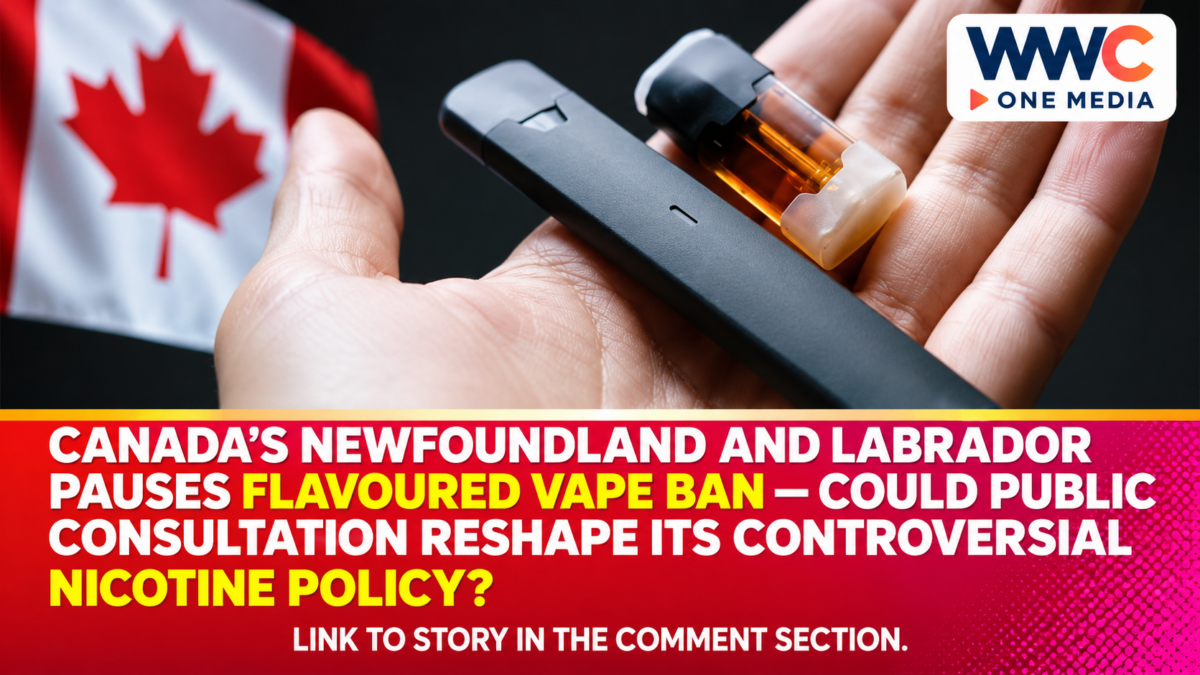
ST. JOHN’S, CANADA — Newfoundland and Labrador has postponed its proposed ban on flavoured vaping products, opening the door to further public consultation as the Canadian province seeks to balance youth health protection, nicotine regulation and the concerns of affected businesses.
Health and Community Services Minister Joedy Wall announced on November 25, 2026, that the provincial government would temporarily halt its proposed amendments to the Tobacco and Vapour Products Control Act.
The legislation, introduced on November 17, would prohibit the sale of non-tobacco-flavoured vaping products, require retailers to obtain licences and strengthen regulatory enforcement.
The decision represents a significant development in Canada’s continuing debate over how governments should address nicotine consumption without overlooking the needs of adults attempting to stop smoking.
However, the postponement does not mean the proposed restrictions have been permanently abandoned.
Newfoundland Vape Ban: Why the Government Is Pausing Bill 35
The provincial government has acknowledged that additional discussions with residents, health organisations and other stakeholders are necessary before proceeding with the legislation.
Wall reaffirmed that reducing the health consequences of tobacco and nicotine consumption remains a government priority.
The consultation will provide an opportunity to examine the potential consequences of the proposed regulations before determining how the legislation should advance.
Details concerning public participation will be announced at a later date.
The postponement highlights the complexity of developing nicotine regulations that address several objectives simultaneously.
Governments must consider youth protection, public health, enforcement capabilities and the economic implications of restrictions affecting regulated businesses.
Similar policy debates have emerged across the Asia-Pacific, including proposals examined in WWC ONE MEDIA’s coverage of higher vape taxes and growing concerns over youth nicotine consumption.
The immediate question facing Newfoundland and Labrador is whether additional consultation will result in substantial changes to Bill 35 or simply delay its implementation.
What Would Newfoundland and Labrador’s Bill 35 Change?
Bill 35 proposes amendments extending beyond the restriction of flavoured vaping products.
The legislation would introduce several significant regulatory changes:
- Prohibit sales of vaping products with flavours other than tobacco, subject to regulatory exemptions.
- Establish licensing requirements for businesses selling vaping products.
- Restrict tobacco and vaping product sales through vending machines.
- Expand inspectors’ authority to examine products and collect evidence of suspected offences.
- Increase penalties for violations.
The proposed legislation also broadens the legal definition of vaping substances and flavoured products.
Its provisions consider not only the characteristics of products but also how those products are presented through packaging, labelling and advertising.
For retailers, the proposed licensing framework could introduce additional administrative and compliance responsibilities.
For regulators, licensing could provide a clearer mechanism for identifying businesses operating within the market and monitoring compliance.
Nevertheless, these measures remain proposals rather than newly implemented legal obligations under Bill 35.
Canadian Student Vaping Figures Highlight Public Health Concerns
The legislative debate comes against a backdrop of continuing concern about nicotine consumption among younger Canadians.
Health Canada’s 2023–2024 student survey found that 15% of surveyed students had used a non-cannabis vaping product during the previous 30 days.
The survey also recorded considerable differences between grade levels and geographic locations.
Among its findings:
- 14% reported recent use of vaping products containing nicotine.
- 4% reported recent use of nicotine-free vaping products.
- Recent vaping prevalence reached 27% among Grade 12 students, compared with 4% among Grade 7 students.
- Vaping prevalence was 22% among students in rural areas and 13% among those in urban areas.
These figures represent reported behaviour during the 2023–2024 school year and should not be interpreted as newly collected November 2026 statistics.
The provincial government has also identified Newfoundland and Labrador as having daily vaping and nicotine consumption rates above the national average.
For public-health authorities, preventing nicotine dependence among young people remains an important objective.
Nicotine is addictive, and adolescents may be particularly vulnerable because their brains are still developing.
Restricting youth access and improving education about nicotine-related health risks are therefore important considerations in the regulatory debate.
Vaping Industry Welcomes the Government’s Decision
The Canadian Vaping Association welcomed the postponement in a statement issued on November 25.
The industry organisation urged the provincial government to consider evidence from other jurisdictions alongside the concerns of businesses and adult consumers.
Its position reflects concerns about how flavour restrictions could affect adult smokers who use vaping products as an alternative to conventional cigarettes.
However, industry advocacy should be distinguished from independent evidence concerning the effectiveness of particular regulatory policies.
Health Canada recognises that vaping can help some adults stop smoking and that completely switching away from combustible cigarettes can reduce exposure to harmful chemicals.
That does not make vaping harmless.
Vaping can expose users to nicotine and other potentially harmful substances, while its long-term health consequences remain an area of continuing research.
For policymakers, the challenge is ensuring that measures intended to protect young people do not produce unintended consequences among adults attempting to quit smoking.
The effectiveness of any proposed flavour restriction should therefore be evaluated using measurable public-health outcomes rather than commercial interests alone.
Retail Licensing and Enforcement Remain Important Considerations
Although the proposed flavour restriction has received considerable attention, Bill 35’s licensing provisions could also significantly affect the regulated retail market.
A licensing system would provide authorities with additional oversight of businesses selling vaping products.
However, the effectiveness of such a framework would depend on its implementation, enforcement resources and the ability of regulators to identify non-compliant sellers.
An important consideration is whether restrictions on regulated products could influence consumer behaviour or demand for products sold outside authorised distribution channels.
Such an outcome has not been established for Newfoundland and Labrador’s proposed legislation.
Nevertheless, illicit distribution remains a regulatory issue worth examining during the consultation.
WWC ONE MEDIA has previously explored the importance of enforcement in its coverage of the destruction of confiscated illegal vaping products and associated tax liabilities.
Other Asia-Pacific jurisdictions have adopted different regulatory approaches, including the strict enforcement environment examined in Singapore’s investigation into suspected vaping offences.
Different legal frameworks reflect different policy priorities. Their effectiveness cannot be assumed to be identical across jurisdictions.
For Newfoundland and Labrador, the consultation provides an opportunity to consider how licensing, inspections, education and product restrictions could operate together.
What Happens Next for Canada’s Proposed Vape Ban?
The provincial government’s next step is to announce how residents, businesses and other interested organisations can participate in the consultation.
No revised implementation date was provided in the November 25 announcement.
The additional discussions could result in changes to the proposed flavour restrictions, licensing requirements, regulatory exemptions or enforcement arrangements.
However, no specific changes have yet been confirmed.
For affected retailers, the postponement creates additional time to evaluate potential compliance requirements.
For health organisations and families, the central concern remains reducing youth exposure to addictive nicotine products.
For adult smokers seeking to quit, access to appropriate cessation support remains an important public-health consideration.
The ultimate question facing Newfoundland and Labrador is whether its revised regulatory approach can deliver meaningful reductions in nicotine-related harm while remaining practical to implement and enforce.
The proposed vape ban may have been paused, but the wider debate over Canada’s nicotine policies is far from over.
Frequently Asked Questions
Has Newfoundland and Labrador cancelled its flavoured vape ban?
No. The provincial government announced on November 25, 2026, that the proposed legislation would be postponed to allow further consultation. It has not permanently abandoned the proposal.
What is Newfoundland and Labrador’s Bill 35?
Bill 35 proposes amendments to the Tobacco and Vapour Products Control Act, including flavour restrictions, retailer licensing, stronger inspection powers and increased penalties.
Is Canada introducing a nationwide flavoured vape ban?
The announcement concerns Newfoundland and Labrador’s provincial legislation. It does not establish a new nationwide Canadian flavour ban.
How common is vaping among Canadian students?
Health Canada’s 2023–2024 student survey found that 15% of surveyed students had used non-cannabis vaping products during the preceding 30 days.
When will Newfoundland and Labrador’s proposed vape restrictions take effect?
No revised implementation date was announced. The provincial government will provide additional information concerning public consultation before proceeding with the proposed amendments.