
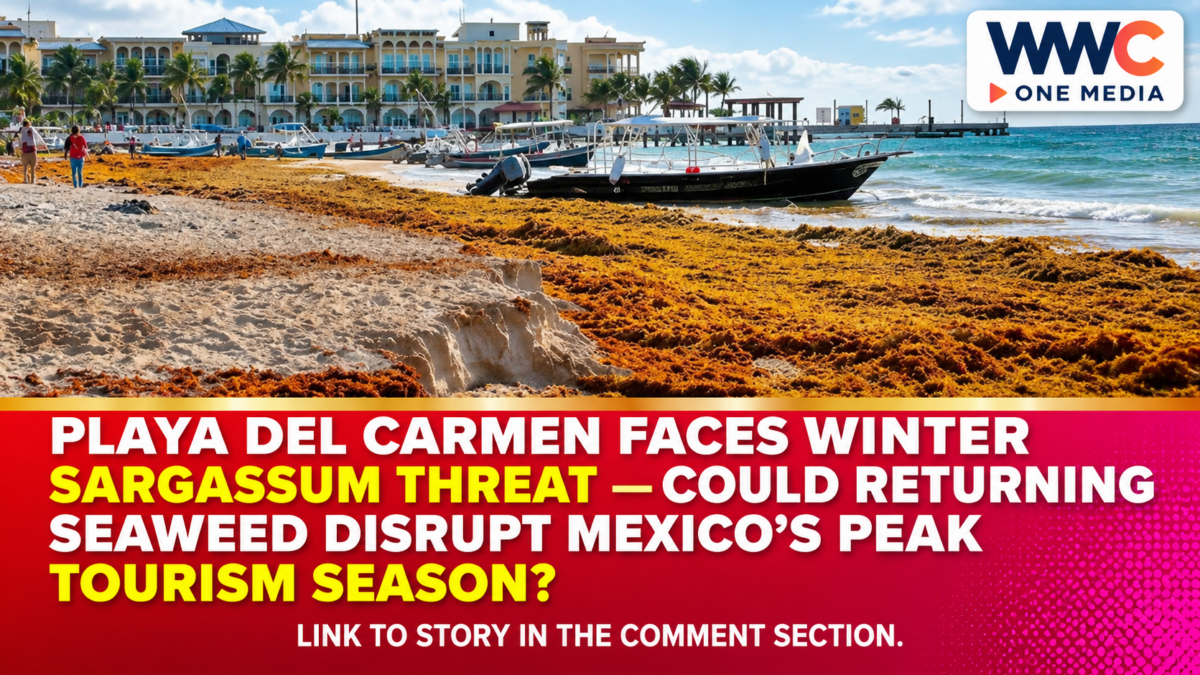
PLAYA DEL CARMEN, MEXICO — Mexico’s Caribbean tourism industry faces another environmental challenge as the possibility of renewed sargassum arrivals raises questions about beach conditions ahead of the 2026–2027 winter holiday season.
Playa del Carmen has already removed more than 35,000 tonnes of sargassum from its public beaches during 2026, as confirmed by municipal authorities on Oct. 1.
Although regional seaweed concentrations have declined substantially since the peak season, oceanographic monitoring continues to identify floating concentrations capable of reaching parts of the Mexican Caribbean.
For hotels, beachfront restaurants, tour operators and other tourism-dependent businesses, the challenge is maintaining an attractive destination while managing an environmental phenomenon that cannot be controlled entirely through shoreline cleaning.
Playa del Carmen sargassum threat remains despite seasonal decline
The end of the main sargassum season does not necessarily guarantee uninterrupted seaweed-free beaches throughout winter.
A Mexican Navy oceanographic bulletin issued on Nov. 8 identified three concentrations of sargassum near the Mexican Caribbean coastline.
One concentration, estimated at seven tonnes, was forecast to have a possibility of reaching Playa del Carmen within 24 hours. Another concentration, estimated at five tonnes, was identified as potentially approaching Tulum within 48 hours.
These projections were based on satellite imagery and ocean surface conditions.
However, predicted arrivals should not be confused with confirmed beach deposits. Changes in wind direction and ocean currents can alter the movement of floating seaweed before it reaches land.
The November monitoring records demonstrate that isolated sargassum arrivals remain possible even when overall regional concentrations are falling.
For the tourism industry, timely information about individual beaches may be more commercially useful than broad regional forecasts alone.
Scientific forecasts offer some reassurance for winter tourism
The October 2026 regional sargassum outlook identified a substantial reduction in seaweed concentrations across monitored regions, with quantities falling by more than half in most areas.
Nevertheless, most monitored regions continued to record comparatively elevated concentrations against historical October observations.
The outlook anticipated further reductions through late November or December, while acknowledging that some Caribbean beaching events could continue.
The expected severity of these arrivals was considerably lower than during previous months.
This creates an important distinction for travellers planning winter holidays in Mexico.
The presence of offshore seaweed does not establish that Playa del Carmen’s beaches will experience widespread or sustained accumulation throughout the holiday season.
Conversely, declining regional concentrations do not guarantee that individual beaches will remain unaffected.
The most reliable assessment of beach conditions requires current, location-specific monitoring.
Mexico prepares a multibillion-peso sargassum response
The government of Playa del Carmen is working with federal and state authorities to improve its capacity to manage recurring seaweed arrivals.
On Oct. 1, Municipal President Estefanía Mercado outlined a broader government strategy involving an investment exceeding MXN2.6 billion to strengthen sargassum management infrastructure, technology and collection capacity.
The initiative also envisages developing opportunities to transform collected seaweed into useful commercial materials.
The investment forms part of preparations for 2027 and should not be interpreted as money allocated exclusively to Playa del Carmen.
Further coordination took place on Oct. 28, when municipal authorities and Mexico’s National Fund for Tourism Development, known as Fonatur, agreed to work towards a unified approach to monitoring, public communication and collection operations.
Preparations include:
- Improving early-warning and monitoring systems.
- Coordinating the deployment of beach-cleaning personnel.
- Identifying suitable collection and transfer locations.
- Developing strategies for concentrating and compacting collected seaweed.
- Improving communication with residents and international visitors.
The Mexican Navy’s monitoring system incorporates satellite imagery, wind observations, ocean currents and tidal information to generate short-term forecasts covering periods of 24 to 48 hours.
The broader economic objective is to reduce the disruption caused by sargassum while developing a more sustainable management system.
Playa del Carmen retains 15 Blue Flag distinctions
Despite the challenges associated with sargassum, Playa del Carmen retained 15 international Blue Flag distinctions for the 2026–2027 season.
The municipal government confirmed the recognition on Oct. 23.
Eight distinctions cover public beaches under municipal responsibility, while seven relate to the hotel sector.
The recognised public beaches include Punta Esmeralda, Montecarlo, Pelícanos, Playa Cisne, Petrel Norte, Xcalacoco, Playa 72 and Playa 88.
Blue Flag recognition involves environmental management, water quality, public safety, education and beach services.
However, certification does not guarantee that a beach will remain permanently free of seaweed.
The challenge of balancing environmental protection with commercial tourism development extends beyond Mexico. Related issues are explored in Phuket’s efforts to restore public beach access and protect coastal environments.
For Playa del Carmen, maintaining environmental standards alongside effective seaweed management could help strengthen visitor confidence.
Why returning seaweed matters to Mexico’s tourism economy
A beachfront destination’s commercial appeal depends partly on its ability to deliver the experience visitors expect.
When seaweed accumulates along the shoreline, businesses may face additional cleaning expenses, operational pressures and questions from prospective customers.
Hotels and tour operators could also encounter difficulties when promotional photographs no longer reflect actual beach conditions.
These are potential economic consequences, not confirmed financial losses from the latest November developments.
The Riviera Maya also faces environmental challenges beyond sargassum, including rainfall and flooding concerns examined in WWC ONE MEDIA’s coverage of Cancún’s November rainfall and flood risks.
For tourism-dependent communities, resilience may require investment in both environmental infrastructure and alternative visitor experiences.
Regional comparisons include Pattaya’s efforts to diversify beachfront tourism through arts and cultural attractions.
Developing cultural, culinary and other recreational experiences could help destinations reduce their dependence on favourable beach conditions alone.
What happens next for Mexico’s winter tourism season?
Playa del Carmen has previously experienced unusual winter sargassum arrivals.
On Jan. 10, 2026, municipal authorities confirmed that southerly winds and ocean currents had transported seaweed and marine debris towards local beaches.
Cleaning operations were deployed in response, while coordination continued with the Mexican Navy and the Quintana Roo government.
That earlier event demonstrates why winter should not automatically be regarded as a seaweed-free period.
Looking ahead, travellers should check recent beach photographs, official monitoring updates and information from their accommodation providers before making decisions based on general Caribbean seaweed forecasts.
For businesses, the immediate priority is maintaining transparent communication and sufficient operational flexibility to respond to changing conditions.
Mexico’s longer-term opportunity lies in developing a management system that protects coastal ecosystems, supports local livelihoods and limits disruption to tourism.
The decisive question is not whether authorities can eliminate every sargassum arrival, but whether they can respond effectively enough to preserve the quality and competitiveness of the country’s Caribbean tourism destinations.
Frequently asked questions
Is sargassum expected in Playa del Carmen during winter 2026?
Isolated arrivals remain possible. Regional scientific projections anticipate declining seaweed concentrations, but local conditions can change with winds and ocean currents.
How much sargassum has Playa del Carmen collected in 2026?
Municipal authorities confirmed on Oct. 1 that more than 35,000 tonnes had been collected from public beaches during the year.
Is Mexico investing in sargassum management?
Yes. Municipal authorities have highlighted a broader government strategy involving more than MXN2.6 billion in investment to strengthen infrastructure, monitoring, collection and processing capabilities.
Are Playa del Carmen’s beaches still Blue Flag certified?
The municipality retained 15 Blue Flag distinctions for the 2026–2027 season, including eight public beach distinctions and seven associated with the hotel sector.
Should tourists cancel their Playa del Carmen holidays because of sargassum?
The available evidence does not establish a destination-wide winter seaweed crisis. Travellers should assess current conditions at their intended beaches and accommodations before making individual travel decisions.










