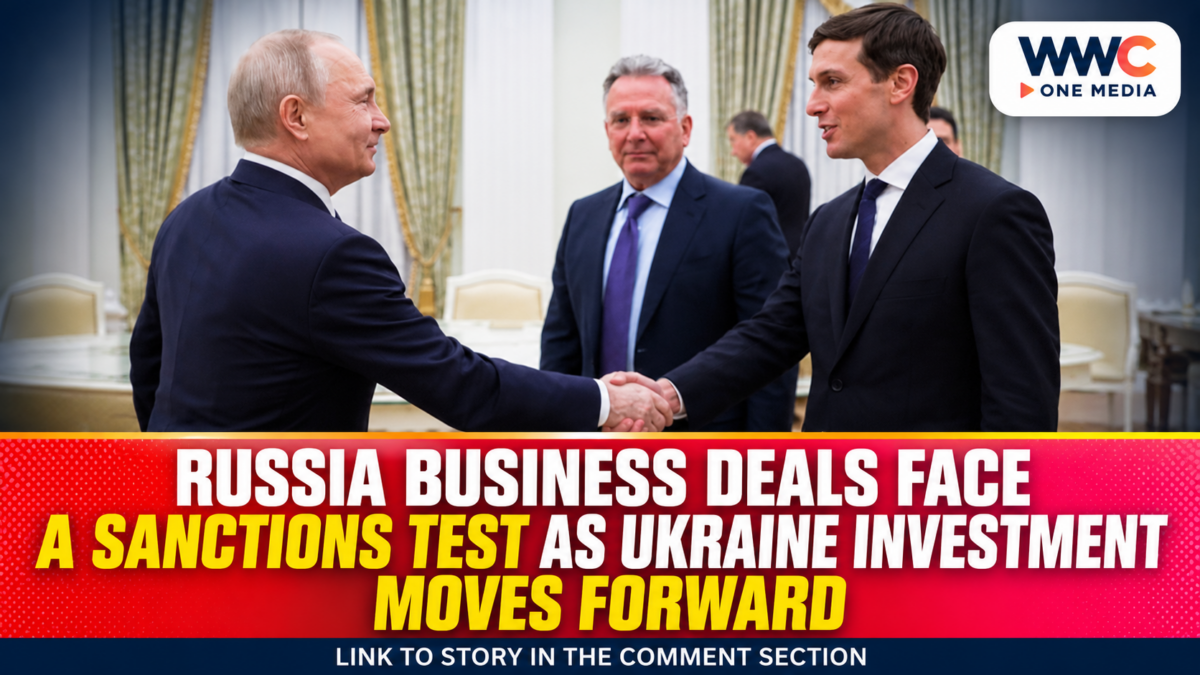
The United States continues to support investment in Ukraine’s reconstruction while its sanctions framework retains restrictions on new investment in Russia by American persons. Government records available as of November 26, 2026, document the expanding US-Ukrainian investment partnership, but do not confirm a formal decision to suspend a specific package of proposed US-Russia commercial ventures.
That distinction matters for companies assessing whether a future opening in Russia could become a viable business opportunity. Diplomatic discussions, investment proposals and legally executable transactions are not the same thing. Even if political negotiations create room for commercial engagement, sanctions rules, licensing requirements, financing restrictions and counterparty checks can still determine whether a deal can proceed.
Russia Business Deals Still Face a Legal Barrier
The central obstacle for American companies is not simply the political temperature between Washington and Moscow. It is the legal framework governing investment and financial activity.
Executive Order 14071, issued in April 2022, prohibits new investment in the Russian Federation by US persons, wherever located, subject to applicable exceptions and authorisations. The Treasury Department’s Office of Foreign Assets Control explains that new investment can include commitments of capital to establish or expand projects, form joint ventures, lend commercially to Russian entities, acquire equity interests or obtain rights to natural resources.
In practical terms, an American company cannot assume that a commercially attractive Russian energy, mining or infrastructure project is automatically available for investment. A transaction must be assessed against the relevant sanctions provisions, the parties involved and any specific licence or exemption that may apply.
The rules also reach beyond a direct investment made by a US company. OFAC guidance warns that certain forms of approval, financing, facilitation or guarantees involving foreign parties can also create sanctions exposure when the underlying transaction would be prohibited if undertaken by a US person.
This is why the legal status of a proposed project matters as much as its commercial value. A negotiating concept is not a licence, and a political announcement does not itself authorise a restricted transaction.
A Sanctions Waiver Does Not Mean Every Restriction Has Disappeared
The Trump administration’s October sanctions action adds another layer to the discussion.
On October 16, President Donald Trump issued Executive Order 14436 to implement the Lindsey O. Graham Sanctioning Russia and Iran Act of 2026. The order described the new law’s sanctions, restrictions and duties, and exercised presidential waiver authority over specified provisions.
However, the same order makes an important distinction: its waiver does not affect sanctions or other measures imposed under executive orders addressing specified harmful foreign activities of the Russian government.
That qualification prevents a broad interpretation that the October action removed every existing Russia-related restriction. The order should be read according to the provisions it actually waives, not as a general permission for American companies to resume investment in Russia.
WWC previously examined the limited scope of the US Russia sanctions waiver and its implications for Ukraine peace negotiations. The distinction remains important for investors: a change to one legal instrument does not automatically cancel separate restrictions operating under other authorities.
Washington’s Documented Investment Partnership Is Focused on Ukraine
While the legal framework governing Russia remains complex, the US government has publicly documented a different economic direction in Ukraine.
The United States and Ukraine signed an agreement on April 30, 2025, establishing the United States-Ukraine Reconstruction Investment Fund, also known as URIF. The fund is designed to support investment in Ukraine’s recovery and to create a structure through which American and Ukrainian interests can participate in projects involving strategic resources and infrastructure.
The fund has moved beyond an initial agreement. In March 2026, its joint board approved an equity investment in Ukrainian technology company Sine Engineering. The investment supports the company’s development of radio communication control systems for unmanned aerial vehicles.
In June, the US International Development Finance Corporation and the World Bank Group’s Multilateral Investment Guarantee Agency established a political-risk-insurance framework intended to support private investment connected with URIF projects.
A further announcement on October 2 outlined investments in critical minerals and energy. These included a proposed joint investment platform with Ukraine’s BGV Group Management, a distributed combined heat-and-power platform, and financing for DTEK’s 200-megawatt/400-megawatt-hour battery energy storage system across six Ukrainian sites.
These projects show that the US-Ukrainian economic partnership has an operating investment structure, although individual projects remain subject to their own implementation requirements.
The Fund’s Financial Position Shows Both Progress and Limits
The US International Development Finance Corporation’s fiscal 2026 annual management report provides a more detailed view of the fund’s financial position.
As of September 30, 2026, DFC had committed US$75 million from existing appropriated resources to URIF. The report recorded US$5 million in disbursements to the fund during the fiscal year and a carrying value of US$3.6 million at the reporting date.
Those figures should not be confused with the total value of projects announced by the fund. A commitment is not the same as a completed payment, and the fund’s carrying value is an accounting measure rather than the total amount of investment opportunities available.
The report also describes URIF as jointly governed by the United States and Ukraine through equal board representation on its general partner. It states that DFC’s exposure is limited to its committed capital and that the fund’s obligations do not carry a federal guarantee.
That structure matters because it shows how the US government is using a defined investment vehicle rather than simply announcing a broad reconstruction pledge. It also makes clear that public participation does not mean the government guarantees every project or absorbs unlimited losses.
Why Russia’s Energy and Investment Prospects Remain Complicated
Russia’s energy sector illustrates why a potential commercial opening would face more than one hurdle.
Oil, natural gas, pipelines, mining and aviation involve different counterparties, ownership structures, technologies, financing arrangements and sanctions considerations. A transaction involving a pre-existing asset may be treated differently from a new investment, while a project involving a designated entity may face restrictions separate from the general investment prohibition.
For international businesses, sanctions compliance can also involve banks, insurers, shipping companies, service providers and intermediaries. WWC’s reporting on Russia’s shadow fleet and the commercial networks behind its oil exports shows how energy trade depends on a wider network than the producer and buyer alone.
The experience of foreign companies already operating in Russia also demonstrates that political risk is not limited to sanctions. WWC has examined how Japanese companies are managing ownership and operational uncertainty in Russia, including the challenges faced by businesses whose local subsidiaries remain exposed to government intervention.
For American investors, a future commercial opportunity would therefore require more than a diplomatic signal. Companies would need to establish that the transaction is legally permitted, that counterparties can be screened, that payments can be processed and that ownership and operating rights can be protected.
What Happens Next
The next meaningful evidence would come from formal government action: a new sanctions licence, a published amendment to an executive order, a Treasury clarification, a signed investment agreement or an official statement identifying a change in the negotiating framework.
As of November 26, the public records reviewed establish the continuing US-Ukrainian investment programme and the legal framework governing Russia-related investment. They do not establish a formal suspension order covering a specific package of US-Russia business proposals.
For businesses, the practical lesson is straightforward. Political negotiations can change expectations, but only the applicable legal instruments and transaction-specific authorisations determine whether a proposed investment can move forward.
Until those conditions change, Russia’s potential commercial opportunities remain subject to a sanctions environment that cannot be set aside by diplomatic optimism alone.
Frequently Asked Questions
Has the United States officially announced that it suspended all business deals with Russia?
The official records reviewed do not establish a blanket suspension announcement covering all US-Russia business deals. They also do not confirm a formal order suspending the specific proposals described in the tip.
Does Executive Order 14436 remove US sanctions on Russia?
No. The October 16, 2026 order waives specified provisions of the 2026 Graham Act. It expressly preserves other measures imposed under separate executive orders addressing harmful Russian government activities.
Can US companies make new investments in Russia?
Executive Order 14071 prohibits new investment in Russia by US persons, subject to applicable exceptions and authorisations. Companies must assess proposed transactions against the relevant sanctions rules and obtain any required authorisation.
What is the US-Ukraine Reconstruction Investment Fund?
URIF is a jointly governed investment fund established through an agreement signed by the United States and Ukraine on April 30, 2025. It supports investment connected with Ukraine’s reconstruction, including energy, critical minerals and strategic industries.
Does the US$75 million commitment mean the fund has already spent that amount?
No. DFC’s fiscal 2026 report states that US$75 million had been committed as of September 30, 2026, while US$5 million had been disbursed during the fiscal year. A commitment and a disbursement are different financial measures.