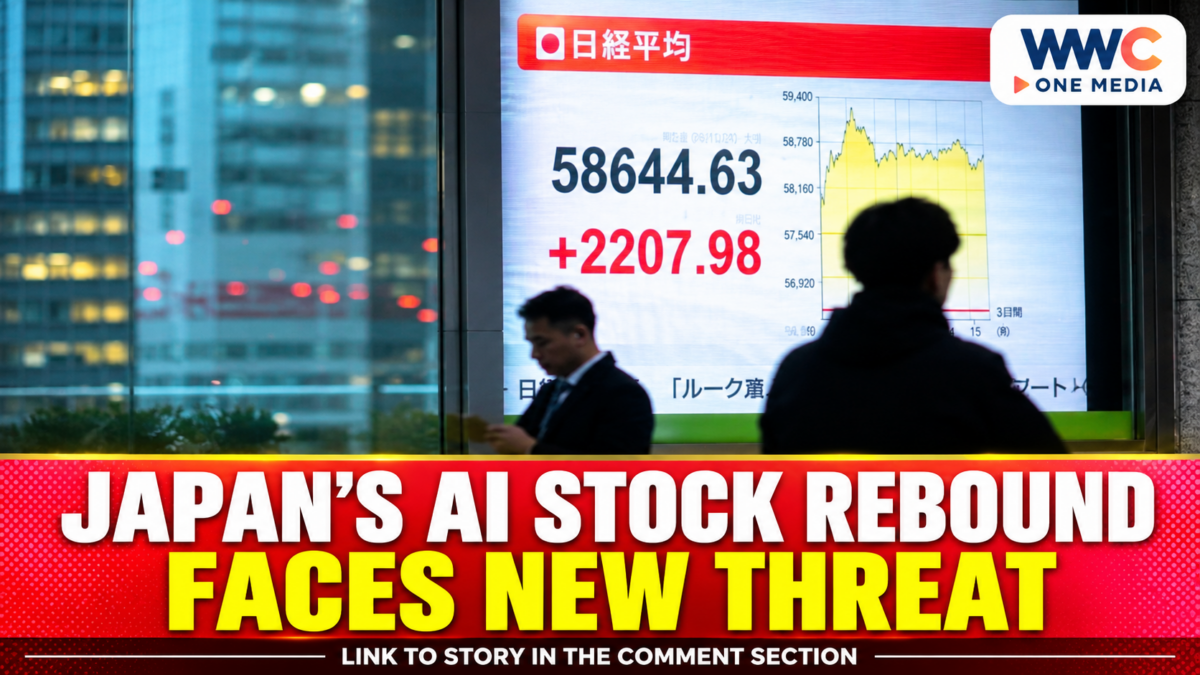
TOKYO, Japan — November 25, 2026 — Japan’s stock market has staged a sharp rebound, but the recovery is facing a less visible risk: investors who borrowed money to bet on artificial intelligence and semiconductor shares may now be under pressure to sell.
The concern is particularly relevant for heavily traded technology names such as Kioxia Holdings, whose outstanding margin-buy positions remained above 51 million shares in the latest Tokyo Stock Exchange data reviewed.
Margin trading allows investors to purchase shares using borrowed funds. It can amplify gains when prices rise, but it also increases losses when the market moves in the opposite direction.
That creates a potential problem for Japan’s latest recovery. If investors use a market rebound to reduce losing positions, their selling could weaken the very share-price gains they are hoping to use to escape losses.
The risk does not mean a new market crash is inevitable. It does, however, highlight how leveraged trading can make a volatile market more vulnerable to sudden changes in investor behaviour.
JAPAN’S NIKKEI REBOUNDS — BUT THE RECOVERY IS NOT YET SECURE
The Nikkei 225 climbed 3.91% on November 24, gaining 2,207.98 points to close at 58,644.63.
The rally followed a difficult period for Japanese equities. The benchmark had closed at 56,436.65 on November 20, after falling to that level during the session.
The November 24 advance was broad, with 167 constituents rising and 58 declining.
Technology stocks played an important role in the recovery. The technology sector contributed 1,579.25 yen to the index’s daily advance, making it the largest sector contributor.
But a strong session does not automatically mean the market has returned to a stable upward trend.
Japan’s recent volatility has been closely connected to investor expectations surrounding artificial intelligence, semiconductor demand and the enormous investment needed to build data centres.
As previously examined in WWC ONE MEDIA’s analysis of the Nikkei’s correction and the risk of declaring a bear market too early, market declines and recoveries need to be assessed using actual closing figures rather than isolated intraday movements.
The latest rebound offers some relief, but the positioning of investors remains an important part of the market picture.
KIOXIA’S MARGIN POSITIONS SHOW HOW LARGE THE EXPOSURE HAS BECOME
Kioxia Holdings provides a clear example of the leverage involved in Japan’s technology-stock trade.
Tokyo Stock Exchange data recorded 51,851,600 outstanding margin-buy shares in Kioxia on November 19.
The following day’s published data showed 51,247,700 shares, a decline of 603,900.
The balance therefore remained above 51 million shares even after the reduction.
These are outstanding margin-purchase positions recorded by the exchange. They should not be interpreted as the number of unique retail investors, nor do they establish that every position is held by an individual investor.
Nevertheless, the figures show that a substantial volume of Kioxia shares was being held through margin transactions.
That matters because investors using borrowed money face additional risks when prices fall. Depending on their account terms and collateral, they may be required to provide additional funds or reduce positions.
A forced reduction in leveraged holdings can create additional selling pressure, particularly when many investors are exposed to the same stock or sector.
The issue is especially relevant to Kioxia because its shares are closely connected to investor expectations about artificial intelligence infrastructure and memory demand.
WHY THE 20% LOSS LEVEL MATTERS
A separate measure tracked by Japanese brokerage Matsui Securities helps explain why losses in margin accounts are attracting attention.
The brokerage describes the margin-trading valuation-loss ratio as a measure of how much unrealised profit or loss investors carrying margin-buy positions have accumulated.
Matsui explains that the indicator commonly moves between zero and minus 20%. When the valuation-loss ratio falls below minus 20%, it can reach a level associated with additional-margin requirements.
The threshold is important because investors who cannot meet those requirements may have to reduce their positions.
However, minus 20% is not a universal automatic liquidation rule for every Japanese investor. Actual requirements depend on the brokerage, the account’s collateral and the applicable margin-trading terms.
The distinction is critical.
A loss indicator approaching a warning level does not prove that a wave of forced selling has already begun. It signals that some leveraged accounts may be increasingly vulnerable if share prices fall further.
The risk is also not limited to one brokerage’s customers. The broader market can be affected if leveraged investors across different platforms respond to the same price movements.
AI AND SEMICONDUCTOR SHARES ARE AT THE CENTRE OF THE RISK
Japan’s technology market has benefited from global investment in artificial intelligence.
Companies supplying semiconductor equipment, memory products, optical-fibre components and other infrastructure have attracted attention as technology groups expand their computing capacity.
But enthusiasm has also encouraged investors to take concentrated positions in shares associated with the AI boom.
That can create a difficult market environment when expectations change.
A company may continue reporting strong business demand while its share price falls because investors are concerned about valuations, future earnings or the amount of capital required to sustain industry growth.
Kioxia’s exposure to NAND flash memory and solid-state storage makes it an important part of the AI infrastructure discussion, although its products serve a different function from high-bandwidth memory used alongside advanced AI processors.
WWC ONE MEDIA previously examined Hong Kong’s leveraged Kioxia trading product, highlighting how financial products can amplify exposure to the Japanese memory-chip manufacturer.
The broader issue is that demand for AI infrastructure and the share prices of companies connected to it do not necessarily move in the same direction every day.
Even when the underlying industry remains strategically important, investors can experience substantial losses if they buy at valuations that the market later reassesses.
SOFTBANK AND OTHER AI-LINKED SHARES ADD TO THE MARKET’S SENSITIVITY
The pressure is not confined to Kioxia.
SoftBank Group has become one of Japan’s most closely watched companies because of its substantial exposure to artificial intelligence investments.
Its share price can be influenced by changes in investor expectations about AI-related businesses, financing conditions and the value of its investment portfolio.
Other companies connected to semiconductor equipment and industrial supply chains also influence market sentiment.
The Nikkei’s official November 24 weighting data show that Advantest accounted for 10.03% of the index, Tokyo Electron 7.71% and SoftBank Group 4.37%.
Those weightings help explain why developments affecting major technology-related companies can have a significant influence on the benchmark.
WWC ONE MEDIA has also examined SoftBank’s recent share-price volatility and the financial risks surrounding its AI investments.
When investors are heavily positioned in technology stocks, a change in sentiment can affect several major companies at the same time.
HOW LEVERAGED INVESTORS CAN TURN A REBOUND INTO ANOTHER SELLING WAVE
The risk surrounding margin trading is not simply that investors have paper losses.
It is that borrowed positions can create additional selling when market conditions deteriorate.
Consider a simplified example.
An investor purchases shares worth ¥1 million using ¥500,000 of borrowed funds and ¥500,000 of personal capital.
If the shares fall in value, the investor’s equity declines more quickly than it would have if the shares had been purchased entirely with personal funds.
The investor may also face additional collateral requirements, interest costs and the possibility of having positions closed under the brokerage’s rules.
If many investors face pressure at the same time, they may sell shares even when they would otherwise prefer to hold them.
That can increase volatility and make market recoveries more difficult to sustain.
The opposite is also true: if prices recover sufficiently, some investors may use the improved market conditions to close positions and limit their losses.
That selling can absorb part of the buying demand supporting a rebound.
It is a potential mechanism, not proof that every investor is preparing to sell.
WHAT INVESTORS SHOULD WATCH NEXT
Japan’s next market sessions will help determine whether the November 24 rebound can develop into a more durable recovery.
Several indicators deserve attention.
First is the level of outstanding margin-buy positions in heavily traded semiconductor and AI-related companies. A sustained reduction could indicate that investors are reducing leverage, although it would not by itself establish whether the selling was forced or voluntary.
Second is the relationship between share prices and margin balances. If prices decline while outstanding leveraged positions remain elevated, the risk of further account stress may increase.
Third is the performance of major technology components in the Nikkei 225, particularly Advantest, Tokyo Electron and SoftBank Group.
Fourth is whether AI-related earnings and business investment continue to justify the valuations investors have assigned to companies across the supply chain.
Japan’s market is not facing a guaranteed collapse. The more immediate question is whether investors can absorb the remaining leveraged exposure without turning ordinary price volatility into a broader selling cycle.
The latest rebound has given the market room to recover.
But with substantial margin positions still visible in key technology shares, the next test may come from investors who are trying to get out of losing trades rather than those looking to buy the rally.