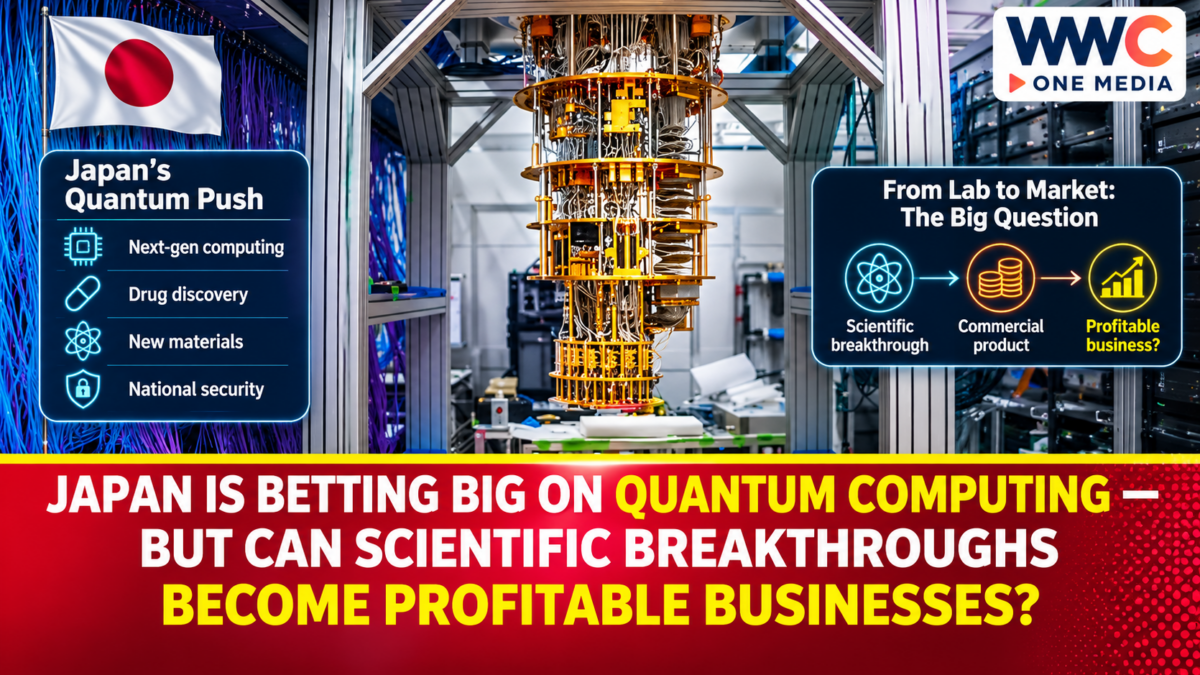
TOKYO, Japan — Japan’s quantum computing ambitions are entering a new phase as national research institutions and international technology companies pursue advanced computing systems capable of addressing complex scientific and industrial problems.
On November 10, 2026, RIKEN and American quantum computing company Quantinuum announced an expanded partnership following the successful upgrade of Japan’s Reimei quantum computer from 20 to 56 qubits.
The collaboration also involves developing next-generation quantum technology with Japanese universities and component suppliers, alongside a separate agreement with SoftBank to explore connections between quantum computers and artificial intelligence data centres.
However, the technological milestone raises a more consequential commercial question.
Can Japan transform advanced scientific research into competitive products, sustainable businesses and measurable economic benefits?
Japan Quantum Computing Enters a New Development Phase
Installed at RIKEN’s Wako campus, Reimei became operational in 2025 as part of a government-supported research initiative.
Its latest upgrade replaces Quantinuum’s 20-qubit System Model H1 with the 56-qubit System Model H2, expanding the range of computational experiments researchers can undertake.
Unlike conventional computers, which process information using binary bits, quantum computers use quantum bits, commonly known as qubits.
Quantum systems can exploit properties such as superposition and entanglement to perform certain specialised calculations.
However, a higher qubit count does not automatically translate into proportionately faster computing or commercially useful performance.
Error rates, connectivity, algorithm design and operational reliability remain important considerations.
For Japan, the upgraded Reimei system represents an opportunity to investigate practical applications rather than simply compete for hardware specifications.
Three Computing Systems Could Reshape Scientific Research
Japan’s approach involves combining quantum computing with existing supercomputing and artificial intelligence infrastructure.
Reimei operates within a hybrid computing environment incorporating RIKEN’s Fugaku supercomputer and ROQUO graphics processing unit (GPU) supercomputer.
| Computing system | Principal role |
|---|---|
| Reimei | Specialised quantum calculations |
| Fugaku | Large-scale conventional scientific simulations |
| ROQUO | GPU-accelerated computing and AI applications |
The hybrid approach allows researchers to allocate different components of complex calculations to the computing systems most suited to those tasks.
Rather than replacing conventional computers, quantum processors could function as specialised accelerators within larger scientific computing environments.
This strategy presents potential opportunities in materials research, energy technology and pharmaceutical development.
Nevertheless, commercial viability will depend on whether hybrid systems can deliver meaningful advantages over established computing methods at an acceptable cost.
Two Research Projects Target Real-World Applications
Quantinuum has identified two research initiatives supported by the upgraded Reimei system.
The first combines quantum simulation, classical computing and generative artificial intelligence to investigate complex material behaviour.
Its potential applications include identifying materials with useful electronic, magnetic or energy-related properties.
The second project focuses on biomolecular chemistry, combining advanced computing methods to investigate molecular properties that could support pharmaceutical and materials research.
These projects are important because they address scientific problems rather than hardware performance alone.
However, their existence does not establish that commercially successful medicines, materials or industrial products have already been developed.
Laboratory findings must undergo further validation before they can support dependable commercial applications.
The distinction between technological capabilities and commercial returns has also been examined in WWC ONE MEDIA’s coverage of Asia’s AI investment boom and the challenge of transforming infrastructure spending into lasting profitability.
Quantum computing may face a similar challenge as companies seek to establish dependable revenue models.
SoftBank Explores Quantum Computing in AI Data Centres
The involvement of SoftBank introduces another potential commercial opportunity.
Under a separate agreement, SoftBank, RIKEN and Quantinuum will assess how quantum computing could be connected directly with Japanese AI data centres.
The partners intend to investigate infrastructure readiness and potential commercial computing services.
This could eventually allow businesses to access specialised quantum computing resources without purchasing and maintaining their own hardware.
However, the announcement does not establish that commercial quantum-enabled data centres have already been launched.
Nor does it provide guaranteed deployment schedules, customer revenues or investment returns.
Japan’s broader digital infrastructure development has previously attracted substantial international commercial interest, including Keppel’s expansion into Tokyo’s data centre market.
Conventional data centre investments and quantum computing infrastructure involve different technical and financial requirements.
For investors, evaluating the emerging market will require examining actual customer demand, infrastructure costs and the performance of completed systems.
Japan’s Quantum Strategy Extends to 2050
Japan’s Cabinet Office has established long-term quantum computing objectives through its Moonshot Research and Development Programme.
The government’s Moonshot Goal 6 targets the development of fault-tolerant universal quantum computing capabilities by approximately 2050.
An intermediate objective calls for demonstrating effective quantum error correction and developing quantum systems of an appropriate scale by 2030.
Fault tolerance is particularly important because quantum information is vulnerable to errors that can accumulate during computations.
Developing methods to manage those errors is essential to expanding the range of calculations quantum computers can perform reliably.
Japan is also pursuing FugakuNEXT, a next-generation supercomputing platform intended to begin operations around 2030 at RIKEN’s Kobe site.
The project includes plans to integrate advanced conventional computing, artificial intelligence and quantum computing capabilities.
These initiatives demonstrate a coordinated research direction, but their announced milestones remain targets rather than guaranteed completion dates.
Japan’s wider efforts to commercialise emerging technologies have encountered similar questions, as explored in the country’s humanoid robotics industry and its challenge of scaling laboratory innovations for industrial use.
Scientific excellence is valuable, but commercial leadership also requires manufacturing capabilities, skilled personnel, customer relationships and sustainable business models.
Quantum Computing Creates a New Cybersecurity Challenge
The development of advanced quantum computers also carries implications for financial institutions, governments and businesses that depend on digital security.
A sufficiently powerful quantum computer could threaten certain public-key cryptographic systems currently used to protect electronic information.
Preparing for that possibility does not require waiting until such a computer becomes commercially available.
On August 13, 2024, the US National Institute of Standards and Technology (NIST) published three principal post-quantum cryptography standards.
In October 2026, the agency released additional guidance outlining the transition towards quantum-resistant cryptographic systems.
For internationally connected businesses, reviewing existing security infrastructure and preparing appropriate migration strategies could become increasingly important.
Nevertheless, Reimei’s 56-qubit upgrade does not establish that the system can defeat modern banking encryption.
The cybersecurity implications concern future capabilities rather than a demonstrated immediate threat from the upgraded Japanese computer.
What Happens Next for Japan’s Quantum Computing Industry?
Japan’s next significant milestones will involve validating research results, expanding access to hybrid computing platforms and demonstrating commercially useful applications.
Technology developers must establish whether quantum computing can solve selected problems more accurately, efficiently or economically than competing conventional methods.
The financial opportunity could extend across specialist hardware, scientific software, infrastructure services and cybersecurity.
However, market leadership will depend on delivering services that organisations are willing to purchase repeatedly.
Japan’s latest quantum computing upgrade represents meaningful scientific progress.
Its greater economic significance will emerge when researchers and businesses demonstrate that the technology can solve important problems at a commercially sustainable cost.
Frequently Asked Questions
What is Japan’s Reimei quantum computer?
Reimei is a Quantinuum quantum computing system installed at RIKEN’s Wako campus and integrated with Japanese supercomputing infrastructure.
How many qubits does Reimei have?
The system was upgraded from 20 to 56 qubits in 2026, using Quantinuum’s System Model H2.
What is SoftBank’s role in Japan’s quantum computing development?
SoftBank is collaborating with RIKEN and Quantinuum to explore connections between quantum computing and AI data centres, including potential commercial applications.
When does Japan expect to develop fault-tolerant quantum computers?
Japan’s Moonshot programme targets large-scale fault-tolerant universal quantum computing capabilities by approximately 2050, with intermediate research objectives for 2030.
Will quantum computers replace conventional computers?
Not necessarily. Japan’s current hybrid approach combines quantum processors, conventional supercomputers and GPU infrastructure to address different computational tasks.