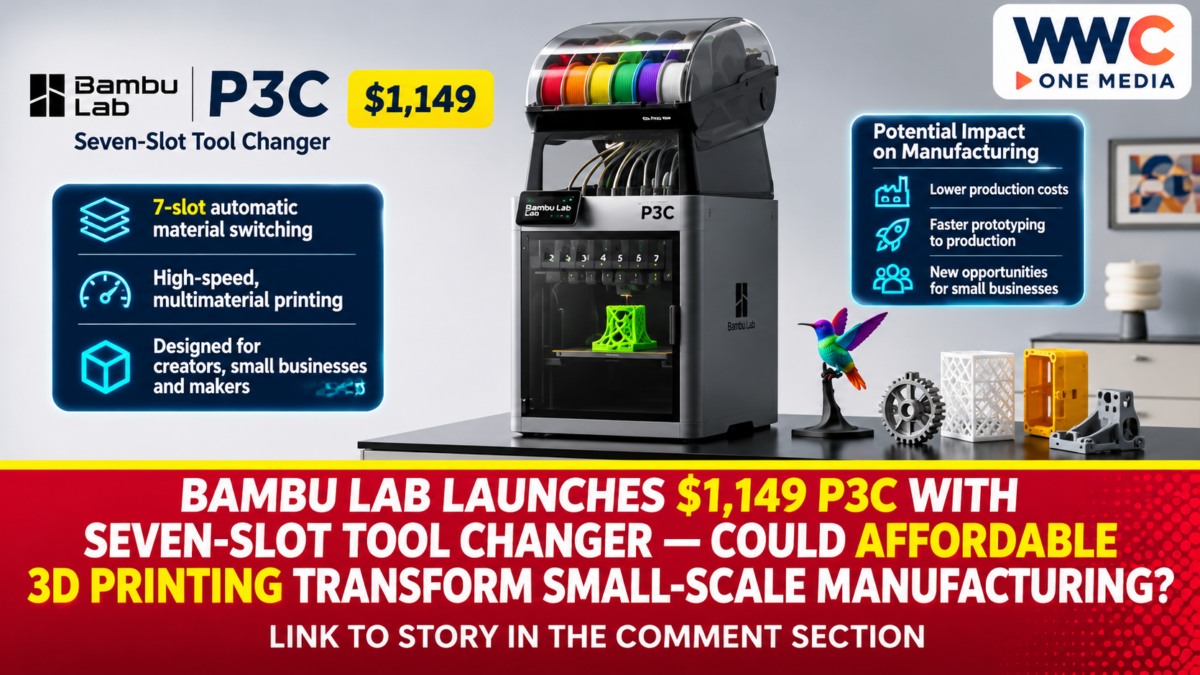
The competition to make advanced manufacturing technology more accessible has intensified after Bambu Lab introduced the P3C, a third-generation desktop 3D printer designed to combine multiple colours, materials and nozzle sizes within a single production process.
Launched on Nov. 24, 2026, the Bambu Lab P3C starts at US$1,149, substantially below the US$2,499 price of the company’s flagship H3C.
The new machine accommodates up to seven printing tools and offers manufacturer-rated material switching times of six seconds.
For independent designers, educational institutions and small manufacturing businesses, the development presents an opportunity to access more advanced production capabilities without purchasing the company’s most expensive desktop equipment.
However, the bigger commercial question is whether lower hardware costs can translate into genuinely affordable and profitable manufacturing.
Bambu Lab P3C brings advanced tool-changing technology to a lower price category
The P3C arrives just three weeks after Bambu Lab introduced its flagship H3C on Nov. 3, 2026.
Both printers incorporate the company’s SwapTek tool-changing architecture.
Unlike conventional single-nozzle printing systems that may require repeated material changes through the same nozzle, a tool-changing printer can select between separate printing tools prepared for different materials or production requirements.
The P3C’s standard package includes five tools equipped with 0.4-millimetre nozzles, with two additional positions available for optional equipment.
Its starting price is approximately 54% below that of the H3C.
The strategy could appeal to customers who require advanced multi-material capabilities but do not need every feature available in the flagship machine.
Nevertheless, the lower purchase price does not establish that the P3C can deliver identical results across every application.
The two models occupy different positions within Bambu Lab’s product range, with differences in equipment capacity and operating capabilities.
Six-second material changes could improve production efficiency
One of the P3C’s central features is its advertised six-second material switching capability.
For a designer producing objects containing several colours or materials, repeatedly changing printing tools can influence both production time and operating expenditure.
Consider a business producing customised merchandise that incorporates detailed lettering, contrasting colours and components requiring different physical characteristics.
Combining those requirements within one automated printing process could reduce the need for separate production stages.
The printer also supports optional nozzle diameters of 0.2, 0.6 and 0.8 millimetres, alongside its standard 0.4-millimetre configuration.
Different nozzle sizes allow users to balance detail against production requirements.
However, the six-second switching figure should not be interpreted as a guarantee that every finished product will be manufactured more quickly.
Actual completion times will depend on design complexity, material selection, printing settings and the number of tool changes required.
Multi-material printing could change how businesses design products
The P3C incorporates Bambu Lab’s FlexFeed extruder, which supports conventional 1.75-millimetre filament and compatible 2.85-millimetre material through an appropriate bypass-feed configuration.
This gives designers additional options when creating products that require both rigid and flexible components.
For example, a prototype could incorporate a rigid outer structure alongside flexible protective sections.
Producing such components within one manufacturing process could potentially reduce subsequent assembly requirements.
The wider commercial opportunities associated with customised production have previously been examined in WWC ONE MEDIA’s coverage of a Singapore entrepreneur who transformed toy-making and 3D printing into a customised manufacturing business.
For smaller manufacturers, the potential advantage lies in producing differentiated products without necessarily relying on conventional mass-production volumes.
However, product quality, material compatibility and durability must still be evaluated before items are offered commercially.
The hidden costs behind affordable desktop manufacturing
The P3C’s US$1,149 launch price includes the printer, AMS 3P filament management equipment and five standard printing tools.
Businesses seeking to use all seven tool positions will require additional equipment.
Bambu Lab has introduced several alternative packages, including a Multi-Colorist Combo priced at US$1,269 before Dec. 3, 2026.
A Multi-Material Combo incorporating additional printing tools and flexible filament starts at US$1,299 during the announced promotional period.
Filament drying is also optional rather than included as standard.
These distinctions matter when calculating the total cost of establishing a production operation.
Beyond the printer itself, businesses must consider filament consumption, electricity, replacement components, product design, maintenance and unsuccessful production runs.
A relatively inexpensive machine does not automatically guarantee profitable manufacturing.
The relevant financial measure is the total cost of producing an acceptable finished product, rather than the purchase price of the equipment alone.
Advanced manufacturing becomes more accessible to educational institutions
Desktop additive manufacturing also presents opportunities for schools, universities and technical training centres.
Students can develop digital designs, manufacture physical prototypes and make adjustments based on their observations.
Access to different materials and printing configurations could support more sophisticated engineering and product-development exercises.
The importance of expanding access to such technologies has previously featured in WWC ONE MEDIA’s reporting on Western Philippines University’s advanced manufacturing and 3D printing facility in Palawan.
For educational institutions, however, acquiring advanced equipment represents only the beginning.
Training, maintenance procedures, appropriate ventilation and responsible material handling remain important components of a sustainable manufacturing programme.
The long-term educational value depends on whether students develop practical design and engineering skills rather than simply learning to operate a particular machine.
Could 3D printing reduce manufacturing waste?
The ability to switch between dedicated printing tools could potentially reduce some of the material wasted during repeated filament changes.
However, waste reduction will depend on the printing configuration and the characteristics of individual production jobs.
Desktop 3D printing still generates waste through support structures, failed prints and material preparation.
Different materials also have different recycling requirements.
The relationship between manufacturing innovation and material recovery has previously been examined in WWC ONE MEDIA’s coverage of Romblon’s marble industry and proposed research into using marble waste for future 3D printing applications.
For manufacturers across Asia-Pacific, developing economically useful products from alternative materials could create opportunities extending beyond conventional production methods.
Nevertheless, environmental benefits should be demonstrated through actual material consumption and lifecycle assessments rather than assumed from the introduction of new equipment.
What happens next for Bambu Lab?
The P3C gives Bambu Lab an opportunity to attract customers interested in tool-changing technology at a substantially lower price than its flagship H3C.
Its commercial performance will depend on more than initial consumer interest.
Long-term reliability, replacement component availability, software support and actual production costs will influence whether businesses adopt the technology for sustained manufacturing operations.
For entrepreneurs, the opportunity is to explore production models that might previously have required more expensive equipment or external manufacturing services.
Bambu Lab has lowered the entry price for its third-generation tool-changing technology.
Whether that development transforms small-scale manufacturing will depend on how effectively businesses convert technological capability into products that customers are willing to purchase.
Frequently Asked Questions
What is the Bambu Lab P3C?
The Bambu Lab P3C is a third-generation desktop multi-material 3D printer launched on Nov. 24, 2026, featuring the company’s SwapTek tool-changing system.
How much does the Bambu Lab P3C cost?
The standard P3C Combo starts at US$1,149 before tax in the United States. Announced UK and European prices are £999 and €1,149, including tax.
Does the Bambu Lab P3C come with seven printing tools?
No. The standard package includes five printing tools and provides two additional positions for optional equipment.
How fast can the Bambu Lab P3C change materials?
Bambu Lab advertises six-second material changes. Actual overall production times depend on the printing configuration and product design.
What is the difference between Bambu Lab P3C and H3C?
The P3C starts at US$1,149 and accommodates seven tools, while the flagship H3C costs US$2,499 and accommodates nine. The P3C also requires optional equipment for filament drying.