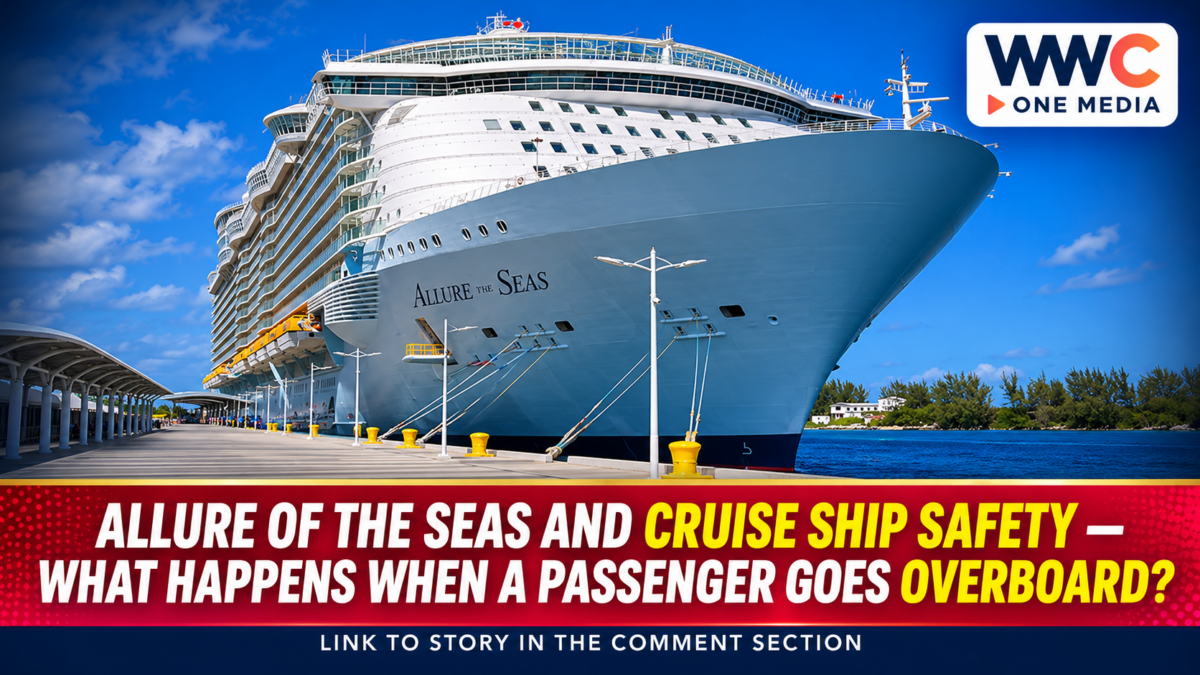
For international cruise operators, a missing passenger at sea represents one of the most serious emergencies that maritime personnel may encounter.
Royal Caribbean’s Allure of the Seas belongs to the company’s Oasis Class fleet, offering extensive accommodation, entertainment and recreational facilities for international travellers.
Behind these passenger experiences lies a complex maritime safety framework involving vessel operators, international conventions, national rescue authorities and technological systems designed to protect people at sea.
Understanding how these systems operate is essential when evaluating reports of passengers going overboard, particularly when the circumstances and outcomes have not yet been independently established.
Allure of the Seas safety: Understanding the regulatory framework
Cruise ship safety involves considerably more than providing life jackets and emergency evacuation instructions.
United States federal legislation establishes specific safety and security requirements for qualifying passenger vessels.
Under Title 46, Section 3507 of the United States Code, applicable vessels must have railings measuring at least 42 inches above the cabin deck.
The legislation also requires the integration of technology capable of capturing images or detecting individuals who have fallen overboard, to the extent that such technology is available.
This qualification is important.
The legal requirement should not automatically be interpreted as confirmation that every cruise vessel has identical detection equipment or that every overboard event will be detected immediately.
Determining the effectiveness of individual safety arrangements requires vessel-specific information and evidence.
The distinction between general safety obligations and the circumstances of a particular emergency has previously featured in WWC ONE MEDIA’s coverage of a cruise emergency in New Orleans and the questions maritime investigators must establish.
Why maritime search and rescue requires international cooperation
An emergency involving a passenger at sea may require coordination beyond the resources available aboard a cruise ship.
The International Convention on Maritime Search and Rescue was adopted on April 27, 1979, and entered into force on June 22, 1985.
The convention establishes an international system intended to coordinate assistance for individuals experiencing emergencies at sea.
Participating governments are encouraged to develop cooperative arrangements with neighbouring countries, including procedures for sharing rescue resources and coordinating emergency operations.
This framework is particularly relevant in regions where international passenger vessels regularly travel between different national jurisdictions.
The Caribbean is one such region where international cooperation may become important during maritime emergencies.
For cruise operators, maintaining effective communication with the appropriate rescue authorities forms an essential part of emergency preparedness.
The Bahamas has an established maritime rescue framework
The Royal Bahamas Defence Force is responsible for protecting the country’s territorial integrity, patrolling its waters and contributing to humanitarian operations.
Its responsibilities include cooperation with local and international partners.
These functions provide an institutional foundation for responding to maritime emergencies involving vessels operating within the region.
However, the existence of this framework does not establish the specific resources deployed during any individual emergency.
The operational details of a particular search must be confirmed through incident-specific information.
Similar coordination challenges have previously been examined in WWC ONE MEDIA’s coverage of a passenger ferry grounding in Occidental Mindoro and the subsequent maritime rescue response.
Although individual emergencies differ significantly, the importance of communication between vessel operators and rescue organisations remains consistent.
Cruise ship surveillance technology could provide important evidence
Applicable US passenger vessel legislation also establishes requirements concerning onboard video surveillance.
The framework provides for surveillance planning, equipment installation, periodic assessment and the retention of recorded footage.
Vessel operators covered by the relevant provisions must generally retain video surveillance records for at least 20 days.
Additional preservation requirements may apply in specified circumstances involving investigations.
For authorities examining a missing passenger incident, available recordings could help establish relevant circumstances.
However, the existence of onboard cameras does not guarantee that every event will be recorded.
Nor does the availability of surveillance equipment independently establish how an incident occurred.
A responsible assessment must distinguish between the equipment a vessel is required to carry, the equipment actually installed and the evidence available in a particular case.
Why an overboard report does not establish the cause of an incident
The circumstances surrounding a person entering the water from a passenger vessel cannot be determined solely from an initial emergency report.
A rescue operation serves an immediate humanitarian purpose: locating and assisting the person in distress.
Questions concerning the cause of an incident require a separate evidentiary assessment.
Relevant considerations could include available recordings, verified communications, vessel records and information obtained during an authorised investigation.
Until those facts are established, it would be inappropriate to assign responsibility to passengers, crew members or the cruise operator.
The importance of distinguishing emergency response from legal responsibility was previously examined in WWC ONE MEDIA’s reporting on a tanker collision involving a passenger riverboat and the evidence required by maritime investigators.
A reported emergency does not independently establish negligence, criminal conduct or equipment failure.
Passenger welfare must remain the priority
For cruise operators, emergency preparedness also involves communication with passengers and appropriate support for affected families.
Public interest in maritime emergencies can be substantial, particularly when they involve internationally recognised cruise brands.
However, speculation about a missing individual’s identity, medical condition or personal circumstances can create unnecessary distress.
The release of verified information should remain consistent with legitimate investigative requirements and respect for individual privacy.
For the international cruise industry, maintaining confidence depends not only on attractive travel experiences but also on responsible emergency management and transparent communication.
What happens next during a maritime emergency?
International maritime rescue arrangements provide procedures for coordinating available resources and determining how search operations should proceed.
The relevant authorities must assess individual circumstances when making operational decisions.
Under the international search-and-rescue framework, rescue efforts should continue where practicable while reasonable prospects of locating survivors remain.
The conclusion of a particular vessel’s participation in a search would not necessarily establish that every participating authority has ended its operations.
Similarly, changes to a cruise itinerary would not independently establish the outcome of an emergency.
For travellers and affected families, reliable official updates remain essential.
The most important measure of maritime safety is not the volume of speculation generated by an incident, but the effectiveness of efforts to protect human life and establish what actually occurred.
Frequently Asked Questions
What is Royal Caribbean’s Allure of the Seas?
Allure of the Seas is a passenger cruise ship belonging to Royal Caribbean’s Oasis Class fleet.
Are cruise ships required to have overboard detection technology?
Applicable US legislation requires qualifying passenger vessels to integrate technology capable of recording or detecting passengers who have fallen overboard, to the extent that such technology is available.
Who coordinates maritime rescue operations in the Bahamas?
The Royal Bahamas Defence Force has maritime security and humanitarian responsibilities and cooperates with other national and international organisations.
How long must qualifying cruise ships retain surveillance recordings?
Applicable US passenger vessel legislation establishes a general minimum retention period of 20 days, with additional requirements in specified circumstances.
Does an overboard incident establish that a cruise operator was negligent?
No. Determining responsibility requires an assessment of the specific circumstances, available evidence and applicable legal requirements.