TOKYO, Japan — November 25, 2026 — Japan has tested how its government would respond if Ebola were detected inside the country, bringing Prime Minister Sanae Takaichi and senior officials into a national emergency exercise designed to examine the first hours of a potential outbreak.
The November 24 exercise simulated the confirmation of Japan’s first domestic Ebola case. It was the first time the Japanese government used Ebola as the focus of its national infectious-disease crisis response drill, according to official government records.
The exercise comes as the Democratic Republic of the Congo (DRC) continues to deal with an outbreak of Bundibugyo virus disease, which the World Health Organization (WHO) declared a public health emergency of international concern in May 2026.
There is an important distinction: Japan did not announce an actual Ebola infection. The domestic case discussed during the exercise was hypothetical. The purpose was to test government readiness before a real emergency occurs.
Japan tests its first-response system for a hypothetical Ebola case
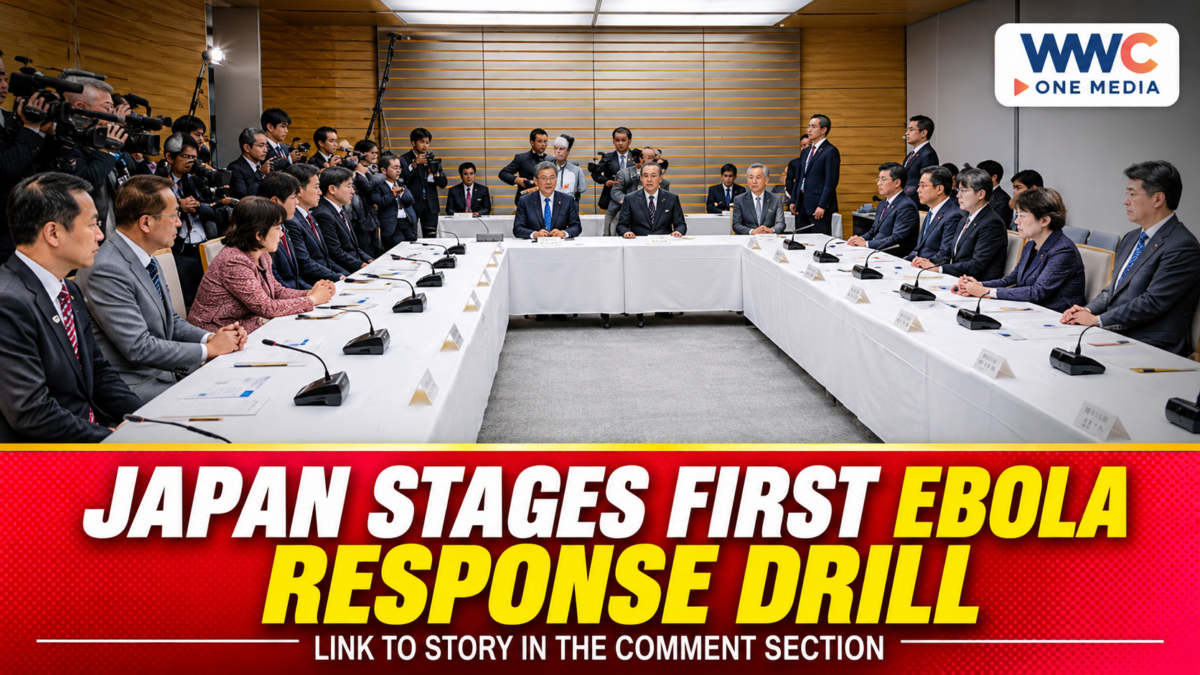
The national exercise took place on November 24 under the leadership of Takaichi, with the Cabinet-level response involving the health minister, the minister responsible for infectious-disease crisis management and other relevant officials.
The scenario assumed that an Ebola patient had been identified in Japan. Officials reviewed how the government would organise its initial response, share information across agencies and establish the actions required to prevent further infections.
The exercise was the fourth government infectious-disease crisis response drill since the Cabinet’s infectious-disease crisis management headquarters began operating in September 2023. It was the first of those exercises to use Ebola as its central scenario.
The government’s instructions focused on three priorities: treating the hypothetical patient, preventing secondary infections, and coordinating quarantine, rapid testing and treatment arrangements.
Officials were also instructed to communicate promptly using scientific information, while preventing discrimination, stigma and the spread of misinformation.
The exercise therefore went beyond the question of whether hospitals could treat a patient. It also examined how Japan would manage public information and coordinate its national response if a highly dangerous infectious disease were detected.
Japan’s health ministry and prefectures also tested coordination
The national exercise was accompanied by a separate Ministry of Health, Labour and Welfare response-headquarters drill.
The ministry scheduled its exercise for the morning of November 24 at its headquarters in Tokyo’s Kasumigaseki district. Its stated purpose was to share information about a hypothetical domestic Ebola case and confirm the ministry’s response policy.
The health minister and other officials were expected to participate.
A further coordination exercise was planned for the afternoon, bringing the national government and all 47 prefectures into an information-sharing process.
Osaka Prefecture confirmed that it would participate in an online meeting to review initial responses, the risk assessment prepared by the Japan Institute for Health Security (JIHS), and the readiness of prefectural authorities.
This nationwide dimension is important. A suspected infection could require coordination among national ministries, local governments, public-health institutions, hospitals and border-control authorities. A response that works only at the central-government level would not be enough.
Japan’s exercise was designed to test how those different parts of the system would work together.
Why the Ebola outbreak in Central Africa matters
Japan’s preparedness exercise is taking place against the backdrop of a serious Ebola outbreak in Central Africa.
On May 17, 2026, WHO Director-General Tedros Adhanom Ghebreyesus determined that the outbreak of Ebola disease caused by the Bundibugyo virus in the Democratic Republic of the Congo and Uganda constituted a public health emergency of international concern.
The declaration was based on the outbreak’s severity, uncertainty about its full extent and the risk of further international spread.
WHO’s August 28 update documented the outbreak’s expansion in the DRC. By August 26, confirmed cases had been reported across 60 health zones in six provinces. The agency recorded 5,794 confirmed cases and 2,786 deaths in the DRC at that reporting cut-off, representing a crude case-fatality ratio of 48.1%.
Those figures are tied to WHO’s August 26 reporting date. They should not be mistaken for a November 25 live case count.
The outbreak involves Bundibugyo virus, one of the viruses that can cause Ebola disease. It is important not to treat every Ebola outbreak as identical: different Ebola-causing viruses can have different epidemiological characteristics, and the availability of vaccines and treatments is not the same for every type.
The scale of the Central African outbreak helps explain why governments outside the affected countries have been reviewing their preparedness and response arrangements.
What makes Ebola a serious public-health threat?
Ebola disease is a severe illness that can be fatal. WHO says transmission occurs through direct contact with the blood or other body fluids of an infected person who is sick or has died, or through contaminated materials.
It is not spread simply because someone is in the same country as an infected person. The nature of exposure, the timing of infection and the ability of health authorities to identify and isolate cases are important parts of outbreak control.
WHO’s general Ebola fact sheet says the average case-fatality rate is around 50%, although rates have varied from 25% to 90% in past outbreaks. These figures describe the disease across different outbreaks and should not be confused with the specific fatality rate recorded for the 2026 Bundibugyo outbreak.
The response to an Ebola event typically involves early detection, laboratory confirmation, infection prevention and control, patient care, contact tracing and safe handling of bodies. Public communication is also essential because misinformation and stigma can discourage people from seeking care or cooperating with health authorities.
These are the types of challenges that make advance planning and inter-agency exercises important.
Japan’s risk assessment and the importance of clear public information
The Japanese government’s exercise included a risk assessment from the Japan Institute for Health Security.
The prime minister’s published account of the simulation said the institute assessed the possibility of domestic transmission as low under the scenario’s conditions. That was a risk assessment within the exercise, not a declaration that Japan had experienced an Ebola case.
Takaichi’s instructions also stressed that public information should be based on scientific evidence and delivered quickly.
That emphasis matters during infectious-disease emergencies. An unclear announcement can create confusion, while exaggerated claims can fuel panic, discrimination or unnecessary fear of people who have travelled from affected areas.
The distinction between a suspected case, a confirmed infection and a hypothetical exercise scenario must remain clear.
For a wider discussion of how public-health authorities interpret disease alerts, WWC ONE MEDIA has examined the difference between surveillance signals, reported infections and confirmed outbreaks across the Pacific.
Preparedness is about more than border screening
An international outbreak can place pressure on several parts of a country’s health-security system at the same time.
Border and quarantine authorities may need to identify travellers who require further assessment. Hospitals need procedures for safely evaluating and treating suspected patients. Laboratories must be able to support timely testing, while local governments need clear channels for receiving instructions and reporting developments.
The November 24 exercise addressed several of these responsibilities through its national and prefectural coordination components.
Japan’s experience also reflects a broader regional challenge: countries connected through international travel and trade need systems that can identify unusual health events, share reliable information and respond without unnecessary delay.
WWC has also examined how regional disease surveillance systems help governments interpret public-health alerts, particularly when early information is incomplete and the cause of an illness has not yet been confirmed.
The lesson is not that every international outbreak will reach every country. It is that governments need the ability to assess risks accurately and act proportionately when new information emerges.
What happens after Japan’s Ebola exercise?
The immediate significance of the November 24 exercise is that Japan has now tested an Ebola-specific national response scenario, including coordination among central authorities, the health ministry and prefectural governments.
The government has said that preparedness exercises are intended to identify issues and strengthen its ability to respond to infectious-disease emergencies.
The effectiveness of that preparation will ultimately depend on how well procedures work outside a simulation: whether suspected infections can be recognised, whether testing and treatment arrangements can be activated, whether local authorities receive timely instructions, and whether the public receives accurate information.
Japan’s exercise was not evidence of an Ebola outbreak inside the country. It was a test of how the government intends to respond if one occurs.
As the Bundibugyo outbreak continues to require international attention, that distinction is central to understanding both the health threat and Japan’s response.