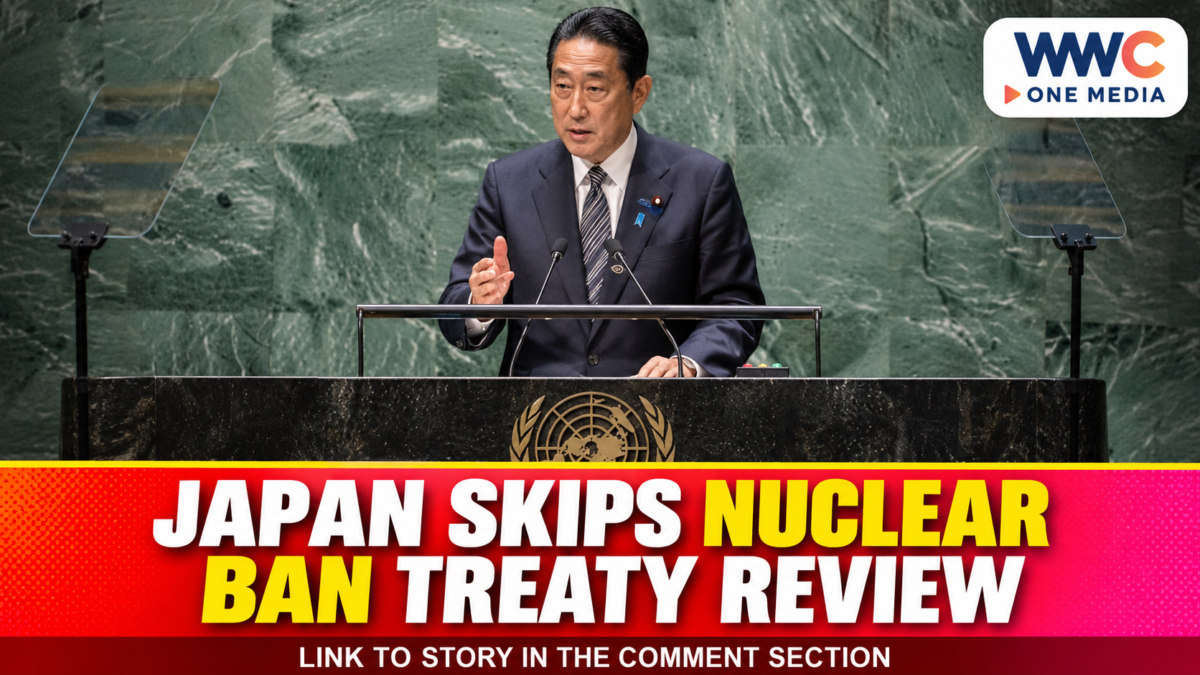
TOKYO, Japan — November 25, 2026 — Japan has decided not to attend as an observer the first review conference of the Treaty on the Prohibition of Nuclear Weapons (TPNW), a decision that puts fresh pressure on the country’s longstanding commitment to nuclear disarmament.
The conference is scheduled for November 30 to December 4 at United Nations Headquarters in New York. It will examine the treaty’s implementation and progress towards its objective of eliminating nuclear weapons.
Japan’s decision has drawn criticism from the mayors of Hiroshima and Nagasaki, the two cities devastated by atomic bombings in August 1945. Both cities have long called on the Japanese government to participate in international discussions aimed at eliminating nuclear weapons.
The decision also exposes a difficult balance in Tokyo’s foreign and security policy: Japan advocates a world without nuclear weapons while relying on the United States’ extended nuclear deterrence to address security threats in its region.
The issue is not simply whether Japan attends one international meeting. It concerns how the country uses its diplomatic influence, its historical experience and its security partnerships in an increasingly tense nuclear environment.
Why Japan is staying away from the UN nuclear-ban treaty review
The TPNW is an international agreement that prohibits activities involving nuclear weapons, including their development, testing, production, acquisition, possession, stockpiling, transfer and use.
It entered into force on January 22, 2021. The first review conference is intended to assess how the treaty is operating and what further steps may be needed to achieve its objectives.
Japan has not signed or ratified the TPNW.
The government’s position has been that the treaty’s comprehensive prohibition is incompatible with its current security approach, particularly its reliance on nuclear deterrence provided by the United States.
Japan’s 2026 Diplomatic Bluebook describes the TPNW as an important agreement that could serve as a pathway towards a world without nuclear weapons. However, it also argues that nuclear disarmament requires the participation of countries that possess nuclear weapons.
Tokyo therefore prefers to pursue disarmament through the Treaty on the Non-Proliferation of Nuclear Weapons (NPT), which it considers the central universal framework for nuclear non-proliferation and disarmament.
This is the policy distinction behind Japan’s decision: the government supports the objective of eliminating nuclear weapons but does not accept the TPNW as the most effective framework under current security conditions.
Hiroshima and Nagasaki challenge the government’s decision
The decision has particular significance for Hiroshima and Nagasaki.
On November 24, Nagasaki Mayor Shiro Suzuki issued a public statement expressing disappointment that Japan would not participate as an observer in the first TPNW review conference.
Suzuki said the city had previously joined Hiroshima in urging Prime Minister Sanae Takaichi to attend the meeting and contribute to discussions about the humanitarian consequences of nuclear weapons.
The mayor argued that Japan’s experience as the only country to have suffered atomic bombings during war gives it a special responsibility to communicate the realities of nuclear destruction to the international community.
The city’s position is that observer participation would allow Japan to contribute to international discussion without requiring it to become a party to the treaty.
That distinction is important. Observer status does not make a country legally bound by the treaty’s obligations, nor does it amount to signing or ratifying the agreement.
For Hiroshima and Nagasaki, participation would provide another opportunity to bring the experiences of atomic bomb survivors, known as hibakusha, into international discussions.
The debate is also linked to the challenge of passing those experiences to younger generations as the number of surviving witnesses continues to decline.
Japan’s three non-nuclear principles remain central to its policy
Japan’s official nuclear policy is built around the Three Non-Nuclear Principles:
- Not possessing nuclear weapons.
- Not producing nuclear weapons.
- Not permitting the introduction of nuclear weapons into Japanese territory.
The principles were first articulated by Prime Minister Eisaku Sato in 1967 and remain a stated part of Japan’s national policy.
The Ministry of Defense describes them as a fixed line of national policy. Japan’s obligations under the NPT also prohibit it, as a non-nuclear-weapon state, from manufacturing or acquiring nuclear weapons.
The distinction between these principles and the TPNW is essential.
Japan can maintain its own policy of not possessing, producing or permitting the introduction of nuclear weapons without joining the treaty that seeks to impose a comprehensive international prohibition.
However, critics argue that refusing to participate even as an observer weakens Japan’s ability to influence discussions about the humanitarian consequences of nuclear weapons.
The question is therefore whether Tokyo can maintain its security position while remaining an active diplomatic participant in international nuclear-disarmament efforts.
The US nuclear umbrella creates a difficult strategic calculation
Japan’s security policy is closely connected to its alliance with the United States.
Tokyo relies on US extended deterrence, including the American nuclear capability, as part of its defence against potential threats.
The 2026 Diplomatic Bluebook states that this arrangement is essential to protecting Japan’s population, territory and independence in the current security environment.
That position reflects Japan’s assessment of developments in its surrounding region, including nuclear weapons expansion and the security challenges posed by neighbouring states.
The government argues that meaningful nuclear disarmament cannot be achieved without involving nuclear-weapon states.
This creates a strategic dilemma. Japan wants to reduce the role of nuclear weapons in international security, but it also considers the US nuclear deterrent necessary under present conditions.
For Tokyo, the preferred approach is to combine deterrence with practical disarmament measures, rather than support a treaty that it believes nuclear-weapon states are unlikely to join.
WWC ONE MEDIA previously examined Japan’s expanding debate over nuclear-powered submarines and its changing defence priorities. Nuclear-powered submarines and nuclear-armed weapons are different subjects, but both debates illustrate how Japan is reconsidering elements of its postwar security policy.
Japan is not abandoning nuclear disarmament diplomacy
Japan’s decision not to attend the TPNW review conference does not mean it has withdrawn from every international nuclear-disarmament initiative.
Tokyo continues to support the NPT and has pursued diplomatic initiatives aimed at reducing nuclear risks and advancing disarmament.
In October 2026, Japan submitted a draft resolution to the United Nations General Assembly First Committee titled “Common steps towards a world without nuclear weapons.” The resolution was adopted with the support of 150 countries.
Japan has also promoted the Hiroshima Action Plan, which includes efforts to improve transparency concerning nuclear arsenals, maintain the declining trend in global nuclear stockpiles, strengthen non-proliferation and encourage international leaders to visit Hiroshima and Nagasaki.
The country also participates in the Non-Proliferation and Disarmament Initiative, a group of non-nuclear-weapon states that works to strengthen the NPT framework.
These initiatives demonstrate that Japan continues to engage in nuclear-disarmament diplomacy, although it favours a different approach from the one embodied by the TPNW.
The challenge is whether those efforts can produce meaningful progress when international disagreements over deterrence and prohibition remain unresolved.
Why the decision matters beyond Japan
The disagreement over Japan’s participation reflects a wider divide in international nuclear diplomacy.
Countries supporting the TPNW argue that nuclear weapons create unacceptable humanitarian risks and should be prohibited under international law.
Countries relying on nuclear deterrence, including Japan’s security partner the United States, maintain that nuclear capabilities remain necessary under current strategic conditions.
The divide is not limited to nuclear-weapon states and non-nuclear-weapon states. Even countries that do not possess nuclear weapons differ over how quickly nuclear disarmament should proceed and which international framework offers the best route.
The first TPNW review conference will provide an opportunity for participating governments to assess implementation, discuss assistance for victims of nuclear weapons use and testing, and consider environmental remediation.
For Japan, staying away means giving up an observer platform at a meeting that directly addresses the humanitarian consequences of the weapons used against Hiroshima and Nagasaki.
The decision also comes as Japan prepares revisions to its three national security documents, a process the government has said is intended to be completed by the end of 2026.
Foreign Minister Toshimitsu Motegi said in an October 16 press conference that the government continues to adhere to the Three Non-Nuclear Principles and that Japan’s position remains unchanged.
The final wording of the revised security documents will therefore be closely watched by neighbouring countries, allies and international disarmament advocates.
A diplomatic choice with consequences for Japan’s global role
Japan’s position reflects an effort to reconcile two responsibilities: protecting national security in a difficult regional environment and maintaining its historical commitment to a world without nuclear weapons.
The government believes nuclear disarmament must involve the states that possess nuclear weapons. Hiroshima and Nagasaki’s municipal leaders argue that Japan should still participate in the TPNW review process as an observer, even without joining the treaty.
Both positions concern the same long-term objective, but they differ over how Japan should pursue it.
The November 30 meeting in New York will proceed without Japan in an observer capacity, leaving the country outside a conference that will examine the implementation and future direction of the nuclear-ban treaty.
For Tokyo, the diplomatic challenge will be demonstrating that its alternative approach can deliver practical progress on nuclear-risk reduction and disarmament.
For Hiroshima and Nagasaki, the message remains that the human consequences of nuclear weapons must stay at the centre of international security discussions.
Japan’s decision may keep its current deterrence policy intact, but it also raises a difficult question for a country shaped by the atomic bombings: how can it lead the pursuit of a world without nuclear weapons while choosing not to take part in a major international review of the treaty designed to prohibit them?