
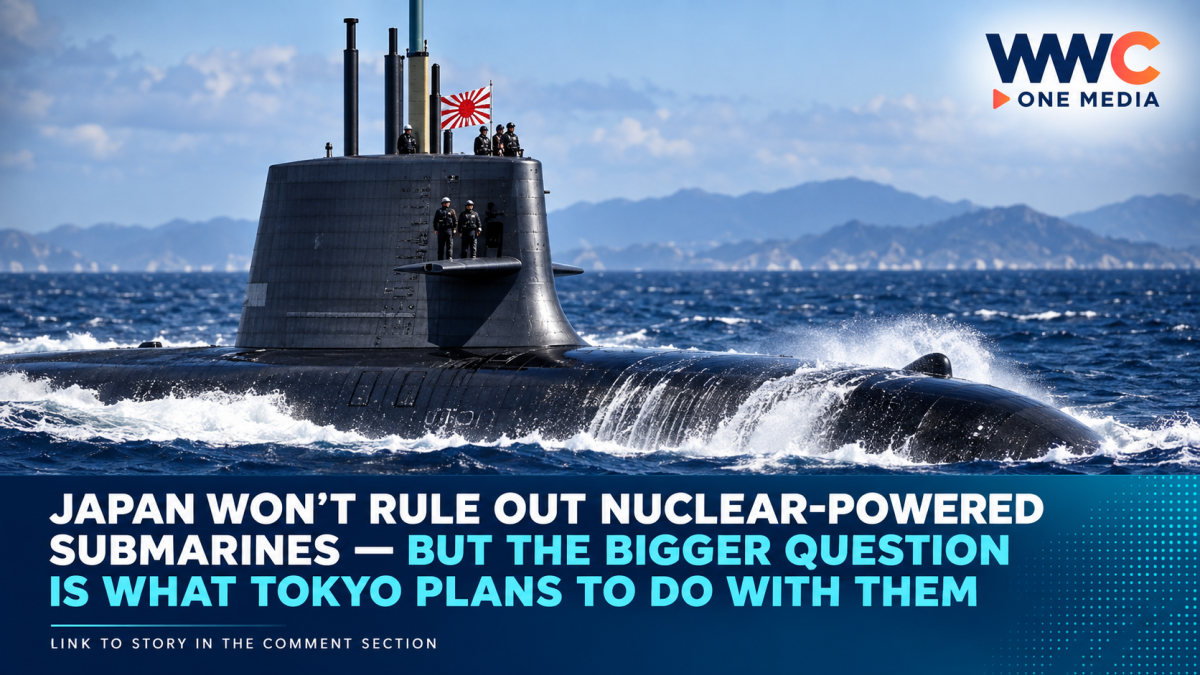
TOKYO — Japan is openly weighing an option that for years sat near the edge of its defense debate: nuclear-powered submarines.
Defense Minister Shinjiro Koizumi confirmed on September 11 that Tokyo will consider the vessels as part of a sweeping review of Japan’s national security strategy, saying the government will proceed without excluding nuclear-powered submarines as an option.
But Koizumi also issued an important qualification: Japan has made no decision to acquire them.
His remarks nevertheless mark another sign of how rapidly Japan’s defense posture is evolving as China expands its naval reach, North Korea develops increasingly sophisticated weapons and neighboring South Korea pushes forward with its own nuclear-powered submarine program.
The debate gained additional momentum after a U.S. Navy official reportedly expressed support for Japan considering nuclear propulsion, pointing to the country’s established civilian nuclear technology and industrial expertise.
What Koizumi Actually Said
During his regular news conference, Koizumi was asked about reports that a U.S. Navy official had reacted favorably to the possibility of Japan acquiring nuclear-powered submarines.
Koizumi declined to comment directly on the American official’s remarks but said Japan’s government has already committed to examining its future defense requirements without automatically eliminating possible options.
That approach, he said, applies to nuclear-powered submarines as well.
The Defense Ministry’s official transcript makes the government’s position clear: nuclear submarines are under consideration, not approved. Koizumi said officials are not beginning the review with a predetermined conclusion.
That distinction matters because discussion of “nuclear submarines” can easily be confused with nuclear weapons.
A nuclear-powered submarine uses a nuclear reactor for propulsion. That does not automatically mean it carries nuclear weapons. Japan’s current discussion centers primarily on propulsion, endurance, speed and the type of missions its submarines may need to conduct in the future.
Why Nuclear Propulsion Changes the Equation
Japan already possesses one of Asia’s most sophisticated conventional submarine forces, with roughly 23 attack submarines in service. Its newer boats use advanced lithium-ion battery technology rather than nuclear reactors.
But conventional submarines face limits that nuclear propulsion can dramatically reduce.
Koizumi said nuclear-powered submarines can remain submerged and operate for much longer periods while achieving substantially higher sustained speeds than conventionally powered vessels.
Those characteristics become increasingly important if Japan expects its submarines to operate farther from home waters, patrol broad sections of the Pacific or carry long-range weapons.
There are major disadvantages as well.
Koizumi pointed to the enormous cost of nuclear propulsion, larger hull requirements and the specialized personnel needed to operate, maintain and repair nuclear reactors. He also noted that conventional submarines can hold advantages in underwater quietness depending on design and operating conditions.
In other words, Tokyo is not simply deciding whether nuclear technology is more advanced. It must decide whether the missions Japan expects its future submarine fleet to perform justify the cost and complexity.
A U.S. Navy Remark Added Fuel to the Debate
The latest controversy intensified after an unidentified U.S. Navy official spoke with Japanese and South Korean media at a U.S. military facility in Hawaii.
According to Kyodo reporting carried by South Korea’s SBS, the official pointed to Japan’s civilian nuclear infrastructure and technological base while responding positively to discussion of nuclear-powered submarines.
The official’s reported comments did not amount to a formal U.S. government offer or approval of a Japanese program.
But politically, the timing was significant.
Japan is currently preparing revisions to its three central defense documents — the National Security Strategy, National Defense Strategy and Defense Buildup Program — with the new versions expected by the end of 2026.
Those documents could shape Japanese military planning for years.
Japan’s Coalition Is Already Pushing the Issue
Pressure to seriously examine nuclear propulsion is also coming from inside Japan’s governing coalition.
In June, the Japan Innovation Party, or JIP, called for Japan to introduce nuclear-powered submarines as soon as possible.
The party argued that nuclear propulsion would be necessary for submarines expected to travel long distances, remain submerged for extended periods and potentially carry vertical-launch systems for long-range missiles.
The JIP also acknowledged that such a program would require substantially higher spending, specialized personnel, an industrial support structure and possible legislative or regulatory changes.
The Liberal Democratic Party has so far been more cautious, publicly emphasizing the need to study “next-generation propulsion” rather than formally committing Japan to a nuclear submarine fleet.
That wording gives Tokyo considerable room to maneuver.
South Korea Is Already Moving Ahead
Japan is not considering the issue in isolation.
South Korea announced in May that it aims to launch its first nuclear-powered submarine by the mid-2030s, presenting the project as a response to North Korea’s submarine-launched nuclear and missile capabilities.
Reuters reported that Seoul plans to use low-enriched uranium and develop the vessel domestically, while working with Washington and international institutions on fuel and nonproliferation arrangements.
That development has altered the strategic calculation in Tokyo.
Koizumi previously noted that countries around Japan increasingly possess or are pursuing nuclear-powered submarine capabilities. Meanwhile, China is strengthening its already formidable undersea fleet and North Korea continues to prioritize naval nuclear capabilities.
The result is an increasingly competitive underwater environment across Northeast Asia and the wider Western Pacific.
China Is the Strategic Elephant in the Room
China remains one of the strongest arguments cited by supporters of a Japanese nuclear-powered submarine program.
U.S. naval officials have described the People’s Liberation Army Navy as moving toward greater reliance on nuclear-powered submarines. China already operates one of the world’s largest submarine fleets and has been expanding both the technological sophistication and geographic reach of its navy.
For Japan, geography matters.
Much of its defense planning has traditionally focused on waters immediately surrounding the Japanese archipelago. But China’s naval operations increasingly extend deeper into the Pacific, while the defense of Japan’s southwestern islands and the possibility of a crisis involving Taiwan have pushed Japanese planners to think at much greater distances.
That makes speed and underwater endurance increasingly valuable.
It does not, however, automatically make nuclear-powered submarines the best choice.
Japan’s conventional submarines are regarded as highly capable, and nuclear-powered boats would demand an entirely new ecosystem of reactor specialists, maintenance facilities, safety procedures, training systems and political agreements.
The Nuclear Question Is Politically Explosive in Japan
Perhaps the greatest obstacle is not technological.
It is political.
Japan is the only country to have suffered wartime atomic bombings, and nuclear issues remain exceptionally sensitive domestically.
Japan maintains its Three Non-Nuclear Principles of not possessing, not producing and not permitting the introduction of nuclear weapons.
Nuclear propulsion is technically different from nuclear armament, meaning a reactor-powered submarine would not necessarily violate those principles simply because of its propulsion system.
Still, the submarine debate is unfolding at the same time Japan is conducting a wider and politically contentious discussion about nuclear deterrence and its security relationship with the United States.
Koizumi himself has argued that nuclear issues should not be treated as untouchable subjects in national-security discussions, remarks that have drawn criticism from atomic-bomb survivor groups.
That means any future submarine decision would almost certainly become much more than a military procurement debate.
It would test how far Japan is prepared to move away from the defense assumptions that shaped much of its postwar era.
What Happens Next Could Matter More Than Koizumi’s Remark
For now, Japan has not ordered nuclear-powered submarines, selected a design, announced a construction schedule or committed funding for such a fleet.
What Tokyo has done is remove the idea from the list of options officials refuse to discuss.
That alone is significant.
Japan is already expanding defense spending, developing longer-range strike capabilities, strengthening military cooperation with the United States and other partners, and reconsidering assumptions that defined its security policy for decades. AP has described the broader process as a gradual but substantial transformation of Japan’s postwar defense posture.
The nuclear-submarine question therefore carries implications far beyond what type of engine powers Japan’s next generation of undersea warships.
The real question is what kind of navy Tokyo believes it will need in the Pacific over the next 20 or 30 years — and how far Japan is prepared to go to build it.
And with Japan’s revised security documents due before the end of the year, that answer may soon become much clearer.




Leave a Reply