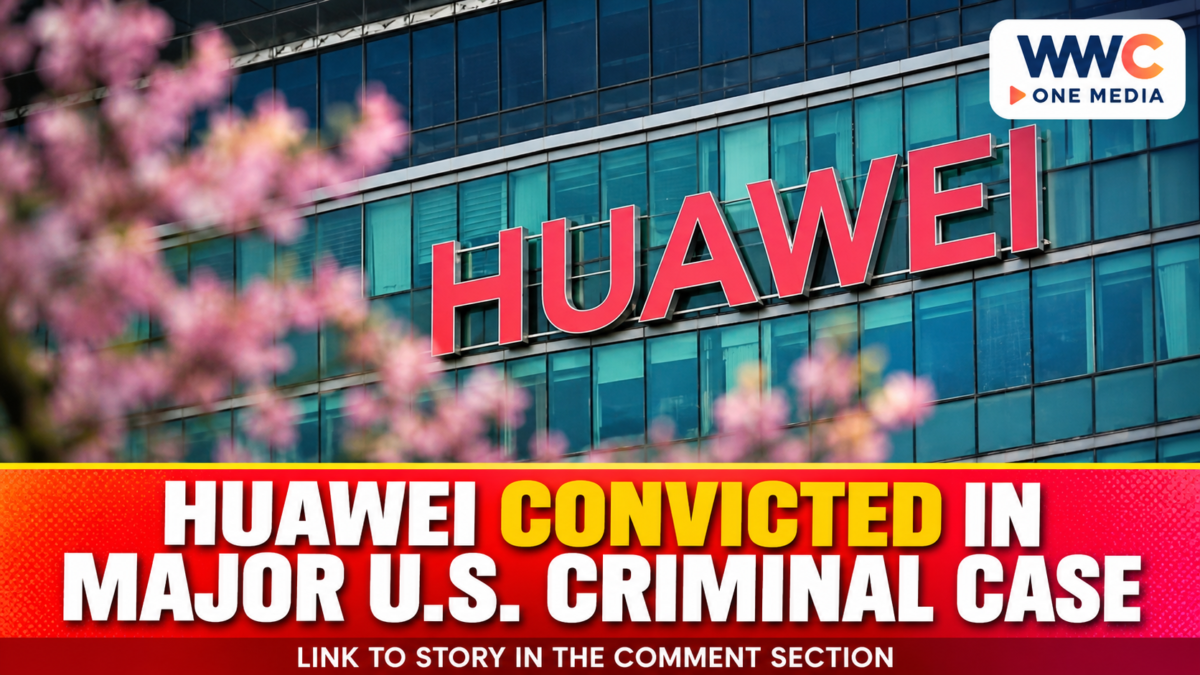
BROOKLYN, New York — November 25, 2026 — Huawei Technologies and three of its subsidiaries have been found guilty in a major U.S. federal criminal case involving business activities connected to Iran, alleged deception of financial institutions, and the theft of confidential technology from American companies.
The verdict, delivered by a federal jury in Brooklyn on November 24, marks a major development in Washington’s long-running legal confrontation with the Chinese telecommunications giant. The case focused on whether Huawei and affiliated companies used deceptive financial practices and improperly obtained intellectual property to expand their international telecommunications business.
The U.S. Department of Justice announced guilty verdicts against Huawei Technologies Co., Ltd., Huawei Device Co. Ltd., Futurewei Technologies Inc. and Huawei Device USA Inc. The department identified convictions involving conspiracy to steal trade secrets, wire fraud, bank fraud, conspiracy to defraud the United States, violations of U.S. sanctions law and money-laundering conspiracy.
However, the outcome was not a conviction on every allegation. Huawei separately confirmed that the jury acquitted it of the government’s racketeering charge, a significant distinction in a prosecution that had sought to establish a broader pattern of corporate criminal activity.
Iran business and banking representations at the centre of the case
A central part of the prosecution concerned Huawei’s business activities in Iran, which the U.S. government said were conducted through an entity called Skycom.
The Justice Department said evidence presented at trial showed that Huawei provided telecommunications-related services in Iran, including infrastructure for internet connectivity and mobile networks. Prosecutors also said Huawei assisted Iranian authorities in monitoring and censoring internet access.
The government further alleged that Huawei provided surveillance cameras that enabled Iranian authorities to monitor protest activity.
The financial allegations focused on how Huawei represented its Iranian operations to banks and other parties. Prosecutors said the company misrepresented Skycom’s relationship with Huawei, the extent of its Iranian business and its compliance with U.S. sanctions.
The distinction between a commercial relationship and corporate ownership was particularly important. The Justice Department said Huawei represented Skycom as a business partner when it was, in fact, a wholly owned subsidiary.
Prosecutors also argued that misleading representations about the Iranian business helped Huawei obtain access to billions of U.S. dollars in credit and loans, as well as U.S.-dollar clearing services.
The jury’s guilty verdicts establish criminal liability on the counts for which the defendants were convicted. They should not be confused with every allegation made during the investigation or with separate claims that were not part of the final findings.
Trade-secret allegations involved T-Mobile, Cisco and other technology companies
The second major part of the prosecution concerned confidential technology and intellectual property belonging to U.S. companies.
The government presented examples involving telecommunications equipment, router software, antenna technology and testing equipment.
One of the most prominent examples involved T-Mobile’s testing robot, known as Tappy. The device was designed to assess smartphone touchscreen responsiveness by simulating human finger movements.
The Justice Department said Huawei obtained access to the robot under a non-disclosure agreement but later used information and technical details from the device to develop its own technology. Prosecutors also presented evidence that an employee removed a component from T-Mobile’s controlled laboratory.
Another example involved Cisco router software. The government said Huawei engineers copied confidential source code used in Cisco products.
The prosecution also described disputes involving CNEX, a U.S. technology company developing solid-state storage technology, and Quintel, an antenna manufacturer. The government said confidential information obtained through business or research relationships was improperly used by Huawei.
These allegations matter because trade secrets are not simply general technical knowledge or publicly available product specifications. They can include confidential source code, engineering designs, testing methods and proprietary commercial information that companies protect to preserve their competitive advantage.
The jury’s conviction on trade-secret-related charges gives the case consequences beyond the sanctions dispute involving Iran. It also places corporate intellectual-property practices and the handling of confidential business information under renewed scrutiny.
Huawei welcomes RICO acquittal and challenges the remaining verdicts
Huawei responded to the verdict in a statement published on November 25.
The company welcomed the jury’s decision to acquit it of the government’s Racketeer Influenced and Corrupt Organizations Act, or RICO, charge. Huawei argued that the result supported its position that the broader allegations were unfounded.
The company also disputed the remaining charges. It said the five trade-secret-related disputes cited by the government were civil matters resolved over the past two decades and argued that no court had found it liable for willful intellectual-property misappropriation.
Huawei said it would review the relevant verdicts and take all necessary legal action to defend its rights and interests.
The company’s position is important to the full account of the case. The prosecution presented evidence that persuaded the jury to convict on several criminal charges, while Huawei continues to dispute the government’s interpretation of its conduct.
The RICO acquittal also means the jury did not accept that particular charge against Huawei. It does not erase the separate guilty verdicts returned on other counts.
The case adds another chapter to the U.S.-China technology dispute
The criminal prosecution is part of a much longer period of U.S. scrutiny of Huawei.
In May 2019, the U.S. Department of Commerce’s Bureau of Industry and Security added Huawei and certain non-U.S. affiliates to the Entity List. The designation imposed licensing requirements on exports, reexports and transfers of items subject to U.S. export-control rules when the listed entities were involved.
That regulatory action was separate from the criminal prosecution. It was based on U.S. national-security and foreign-policy concerns and restricted Huawei’s access to certain American-origin technology and products.
The distinction remains important after the latest verdict. The criminal judgment does not itself replace the Entity List rules, and the 2019 export-control restrictions should not be described as a penalty newly imposed by the jury.
The broader technology competition between Washington and Beijing also extends beyond Huawei. Artificial intelligence, advanced semiconductors, data-centre infrastructure and technology supply chains have become increasingly important areas of policy scrutiny.
WWC ONE MEDIA has examined the wider debate over proposed U.S. disclosure requirements involving Chinese-developed AI models, as well as Washington’s efforts to restrict access to advanced AI chips.
The Huawei case is different from those policy initiatives because it involves criminal convictions following a trial rather than a proposed regulatory framework or a new export-control rule. Nevertheless, all three developments illustrate how technology, national security and international commerce increasingly intersect.
For companies operating across Asia-Pacific, the case is another reminder that international technology partnerships can carry legal and compliance obligations across multiple jurisdictions. Businesses dealing with telecommunications equipment, software, research partners, financial institutions and sensitive technology must consider the laws governing both their commercial relationships and the movement of controlled goods or information.
The continuing U.S.-China trade discussions provide another part of that regional context. WWC has reported on the bilateral trade council’s discussions over tariff arrangements and the wider debate over technology and economic cooperation between Washington and Beijing. Those negotiations do not resolve the separate criminal proceedings against Huawei.
Sentencing set for September 2027
The case is not yet at its final stage.
The Justice Department said sentencing is scheduled for September 14, 2027. The defendants could face criminal fines, forfeiture and restitution.
A federal district court judge will determine the sentences after considering the U.S. Sentencing Guidelines and other statutory factors. The final financial consequences therefore remain undecided.
For Huawei, the immediate challenge is to address the criminal findings while continuing to defend its position on the remaining allegations. For U.S. prosecutors, the verdict represents a significant outcome in a case that has spanned years of investigation and litigation.
The broader implications will depend on the sentencing decision, any subsequent legal challenges and how the verdict affects the company’s commercial relationships and compliance obligations.
For now, the central fact is clear: a U.S. federal jury has convicted Huawei and three subsidiaries on multiple criminal charges involving sanctions, financial fraud and trade secrets, while also acquitting Huawei of the government’s RICO charge. The next major milestone is the September 2027 sentencing.