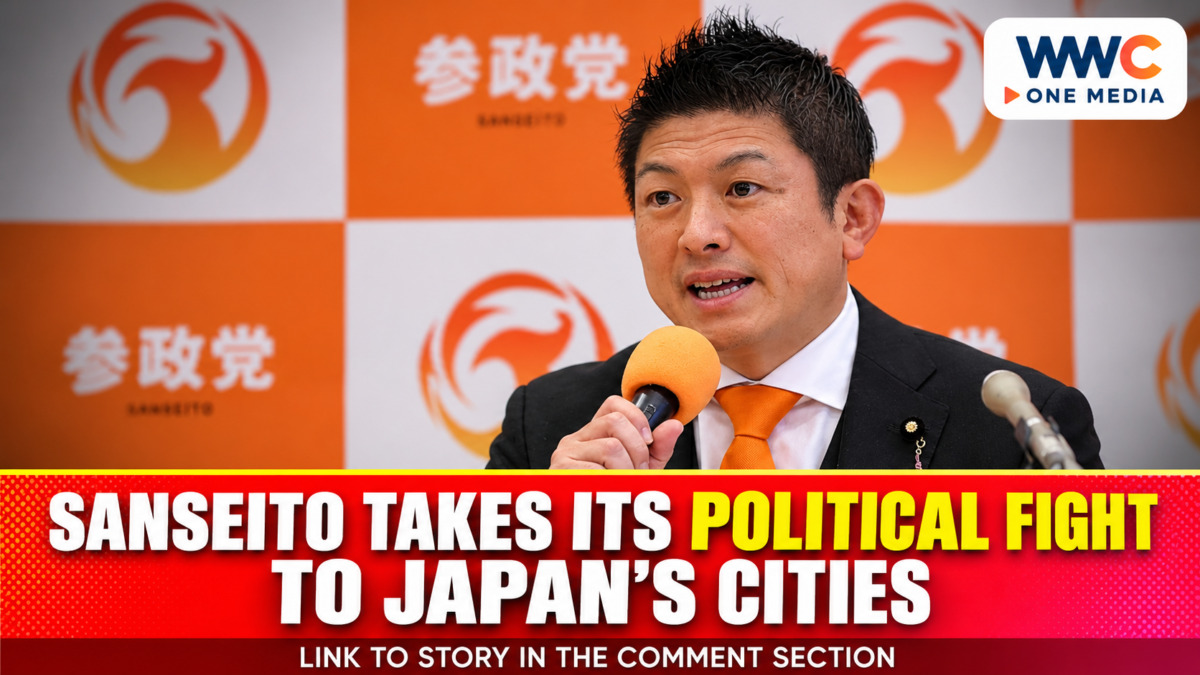
TOKYO, Japan — November 25, 2026 — Japan’s opposition party Sanseito is expanding its campaign beyond national politics, backing candidates in major city and prefectural elections as it prepares to compete more aggressively in the country’s April 2027 unified local elections.
The party’s recent involvement in mayoral contests in Yokohama and Fukuoka, together with its endorsement of a candidate in the upcoming Saga gubernatorial election, points to a deliberate effort to build political influence at the local level.
For Sanseito, the strategy is about more than individual election results. Local campaigns give the party opportunities to develop candidates, strengthen regional organizations and establish a broader presence before the next major round of national and local political contests.
But its recent results also show the challenge ahead: gaining attention and entering competitive races do not automatically translate into winning local executive offices.
Sanseito moves beyond national campaigning
Led by Sohei Kamiya, Sanseito has been increasing its involvement in elections for governors and mayors, alongside its participation in local assembly contests.
The party’s own September 30 political report described a growing ambition to become more active in mayoral and gubernatorial elections. It identified its support for candidates in Okinawa, Yokohama and Fukuoka as part of that direction.
The distinction between endorsing a candidate and formally running a party candidate matters. In the Yokohama and Fukuoka mayoral contests, the candidates backed by Sanseito were listed as independents in the official election results. Their endorsements nevertheless gave the party a visible role in the campaigns.
That approach allows Sanseito to support candidates around agreed policy priorities while building relationships with voters outside its existing membership.
The party’s September 29 endorsement announcement for Fukuoka candidate Yoshitomi Keiko also included a policy agreement covering local economic development, food taxation, education, welfare, disaster preparedness and the management of issues involving foreign residents.
These subjects give the party a route into local debates that are directly connected to residents’ daily lives, rather than relying exclusively on national political messaging.
Yokohama gave Sanseito an early test
Sanseito backed Atsushi Fukuyama in the October 18, 2026, Yokohama mayoral election.
The party later described Fukuyama’s performance as a second-place finish, despite his defeat. The result gave Sanseito an opportunity to test its campaign organization in one of Japan’s largest cities.
The contest was important because Yokohama is a major urban centre with a large electorate and complex policy demands. A campaign there requires more than a recognizable party leader or a strong national message: candidates must also address municipal concerns and reach voters across a wide metropolitan area.
Sanseito’s involvement in the race was therefore a test of whether its political brand could translate into support in a large city election.
The party’s broader expansion also comes as Japanese politics faces renewed debate over local representation and election rules. WWC has previously examined Japan’s debate over voting rights and the rules governing participation in elections.
Fukuoka exposed the limits of the party’s local reach
The November 15 Fukuoka mayoral election provided a more complicated result.
Sanseito endorsed Yoshitomi Keiko, who received 46,156 votes in an election contested by 13 candidates. The official count recorded 592,723 valid votes across the city, placing her share at approximately 7.8%.
More significantly, no candidate reached the legal threshold required to win.
Former Lower House member Shuji Inatomi received the highest total, with 137,667 votes, but that represented approximately 23.2% of valid ballots. The required minimum was one-quarter of the valid vote, or 148,181 votes.
The result meant that finishing first was not enough to secure the mayoralty. A new election is required under Japan’s election law.
This is not a conventional runoff between the two leading candidates. A re-election is a fresh contest in which candidates can file again, and people who did not participate in the first election may also enter if they meet the legal requirements.
The result highlights how a crowded field can divide support among candidates. It also gives Sanseito another opportunity to campaign in Fukuoka, although its endorsed candidate’s first-round vote total shows that the party still has considerable ground to cover if it wants to compete for the city’s top office.
The unusual Fukuoka outcome is part of a wider discussion about the rules governing local elections. WWC previously examined why the leading vote-getter in Fukuoka failed to win the mayoral election.
Saga becomes the next test
Sanseito has also formally endorsed Yukari Yoshida for the Saga gubernatorial election scheduled for December 20, 2026.
The party announced that it had signed a policy agreement with Yoshida covering regional infrastructure, economic development, education, disaster preparedness and other prefectural priorities.
Among the subjects included in the agreement are expansion plans for Kyushu Saga International Airport, completion of the Kyushu Shinkansen’s western route, support for small and medium-sized businesses, and a review of the proposed Saga Prefectural University project.
The agreement also addresses the administration’s handling of foreign-resident data and related public costs.
These are significant local-government issues because a prefectural governor has responsibilities that extend beyond party politics. Decisions involving transport infrastructure, disaster planning, education and economic development can affect regional investment and the delivery of public services.
The Saga contest will therefore offer another opportunity for Sanseito to demonstrate whether its endorsements and campaign networks can influence voters in a prefectural election.
The 2027 local elections are driving the expansion
Sanseito’s longer-term objective is to strengthen its organization ahead of Japan’s unified local elections in April 2027.
In its October 28 political report, the party said its third political academy had graduated 822 participants. It also reported that approximately 300 graduates had applied for its candidate recruitment initiative, with around 100 expected to receive official endorsements at that stage.
The same report listed 117 newly approved prospective candidates, including 104 intended for elections in April 2027.
Those figures are the party’s own reported recruitment and candidate-development numbers. They indicate the scale of its stated preparation, but they should not be interpreted as confirmed election victories or as a measure of public support.
The strategy is significant because local elections provide a route to political influence that does not depend entirely on winning seats in the national Diet. Municipal and prefectural assembly members can build local networks, raise regional issues and establish a political presence between national elections.
For a party seeking to expand its reach, that network can become an important foundation for future campaigns.
A bigger organization does not guarantee local victories
Sanseito’s growing activity comes amid a broader reshaping of Japan’s political landscape, where opposition parties are seeking stronger local organizations and more reliable voter bases.
The party’s recent campaigns show that it is willing to compete in prominent mayoral and gubernatorial contests, rather than limiting its activity to national parliamentary elections or local assembly seats.
However, the results in Yokohama and Fukuoka also underline the difference between visibility and electoral strength. An endorsement can raise a candidate’s profile, but voters ultimately decide whether that support is enough to deliver office.
The party’s next challenge will be to convert its candidate recruitment efforts into sustained local representation, while demonstrating that its policy agreements can attract support beyond its existing base.
Japan’s 2027 unified local elections will provide a much broader test of that ambition. The outcome will help show whether Sanseito can transform its growing campaign activity into a durable presence in local government—or whether its recent mayoral and gubernatorial efforts remain early steps in a much longer political project.