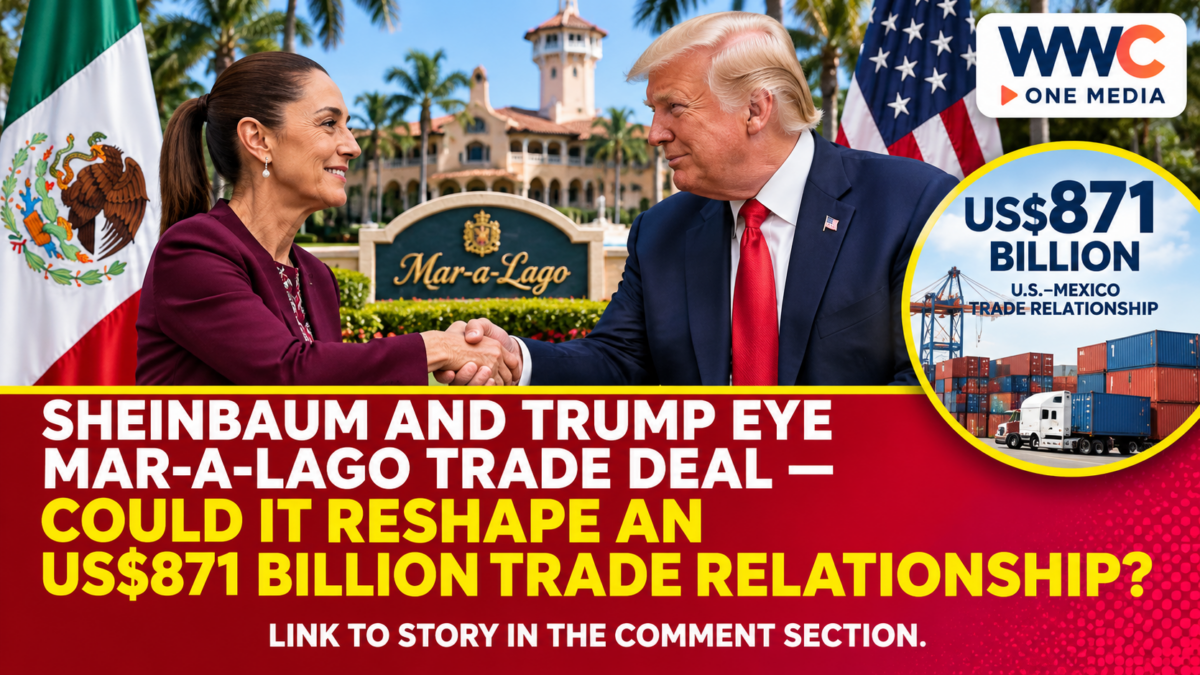
MEXICO CITY, Mexico — The prospect of a new US-Mexico trade deal is drawing attention to the future of North American commerce as Mexican President Claudia Sheinbaum pursues further negotiations with US President Donald Trump.
A potential breakthrough at Mar-a-Lago in Florida could provide greater clarity for businesses navigating uncertainty surrounding tariffs, manufacturing requirements and cross-border supply chains.
The economic stakes are substantial. Merchandise trade between the United States and Mexico reached US$871.6 billion in 2025, illustrating the scale of commercial activity that could be affected by changes to bilateral trade arrangements.
However, diplomatic progress should not be mistaken for a completed agreement.
For manufacturers, agricultural producers, logistics operators and international investors, the decisive developments will be the actual terms of any agreement and the timetable for implementation.
US-Mexico Trade Deal Could Shape an US$871 Billion Market
The United States and Mexico maintain extensive commercial relationships involving manufactured products, agricultural commodities and commercial services.
In 2025, US merchandise imports from Mexico reached US$534.3 billion, while American goods exports to Mexico amounted to US$337.3 billion.
The resulting US goods trade deficit stood at approximately US$197 billion.
Services trade presents a different picture. The United States recorded a US$13.1 billion services trade surplus with Mexico during the same year.
| US-Mexico trade indicator | 2025 value |
|---|---|
| Total merchandise trade | US$871.6 billion |
| US goods exports to Mexico | US$337.3 billion |
| US goods imports from Mexico | US$534.3 billion |
| US goods trade deficit | US$197 billion |
| Total services trade | US$92.5 billion |
| US services trade surplus | US$13.1 billion |
These figures highlight why negotiations involving the two economies carry considerable commercial significance.
The goods trade deficit and services surplus also illustrate why assessing an economic relationship through merchandise figures alone may provide an incomplete picture.
The diplomatic groundwork for further negotiations has been examined in the earlier Trump–Sheinbaum trade meeting planned during APEC in China.
The next challenge will be translating political dialogue into predictable commercial conditions.
USMCA Remains in Force Despite Renewal Setback
The United States-Mexico-Canada Agreement, commonly known as USMCA or T-MEC in Mexico, entered into force on July 1, 2020.
It replaced the North American Free Trade Agreement, which had governed regional trade relations since 1994.
On July 1, 2026, representatives of the United States, Mexico and Canada conducted a joint review of the agreement.
Washington declined to renew USMCA in its existing form, identifying concerns that it intended to address through continued negotiations with its North American partners.
Importantly, the decision did not immediately terminate the agreement.
USMCA remains in force while outstanding matters are addressed or until termination occurs under the applicable provisions.
This distinction is particularly important for exporters assessing their existing eligibility for preferential tariff treatment.
Businesses should not assume that current trade preferences have automatically disappeared because the United States declined to endorse renewal.
Similarly, expectations surrounding a potential bilateral agreement should not be treated as evidence that the existing trilateral framework has already been replaced.
Automotive Manufacturing Faces a Major Commercial Test
Automobile manufacturing is among the industries directly affected by discussions concerning the future of North American trade.
During bilateral negotiations conducted in Washington from June 15 to 17, 2026, American and Mexican representatives discussed regional sourcing requirements for selected industrial products, alongside trade involving automobiles, steel and aluminum.
Further discussions during July addressed these sectors within a wider agenda covering regional manufacturing and economic security.
Rules of origin determine whether products meet the conditions required to qualify for preferential treatment under a trade agreement.
Changes to these rules could influence where manufacturers purchase components, process materials and assemble finished products.
For automotive businesses, such adjustments could require suppliers to review their procurement arrangements, production strategies and compliance procedures.
Companies with extensive international supply networks may face particularly complex decisions if regional content requirements change.
These considerations have also emerged in discussions surrounding Mexico’s auto parts industry and its ability to remain competitive under changing US trade conditions.
Nevertheless, the ongoing negotiations should not be interpreted as confirmation that specific new automotive requirements have already been adopted.
Mexico’s China Relationship Adds Another Dimension
North American trade negotiations also carry implications for manufacturers and suppliers across the Asia-Pacific.
During the July 23 negotiating round in Mexico City, US Trade Representative Jamieson Greer and President Sheinbaum discussed regional manufacturing, supply-chain resilience and concerns involving economic benefits flowing to countries outside USMCA.
Potential changes to regional sourcing rules could affect businesses that rely on components manufactured outside North America.
For Asian manufacturers, the commercial implications would depend on the wording of any revised requirements and how those provisions are implemented.
Companies operating manufacturing facilities in Mexico could face decisions involving supplier selection, investment planning and product qualification.
Mexico’s position between two major economic partners has previously been examined in the country’s increasingly complex trade relationship with China and the United States.
However, the reviewed negotiating records do not establish that Mexico has agreed to end commercial relationships with Chinese companies.
Nor do they establish that all Asian-origin components would become ineligible for use in North American manufacturing.
Such conclusions would require examination of formally adopted product-specific provisions.
Agriculture, Metals and Digital Commerce Are Also at Stake
The bilateral negotiating agenda extends beyond automotive manufacturing.
Discussions during the June and July rounds included agriculture, labour, environmental matters, electronic payment services, steel and aluminum products.
The two governments also supported creating a committee to examine the implementation of USMCA’s sectoral annexes and improve regulatory compatibility.
For agricultural exporters, changes to market-access conditions could influence the commercial viability of cross-border transactions.
For industrial manufacturers, tariff arrangements and sourcing requirements could affect production expenses and pricing strategies.
Businesses providing electronic payment services may also have an interest in regulatory developments affecting cross-border operations.
The breadth of these discussions demonstrates why any future trade agreement must be assessed through its individual provisions rather than a single headline announcing diplomatic progress.
Washington’s continuing negotiations have also been explored in the evolving White House approach to Mexico trade discussions.
What Happens Next for US-Mexico Trade?
The immediate commercial question is whether further high-level negotiations produce a clearly defined agreement.
Businesses will need to examine whether any announced arrangement modifies existing tariffs, introduces new sourcing requirements or establishes specific implementation deadlines.
Another important distinction is whether a future agreement addresses selected bilateral trade issues or represents a wider restructuring of North American commercial arrangements involving Canada.
For internationally connected manufacturers, greater regulatory certainty could support investment planning and more predictable supply-chain decisions.
However, an agreement that introduces substantially different compliance requirements could also create adjustment costs.
The economic relationship between Mexico and the United States remains substantial, regardless of the uncertainty surrounding negotiations.
A diplomatic breakthrough could help define its next chapter.
Ultimately, the commercial significance of the proposed US-Mexico trade deal will be determined not by the location of the negotiations, but by the obligations governments accept and the conditions businesses must satisfy.
Frequently Asked Questions
Has a new US-Mexico trade deal been signed?
A completed new bilateral agreement has not been established by the primary records reviewed for this report.
How much trade takes place between the United States and Mexico?
Bilateral merchandise trade reached US$871.6 billion in 2025, while services trade amounted to US$92.5 billion.
Is USMCA still in force?
Yes. The United States declined to renew USMCA in its existing form during the July 2026 joint review, but that decision did not immediately terminate the agreement.
Which industries could be affected by a new trade agreement?
Automotive manufacturing, steel, aluminum, agriculture, electronic payment services and other industries involved in regional trade could be affected, depending on the final provisions.
Could a new US-Mexico trade deal affect Asian manufacturers?
Potentially. Changes to sourcing requirements, tariffs or product eligibility could influence Asian suppliers involved in North American manufacturing networks. The precise consequences would depend on the final agreement.