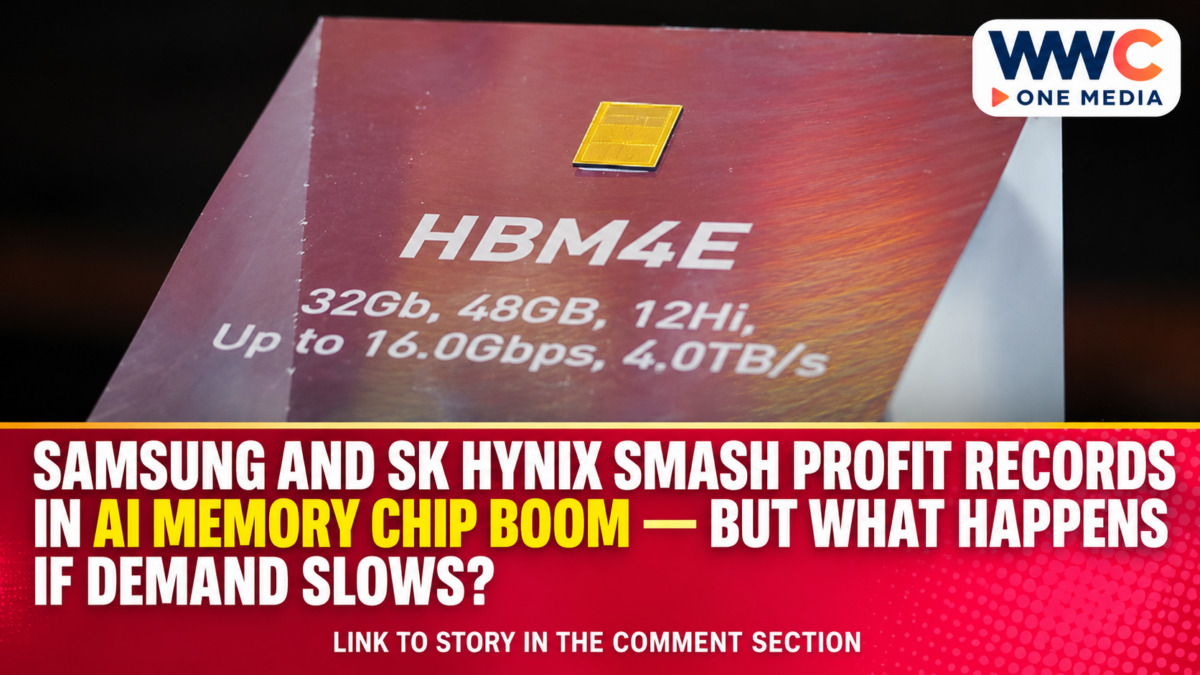
SEOUL, South Korea — Nov. 24, 2026 — Samsung Electronics and SK hynix are enjoying unprecedented financial success as the artificial intelligence memory chip boom transforms the global semiconductor industry. However, the aggressive expansion of computing infrastructure and semiconductor manufacturing capacity raises a critical question about whether today’s elevated memory prices can be sustained.
Both South Korean technology giants reported record-breaking third-quarter results, supported by growing demand for advanced memory products and favourable pricing conditions.
The challenge now is ensuring that future customer demand remains sufficient to absorb expanding semiconductor production.
While the companies remain optimistic about the industry’s growth prospects, a substantial slowdown in artificial intelligence infrastructure spending could expose memory manufacturers to weaker pricing and profitability.
Samsung Electronics and SK hynix Deliver Record Profits
Samsung Electronics announced on Oct. 29 that its consolidated third-quarter revenue reached 195.3 trillion South Korean won (KRW), while operating profit climbed to KRW 107.4 trillion.
Its Device Solutions division generated KRW 147.1 trillion in revenue and KRW 106.5 trillion in operating profit.
Meanwhile, SK hynix announced on Oct. 28 that its third-quarter revenue reached KRW 104.6155 trillion, with operating profit of KRW 83.3338 trillion.
The company reported an operating margin of 80% and net profit of KRW 39.7756 trillion.
The results demonstrate the extraordinary financial opportunities available to semiconductor manufacturers during periods of strong demand and favourable pricing.
However, current earnings should not automatically be interpreted as a permanent benchmark for future profitability.
The distinction between market expectations and sustainable commercial performance is also relevant to Nvidia’s recent share-price recovery and remaining business risks.
Why the AI Memory Chip Boom Depends on Infrastructure Spending
Artificial intelligence requires more than advanced processors. Computing systems also need memory capable of supplying large quantities of data efficiently.
High-bandwidth memory, commonly known as HBM, supports demanding computing workloads by facilitating rapid data transfers between memory and processors.
Dynamic random-access memory, or DRAM, provides temporary working memory, while NAND flash technology supports persistent data storage.
Together, these technologies form essential components of modern computing infrastructure.
The financial scale of the infrastructure expansion is evident in Alphabet’s latest quarterly performance.
The Google parent reported US$51.4 billion in capital expenditure during the third quarter of 2026, with most spending directed towards technical infrastructure supporting its AI investments.
Its full-year capital expenditure guidance remained between US$195 billion and US$205 billion, with a further significant increase anticipated in 2027.
However, Alphabet also reported negative quarterly free cash flow of US$9.1 billion.
This illustrates an important economic consideration: expanding computing capacity requires substantial financial commitments before the full commercial benefits can be realised.
Similar financing considerations are examined in Blackstone’s AI data centre financing and debt exposure.
Could Expanding Semiconductor Production Trigger Lower Prices?
The relationship between supply and demand remains central to the outlook for semiconductor manufacturers.
When demand exceeds available manufacturing capacity, suppliers may gain greater flexibility to negotiate favourable prices. When supply grows faster than customer purchases, that advantage can diminish.
This creates a potential vulnerability for memory manufacturers investing heavily in additional capacity.
Samsung’s third-quarter capital expenditure reached KRW 29 trillion, including KRW 27.2 trillion allocated to its Device Solutions division.
SK hynix is likewise pursuing production expansion, including increasing manufacturing capacity at its M15X facility to support HBM4 output.
These investments could strengthen their competitive positions if demand continues expanding.
But manufacturing investments also create financial exposure when expected customer orders fail to materialise.
A slowdown in data centre construction or equipment procurement could leave suppliers competing more aggressively for available orders.
The timing of infrastructure delivery is therefore important. As examined in Australia’s projected AI data centre investment pipeline, proposed projects must still overcome practical development constraints before becoming operating facilities.
This does not establish that memory prices are collapsing. It identifies a commercial risk that could emerge if future supply and demand become unbalanced.
SK hynix Expects Memory Supply Constraints Through 2030
Despite potential downside risks, SK hynix maintains a favourable long-term industry outlook.
The company expects memory demand to remain ahead of available supply through 2030, reflecting continued AI adoption and the time required to develop advanced manufacturing facilities.
SK hynix has also secured long-term agreements with 14 major customers, covering more than half of its total production capacity for 2027 and 2028.
These arrangements include pricing mechanisms that accommodate changes in market conditions within negotiated limits.
Such contracts can improve planning and provide greater visibility over future sales.
Nevertheless, their existence should not be interpreted as eliminating every commercial risk. Contractual protections depend on their precise terms, while future profitability remains influenced by manufacturing costs, product demand and pricing.
Samsung also intends to pursue multiyear agreements as part of its strategy to establish a more dependable revenue base for advanced memory products.
The Next Challenge: Turning AI Investment Into Sustainable Revenue
The semiconductor industry’s longer-term performance will depend partly on whether businesses can generate sufficient returns from artificial intelligence.
Technology companies must balance computing expenditure against commercial opportunities, operating costs and available financing.
Projects that generate dependable revenue may support continued infrastructure investment. Projects with weaker financial returns could face delays, revised budgets or reduced expansion plans.
These considerations extend beyond South Korea and the United States.
Infrastructure developers throughout the Asia-Pacific region face similar questions about project delivery, financing and customer commitments, as illustrated by Firmus and DayOne’s AI infrastructure funding challenges.
For memory manufacturers, the important distinction is between announced computing ambitions and actual semiconductor purchases.
Continued AI adoption does not necessarily guarantee that every planned data centre will be constructed or that elevated memory prices will remain unchanged.
What Happens Next for Samsung and SK hynix?
Upcoming corporate earnings disclosures and infrastructure spending updates will provide further evidence about the strength of semiconductor demand.
Investors will need to monitor memory selling prices, customer purchasing commitments, manufacturing expansion and the ability of major technology companies to generate cash from AI investments.
Samsung and SK hynix currently benefit from record operating performance and favourable demand conditions.
Their longer-term challenge is maintaining that performance even if the industry enters a less favourable pricing environment.
As of Nov. 24, 2026, a memory price collapse has not been established by the reviewed corporate disclosures. It remains a downside scenario rather than a confirmed outcome.
The defining question for South Korea’s semiconductor giants is not simply how much memory they can manufacture, but whether customers will continue purchasing it at prices capable of sustaining today’s exceptional profitability.