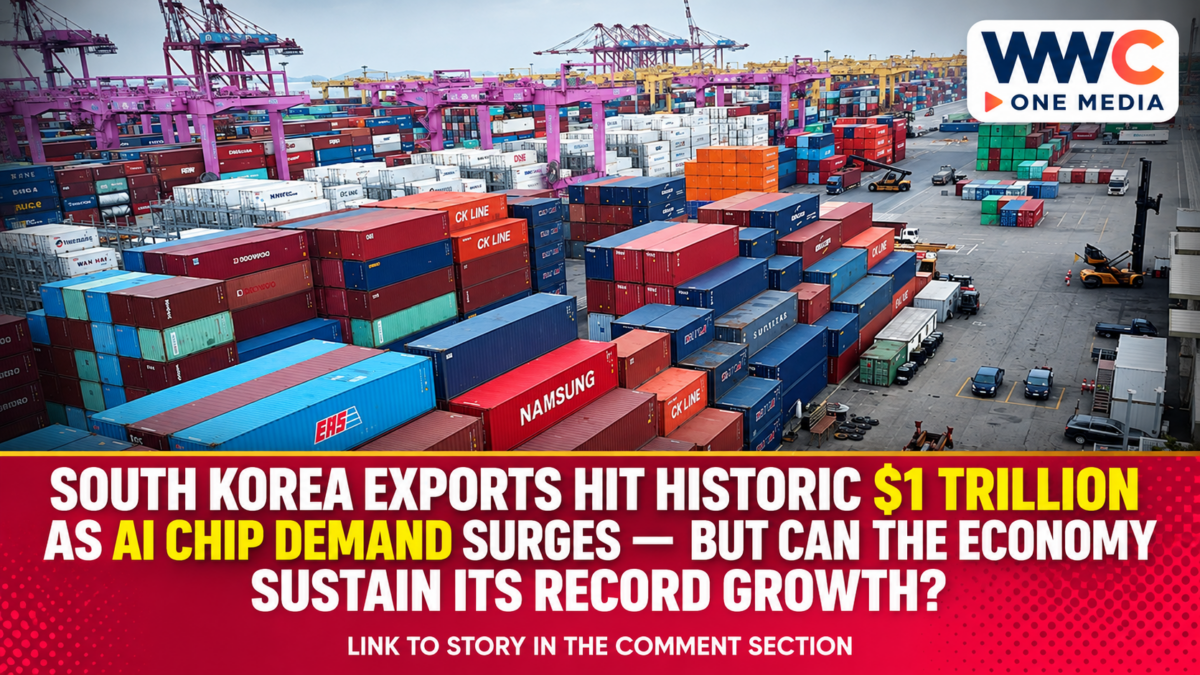
SEOUL, South Korea — South Korea exports reached US$1 trillion for the first time on Nov. 19, 2026, marking a historic achievement for one of Asia-Pacific’s major manufacturing economies as global investment in artificial intelligence accelerates demand for semiconductors.
The milestone was recorded at 2:09:38 p.m. Korean Standard Time, making South Korea the fourth country to achieve US$1 trillion in annual merchandise exports, following Germany, the United States and China.
But behind the extraordinary achievement lies a bigger economic question: Can South Korea transform the AI investment boom into sustainable industrial growth without becoming excessively dependent on the semiconductor market?
South Korea exports reach a historic economic milestone
South Korea’s transformation into a trillion-dollar exporter reflects decades of industrial development, technological advancement and expanding participation in international trade.
The country first achieved US$100 million in annual exports in 1964. Its export value has since expanded approximately 10,000-fold over 62 years.
Annual exports reached US$709.3 billion in 2025 before crossing the trillion-dollar threshold in November 2026, with several weeks remaining in the calendar year.
The achievement demonstrates the commercial importance of advanced manufacturing in an increasingly technology-driven global economy.
However, export revenue should not be confused with corporate profits, government income or gross domestic product. The milestone measures the accumulated value of merchandise exports rather than the amount of wealth retained by businesses or households.
Artificial intelligence is reshaping South Korea’s export economy
The expansion of AI infrastructure has created substantial international demand for memory semiconductors, computing equipment and supporting industrial components.
South Korea’s semiconductor exports reached US$56.44 billion in October 2026, representing a 259.4% increase compared with the same month last year.
Computer exports also climbed 496.6% to US$5.85 billion during October, supported by investment in server infrastructure and demand for solid-state drives.
These figures illustrate how investment in artificial intelligence can generate economic activity far beyond software development.
AI infrastructure requires memory, data storage, networking systems and electricity-distribution equipment. Suppliers participating in these industries stand to benefit when technology companies expand their computing capacity.
The development also reflects a wider regional trend examined in Asia’s AI investment boom and its long-term profitability challenge.
Higher memory-chip prices have supported export values alongside stronger demand. However, that combination creates exposure to future price fluctuations if supply increases faster than consumption.
South Korea’s export boom extends beyond semiconductors
Although technology products have played a leading role in the record-breaking performance, other industries are also contributing.
Exports excluding semiconductors increased by 20% during the first 10 months of 2026.
The country’s expanding export portfolio includes petroleum products, ships, display panels, cosmetics, pharmaceuticals and agricultural and fisheries products.
Electrical equipment has emerged as another area benefiting from AI infrastructure development. October exports reached US$1.99 billion, rising 74% year on year as demand for transformers, wires and cables expanded.
Meanwhile, cosmetics exports reached US$12.4 billion during the January-to-October period, exceeding the previous full-year record of US$11.4 billion.
Small and medium-sized enterprises also contributed to the expansion. Their exports reached a record US$107.6 billion during the first 10 months of 2026, increasing 9.9% from a year earlier.
This broader participation matters because a more diversified manufacturing economy may be better positioned to manage disruptions affecting individual industries.
South Korea is not alone in experiencing technology-driven industrial expansion. The growth examined in Central Taiwan Science Park’s record manufacturing revenue provides further regional context for the changing semiconductor supply chain.
China, the United States and ASEAN remain important markets
South Korea’s trade expansion has reached several major international markets, reflecting the geographical reach of its manufacturing industries.
During the first 10 months of 2026, export growth was recorded across several destinations:
| Export destination | Year-on-year growth |
|---|---|
| China | 88% |
| United States | 77% |
| ASEAN | 69% |
| India | 38% |
| European Union | 23% |
| Japan | 18% |
| Latin America | 10% |
The geographical distribution of export growth suggests that South Korea’s manufacturing expansion is not confined to a single overseas market.
Nevertheless, selling to multiple destinations does not necessarily eliminate exposure to a common economic risk. Technology manufacturers across different markets may ultimately depend on the same global AI investment cycle.
The relationship between technological demand, industrial production and international commerce is also explored in Taiwan’s record-breaking export orders and AI-driven manufacturing expansion.
For Asia-Pacific economies, understanding these connections is increasingly important when assessing the durability of trade growth.
Could semiconductor dependence become South Korea’s biggest vulnerability?
The trillion-dollar milestone does not remove the risks facing South Korea’s export-oriented economy.
The government has identified semiconductor and petroleum-product price volatility, rising trade protectionism and intensifying international competition as continuing challenges.
Semiconductor demand can change as manufacturers adjust production capacity, technology companies revise spending plans and customers manage inventories.
If AI infrastructure investment slows or memory-chip prices decline, semiconductor exporters could face weaker revenue growth even if shipment volumes remain relatively stable.
International technology restrictions add another layer of uncertainty. Businesses operating across national borders must consider regulatory compliance, customer eligibility and changing trade policies.
These challenges form part of the wider debate surrounding US AI chip export controls and overseas computing restrictions.
South Korea’s long-term challenge is therefore not simply maintaining high semiconductor exports. It is ensuring that other industries remain competitive if the technology sector experiences a downturn.
What happens next for South Korea’s economy?
The South Korean government intends to strengthen established manufacturing industries while developing new sources of export growth.
Its priorities include improving industrial competitiveness through artificial intelligence, supporting biotechnology and robotics, and expanding international sales channels for consumer products.
Trade cooperation, industrial diversification and wider participation by smaller businesses will also be important factors in determining whether the export expansion can become more sustainable.
The next phase of South Korea’s economic development will depend partly on how successfully the country converts today’s strong external demand into lasting productive capacity and employment opportunities.
Reaching US$1 trillion in exports is a historic achievement. Maintaining that momentum through changing technology markets, competitive pressures and international trade conditions will be the next major test.