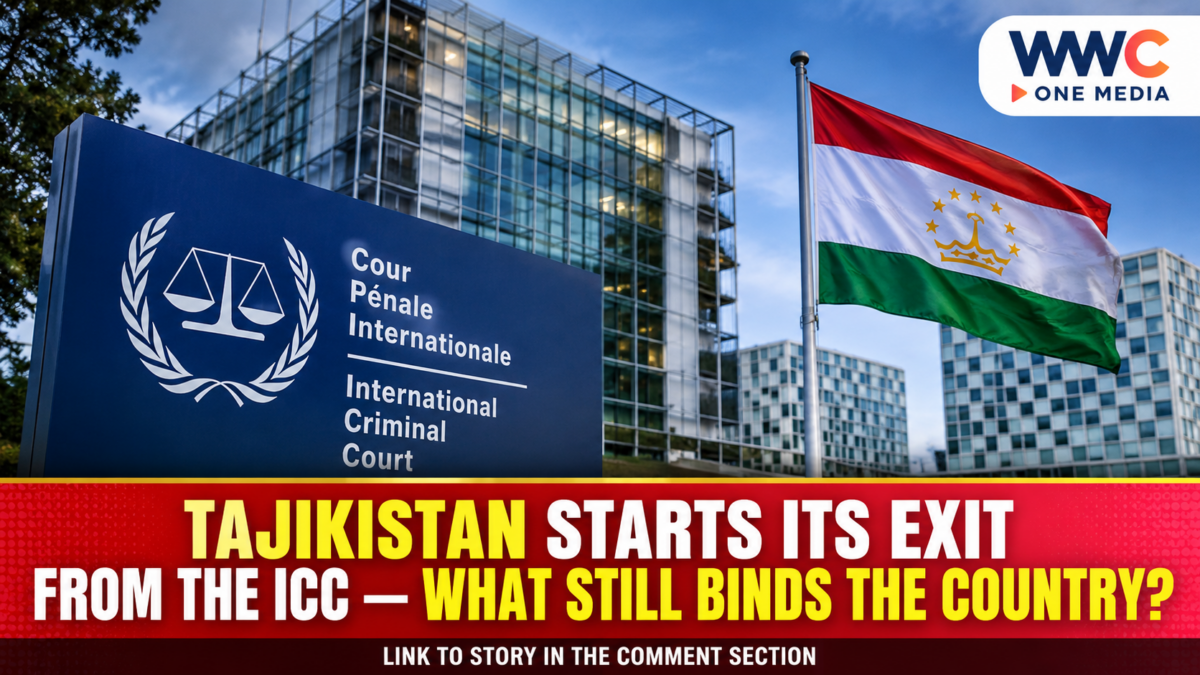
ajikistan has notified the United Nations that it will withdraw from the Rome Statute, with the decision scheduled to take effect on November 20, 2027. The notification was formally recorded on November 20, 2026, the same day Russian President Vladimir Putin visited Dushanbe for talks with Tajik President Emomali Rahmon.
The timing places the decision in a sensitive international context. Putin is subject to an International Criminal Court arrest warrant, and the European Union publicly criticised Tajikistan for hosting him while it remained bound by the Rome Statute. But the public record does not establish that the visit caused the withdrawal decision or that the two events were part of a coordinated arrangement.
The more immediate legal point is that Tajikistan remains a State Party for another year. And even after the withdrawal takes effect, the treaty says certain obligations arising during membership do not simply disappear.
Tajikistan’s ICC withdrawal is not immediate
The UN Secretary-General, acting as depositary of the Rome Statute, issued notification C.N.506.2026.TREATIES-XVIII.10 confirming that Tajikistan’s withdrawal action was effected on November 20, 2026. The document sets November 20, 2027 as the date the withdrawal will take effect.
Tajikistan signed the Rome Statute on November 30, 1998, and deposited its instrument of ratification on May 5, 2000. It has therefore been part of the treaty system for more than two decades.
Article 127 establishes the one-year period between receipt of a withdrawal notification and its effective date, unless a later date is specified. That means the notification does not immediately remove Tajikistan from the Court’s treaty framework.
Until November 20, 2027, Tajikistan remains a State Party. The legal consequences of that status continue to matter during the transition, including the treaty’s general cooperation requirements.
Putin’s visit brought the legal issue into sharper focus
Tajikistan’s government confirmed that Putin arrived in the country on November 20 for a working visit and was welcomed at Dushanbe International Airport by Rahmon. The European Union said the Russian president’s visit took place on November 19 and 20.
The visit drew attention because the ICC issued an arrest warrant for Putin on March 17, 2023. The Court said there were reasonable grounds to believe he bore individual criminal responsibility for the alleged war crimes of unlawful deportation and transfer of children from occupied areas of Ukraine to Russia. These remain allegations in an ICC proceeding, not a criminal conviction.
In a November 22 statement, the EU said Tajikistan had failed to comply with its obligations under the Rome Statute by hosting Putin. That is the EU’s stated legal and political position; the statement is not itself an ICC judicial finding that Tajikistan committed a crime or a formal ruling on state responsibility.
The timing is significant because the UN recorded Tajikistan’s withdrawal notification on November 20, during the same visit. However, no public primary record reviewed for this report establishes that the withdrawal was submitted to facilitate Putin’s visit or to avoid a specific arrest request.
What Article 127 means after the 2027 exit
The withdrawal clause does more than set a departure date. Article 127(2) says a state is not released from obligations arising under the Statute while it was a party. It also says withdrawal does not affect cooperation with the Court in investigations and proceedings for which the state had a duty to cooperate and which began before the withdrawal became effective.
In practical terms, leaving the treaty is not the same as erasing the legal history of membership. The provision is designed to prevent a state’s departure from automatically ending matters already within the Court’s consideration or wiping out obligations that arose while the state was bound by the treaty.
The distinction matters in the Ukraine situation. The ICC Prosecutor opened an investigation into the situation in Ukraine in March 2022, and the arrest warrant for Putin followed in March 2023. Both events occurred before Tajikistan’s scheduled withdrawal date in November 2027.
That does not, by itself, answer every question about a particular cooperation request or how Tajikistan’s authorities would be required to act in a specific circumstance. The Rome Statute sets out procedures for requests, arrest and surrender, while Article 127 preserves qualifying obligations after withdrawal. The details of any specific request would need to be assessed against the treaty and the relevant record.
The ICC’s response and the wider pattern of withdrawals
The Presidency of the Assembly of States Parties to the Rome Statute issued a statement on November 23 expressing concern over Tajikistan’s decision and urging the country to remain part of the treaty system. It also recalled that withdrawal does not relieve a state of obligations arising during the period when it was a party.
The development comes amid several other withdrawal notifications recorded by the UN in 2026, including those from Niger, Burkina Faso, Mali, Venezuela, Chad and Naoero. Tajikistan’s notice adds to a broader debate over the reach and political support for international criminal accountability.
The Philippines offers a relevant comparison for local readers. Its withdrawal from the Rome Statute took effect on March 17, 2019, but the ICC has maintained that withdrawal does not automatically erase its jurisdiction over alleged crimes committed while the country was a State Party. WWC has examined the legal and political consequences of that distinction in its coverage of the Philippines’ continuing dispute over ICC arrest warrants and the legal questions surrounding the Dela Rosa case.
The debate also reaches beyond individual country withdrawals. The ICC’s authority and its ability to operate depend on cooperation by States Parties, a challenge explored in WWC’s report on pressure against the Court and the consequences for international justice.
What happens next
Tajikistan’s withdrawal is scheduled to take effect on November 20, 2027. Until then, it remains a State Party to the Rome Statute. The next year will therefore be important for determining how the country handles its remaining treaty responsibilities and whether it clarifies its position on cooperation with the Court.
The ICC’s Assembly Presidency has publicly urged Tajikistan to reconsider and continue engaging with the institution. No public reversal of the withdrawal notification was identified in the records reviewed as of November 24, 2026.
The key question is not simply whether Tajikistan will leave the treaty. It is how the country will address obligations that continue through the transition and may survive the effective date under Article 127. The withdrawal changes Tajikistan’s future relationship with the Court, but it does not automatically erase the legal consequences of its past membership.
Frequently asked questions
When will Tajikistan leave the International Criminal Court?
Tajikistan’s withdrawal from the Rome Statute is scheduled to take effect on November 20, 2027, one year after the UN recorded the notification.
Why is Tajikistan withdrawing from the ICC?
The UN depositary notification records the withdrawal but does not state the government’s reasons. The motive should not be presented as established without an official explanation.
Was Vladimir Putin in Tajikistan when the withdrawal was notified?
Yes. Tajikistan’s government confirmed Putin’s working visit on November 20, 2026, the same date recorded for the withdrawal action by the UN.
Does withdrawal end all ICC obligations immediately?
No. Article 127 says withdrawal does not release a state from obligations arising while it was a party and preserves certain cooperation duties for investigations and proceedings begun before the withdrawal takes effect.
Can the ICC still consider matters after a country withdraws?
Article 127 says withdrawal does not prejudice the continued consideration of matters already under consideration by the Court before the withdrawal becomes effective. The legal effect in a particular case depends on the relevant proceedings and treaty provisions.