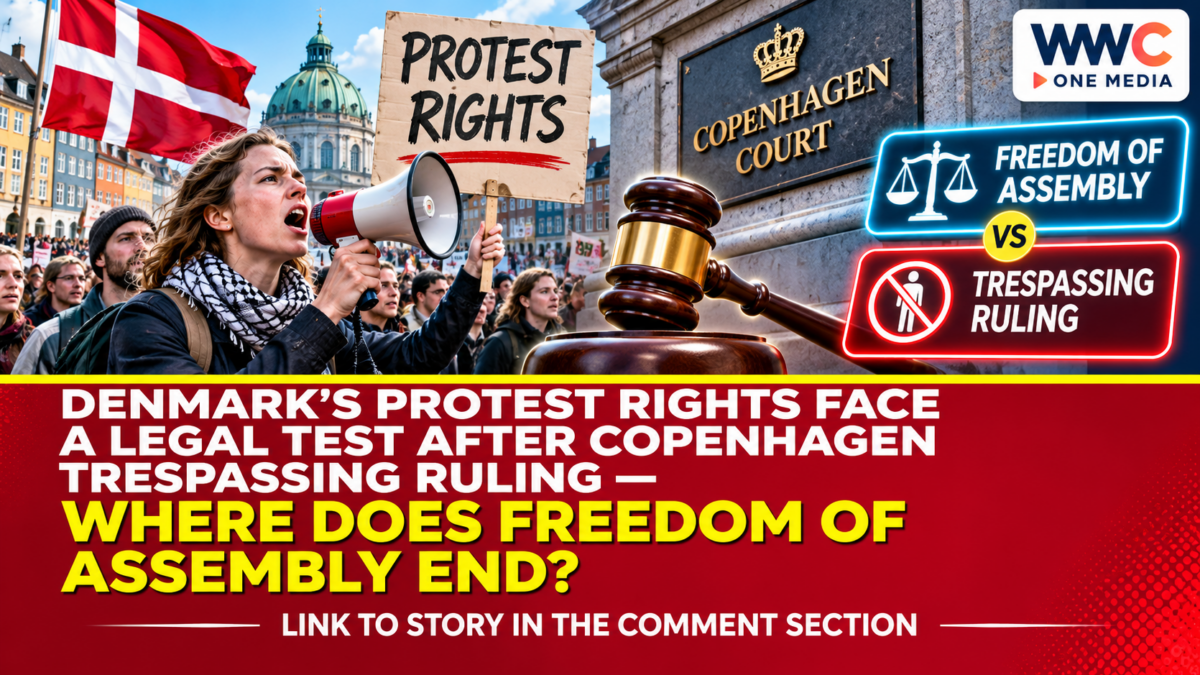
Denmark’s protest rights have come under renewed examination after the Copenhagen City Court imposed fines on six defendants on Nov. 23, 2026, for unlawfully entering University of Copenhagen premises. The judgment also addressed separate incidents involving demonstrations at business premises associated with Maersk.
The decision highlights a fundamental legal question concerning the relationship between political expression and the rights of institutions affected by protest activities.
For universities, businesses and public authorities, the challenge is maintaining legitimate operations without imposing unjustified restrictions on peaceful political participation.
Denmark’s Protest Rights Examined in Copenhagen Judgment
The proceedings concerned demonstrations supporting Palestinian causes, including an action seeking an academic boycott of Israeli universities.
The court examined whether the defendants’ freedom of expression and assembly justified their presence inside university facilities.
It concluded that the university-related conduct constituted unauthorised entry under Section 264 of Denmark’s Criminal Code.
Additional findings concerned conduct at Maersk premises and statements directed towards police personnel.
The court imposed individual financial penalties, with total fines ranging from 1,200 to 7,250 Danish kroner.
Two defendants also received partial acquittals concerning one of the incidents.
These different outcomes are significant because they demonstrate that the court did not treat participation in a demonstration as sufficient, by itself, to establish criminal liability for every alleged offence.
Individual conduct and the circumstances surrounding each allegation remained relevant to the judgment.
Why Access to Property Became a Central Legal Issue
The distinction between entering publicly accessible spaces and occupying premises with restricted access formed an important part of the proceedings.
An institution may perform functions serving the public while maintaining restrictions on access to particular buildings or operational areas.
A university, for example, could provide public educational services while limiting access to administrative offices and other controlled facilities.
Similarly, a private company may receive visitors without granting unrestricted access to its workplace.
The legal question is therefore not simply whether a demonstration supports a political cause. It also involves whether participants possess lawful authority to enter or remain at the particular location.
The Copenhagen proceedings illustrate why property access and political expression require separate consideration.
From an institutional perspective, access restrictions can serve legitimate operational purposes. From a civil liberties perspective, however, restrictions should not become a means of suppressing lawful criticism.
Both interests require careful evaluation when disputes arise.
Freedom of Assembly Is Protected but Not Unlimited
Section 79 of Denmark’s Constitution recognises the right to assemble without weapons and without obtaining prior permission.
It also provides for police attendance at public gatherings and permits restrictions on outdoor assemblies when threats to public peace are anticipated.
Denmark’s police guidance separately instructs organisers to notify authorities about planned demonstrations and processions.
Advance notification should not automatically be confused with a requirement to obtain political approval for the views expressed during a gathering.
The European Convention on Human Rights provides further protections through its provisions on freedom of expression and peaceful assembly.
However, the convention also permits restrictions that satisfy applicable legal requirements and are necessary to protect legitimate interests, including the rights of other people.
The Copenhagen case therefore concerns the application of these safeguards to particular conduct rather than the removal of the general right to protest.
Why the Ruling Matters to Businesses and Universities
Public demonstrations directed at companies can raise practical concerns involving employee access, workplace safety and business continuity.
For universities, comparable issues may involve teaching activities, administrative services and the accessibility of academic facilities.
The significance of these concerns should nevertheless be evaluated using evidence rather than assumptions about protesters or their political objectives.
A hypothetical demonstration outside a company’s offices may allow participants to communicate their views without preventing employees from working.
A different situation could arise if an action obstructs access to essential facilities.
WWC analysis: Institutions should distinguish criticism of their activities from conduct that interferes with legitimate operations. A proportionate response to the latter does not require dismissing or suppressing the former.
This distinction also matters to companies facing public criticism concerning environmental policies, investment decisions or international commercial relationships.
For Philippine readers, WWC’s earlier coverage of Greta Thunberg and opposition to the Pax Silica initiative provides additional context for understanding the intersection of activism and corporate development.
What Philippine Authorities Can Learn From Denmark
Denmark’s legal framework does not determine how Philippine courts should resolve disputes involving local demonstrations.
Nevertheless, the underlying questions are relevant to both countries.
Authorities managing public assemblies must consider the rights of participants alongside legitimate responsibilities involving public safety and access to essential facilities.
These competing considerations have also featured in WWC’s examination of the Cebu rally confrontation and competing accounts of police conduct.
Maintaining reliable records of police instructions, security decisions and the circumstances surrounding individual interventions could support subsequent independent review.
The importance of accountability is further illustrated by the Philippine ASEAN protest review.
Neither support for a political cause nor opposition to that cause should determine whether an individual’s conduct receives fair legal consideration.
What Happens Next?
The Copenhagen judgment establishes the trial court’s findings concerning the incidents examined in the proceedings.
The publicly accessible judicial announcement does not identify whether any defendant has subsequently initiated an appeal.
Any further proceedings would require separate verification before their outcome could be reported.
The wider policy question remains relevant beyond this individual case: how governments can preserve meaningful opportunities for political expression while protecting legitimate institutional and individual rights.
The challenge is to apply legal safeguards consistently, regardless of whether a demonstration’s message is popular, controversial or critical of powerful organisations.
Frequently Asked Questions
What did the Copenhagen City Court decide?
It imposed fines on six defendants for unauthorised access to University of Copenhagen premises. The judgment also addressed separate conduct at Maersk business locations.
How much were the defendants fined?
The individual total fines listed in the court’s announcement ranged from 1,200 to 7,250 Danish kroner.
Does Denmark protect peaceful demonstrations?
Yes. Section 79 of its Constitution protects unarmed assembly, subject to applicable legal restrictions.
Does freedom of assembly automatically permit entry into private premises?
No. Political expression does not automatically establish lawful access to restricted property.
Does the judgment directly affect Philippine protest laws?
No. Philippine demonstrations are governed by domestic law. The Danish proceedings nevertheless offer a comparative example of balancing civil liberties and institutional rights.