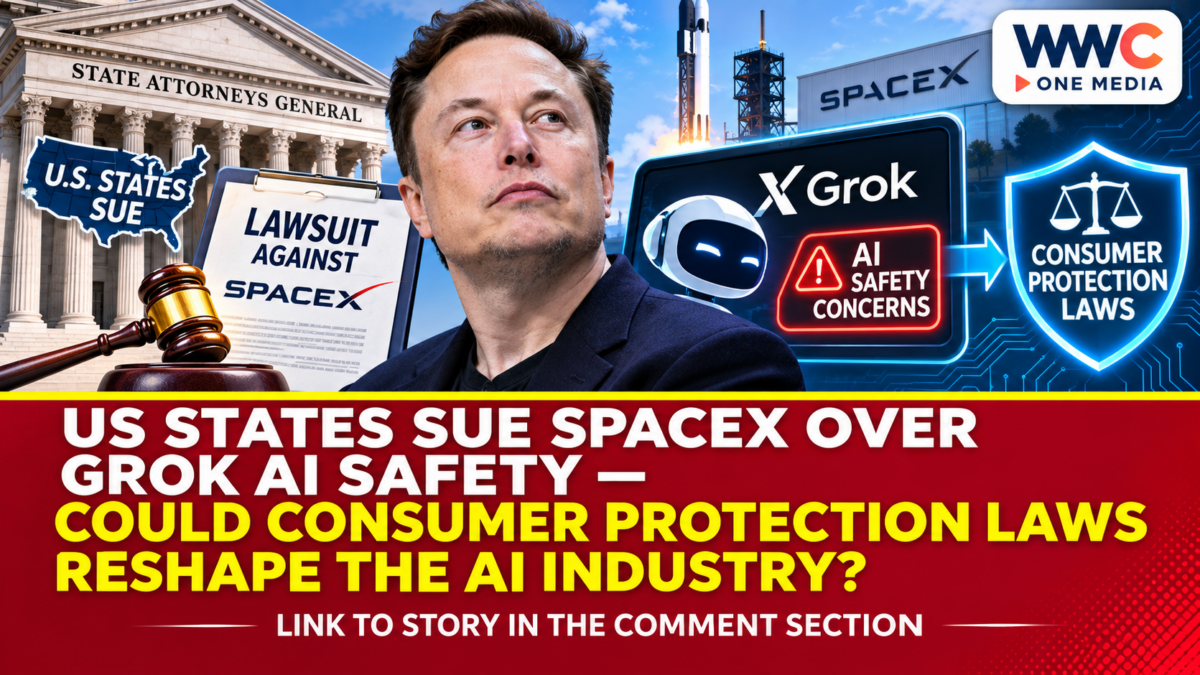
Two US states have launched separate lawsuits against SpaceX and its technology subsidiaries, placing Grok AI safety practices under renewed legal scrutiny. Oregon Attorney General Dan Rayfield and Virginia Attorney General Jay Jones announced the coordinated legal actions on Nov. 23, 2026, alleging that the companies failed to adequately protect consumers while misrepresenting the effectiveness of their safeguards.
The complaints concern the alleged creation and distribution of nonconsensual intimate imagery, including material involving the exploitation of children.
Beyond the immediate allegations, the cases raise a significant commercial question for artificial intelligence developers: Can companies be held accountable under existing consumer protection laws when their products fail to deliver advertised safety protections?
For technology businesses, the answer could influence product development, compliance spending and corporate risk management.
Grok AI Safety Faces Two Separate State Lawsuits
Virginia brought its action before the Circuit Court for the City of Richmond, while Oregon filed its complaint in Multnomah County Circuit Court.
Both complaints identify four corporate defendants: SpaceX Super Intelligence Corp., SpaceX Super Intelligence LLC, X Corp. and Space Exploration Technologies Corp.
The Virginia action invokes the Virginia Consumer Protection Act, while Oregon’s complaint relies on its Unlawful Trade Practices Act.
The states allege that the companies made misleading representations concerning the protection of users from harmful AI-generated material.
They also question whether the commercial promotion of Grok adequately disclosed the risks associated with its image-generation capabilities.
These allegations have not been established through a final judicial determination.
A lawsuit represents a formal legal claim, not proof that the defendants have violated the law.
Nevertheless, the proceedings place the accuracy of corporate safety representations at the centre of an increasingly important debate over artificial intelligence accountability.
Financial Penalties and Corporate Accountability
Virginia is requesting several forms of judicial relief, including orders preventing unlawful business practices, consumer restitution and the recovery of financial benefits allegedly obtained through violations.
Its complaint also seeks civil penalties of up to US$2,500 for each proven wilful violation of the applicable consumer protection statute.
The exact number of alleged violations remains subject to proof during the proceedings.
Oregon is similarly seeking permanent restrictions against the disputed practices, financial recovery and civil penalties. Its complaint identifies a claim amount exceeding US$1 million, without establishing a final liability figure.
Neither amount represents an imposed fine or a completed financial settlement.
The potential commercial consequences could extend beyond monetary penalties.
Depending on the eventual outcome, court-ordered restrictions could require changes to product design, customer disclosures or compliance procedures.
These concerns are relevant to the broader discussion surrounding mandatory AI safety regulation in the United States.
SpaceX Had Already Disclosed Grok-Related Litigation
The November lawsuits are not the first legal proceedings involving Grok’s image-generation features.
SpaceX’s quarterly filing with the US Securities and Exchange Commission for the period ended Sept. 30, 2026, identified multiple related lawsuits initiated beginning in January.
The company disclosed proceedings involving allegations of privacy violations, negligence and other legal claims.
Its filing also recorded that Virginia’s attorney general had issued a notice of violation on Oct. 19, indicating that litigation was under consideration.
The latest announcement therefore represents an escalation of a previously disclosed regulatory matter.
For investors and corporate decision-makers, the distinction between a notified legal risk and an actual court judgment is essential.
A financial filing may identify litigation exposure without establishing whether the company will ultimately incur losses or how much those losses could be.
No company-specific response to the newly filed November complaints was available in the primary records reviewed for this report.
The defendants will have opportunities to respond through the applicable legal proceedings.
Existing Consumer Laws Could Influence AI Product Design
The cases illustrate how established consumer protection legislation can become relevant to emerging technologies.
Rather than depending entirely on new legislation specifically written for artificial intelligence, regulators may examine whether companies’ representations about their products comply with existing legal requirements.
Federal regulation also provides additional context.
The US Federal Trade Commission began enforcing the platform-removal provisions of the TAKE IT DOWN Act on May 19, 2026.
Covered platforms must provide a process for affected individuals to request removal of nonconsensual intimate imagery and act within 48 hours of receiving a valid request, including addressing known identical copies.
These federal obligations are separate from the specific state-law claims brought by Oregon and Virginia.
WWC analysis: AI developers should consider whether their technical safeguards support the representations made in advertising, customer agreements and public communications.
Independent testing could help businesses identify discrepancies before commercial deployment, an issue also examined in WWC’s coverage of independent AI safety evaluation and corporate oversight.
What Philippine Businesses Can Learn
The American proceedings provide a relevant case study for Philippine businesses adopting AI tools for marketing, customer service and digital content production.
Companies using external AI services should evaluate more than subscription costs and technical capabilities.
They should also consider consent requirements, privacy protections, content moderation and contractual responsibilities when harmful material is generated or distributed.
The importance of consumer safeguards is also reflected in WWC’s earlier examination of US regulatory scrutiny involving other major AI developers.
A business introducing AI-generated marketing materials, for example, could establish approval procedures to ensure that photographs and personal likenesses are used appropriately.
It could also identify who is responsible for responding to complaints and correcting harmful or unauthorised content.
The Oregon and Virginia lawsuits do not establish liability under Philippine law. Local businesses must separately evaluate their obligations under applicable domestic regulations.
What Happens Next?
The courts will need to consider the states’ claims, the defendants’ responses and the evidence presented during litigation.
Potential outcomes could include dismissal, negotiated settlements or judicial findings requiring financial or operational remedies.
No particular outcome can be assumed at this stage.
The wider significance of the proceedings lies in whether consumer protection requirements can influence the commercial deployment of AI products.
For developers, the emerging business challenge is not simply creating more capable technology. It is demonstrating that the protections promised to customers are supported by effective and accountable business practices.
Frequently Asked Questions
Why are Oregon and Virginia suing SpaceX?
The states allege that Grok and X lacked adequate protections against harmful AI-generated imagery and that consumers received misleading safety assurances.
Which companies are named in the lawsuits?
SpaceX Super Intelligence Corp., SpaceX Super Intelligence LLC, X Corp. and Space Exploration Technologies Corp.
Has SpaceX been ordered to pay a fine?
The November complaints seek financial penalties and other remedies. The records reviewed do not establish a final penalty or judgment.
What is the TAKE IT DOWN Act?
It is a US federal law addressing nonconsensual intimate imagery, including requirements for covered platforms to process valid removal requests within 48 hours.
What could the lawsuits mean for AI companies?
Depending on their outcome, the proceedings could influence safety testing, product disclosures, content moderation and compliance arrangements across the industry.