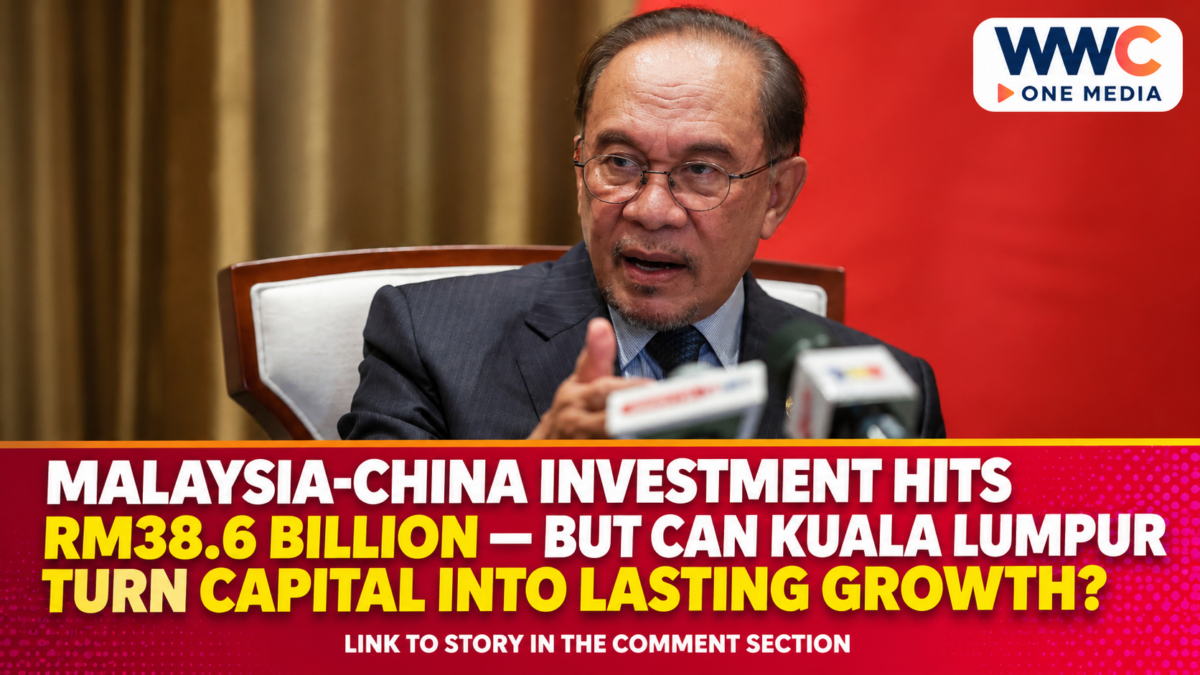
KUALA LUMPUR — Malaysia-China investment reached RM38.6 billion in approved projects during the first nine months of 2026, placing China behind the United States among Malaysia’s leading foreign investment sources. Prime Minister Anwar Ibrahim subsequently used a high-level business dialogue in Shenzhen on Nov. 18 to reinforce Malaysia’s commitment to closer economic cooperation with China.
The combination of rising investment approvals and renewed commercial engagement gives Kuala Lumpur an opportunity to expand its industrial capacity. But the more consequential test is whether those investments produce operating businesses, competitive domestic suppliers and better-paying employment.
Malaysia’s challenge is no longer simply attracting international capital. It is ensuring that foreign investment delivers lasting economic value.
Malaysia-China investment strengthens an expanding portfolio
Figures released by the Malaysian Investment Development Authority (MIDA) on Nov. 17 put nationwide investment approvals at RM350.4 billion between January and September 2026, an increase of 20.7% from the corresponding period in 2025.
China contributed RM38.6 billion in approved foreign investments, narrowly ahead of Singapore’s RM38.5 billion. The United States remained the largest contributor, with RM60 billion.
These figures demonstrate the importance of maintaining investment relationships across competing global economies rather than relying exclusively on a single commercial partner.
The diversification strategy is particularly relevant to businesses navigating changing trade rules and geopolitical uncertainty. WWC’s examination of ASEAN’s shifting supply chains and investment competition explores the wider regional implications of these developments.
For Malaysia, accommodating investors from different markets could help build industrial networks that remain commercially viable even when international political relationships become more complicated.
Shenzhen dialogue puts business implementation in focus
During the Malaysia-China High-Level Trade and Investment Dialogue, Anwar highlighted the importance of cooperation between governments and business leaders.
His remarks addressed investment facilitation, policy stability, employment opportunities and the importance of improving wages through economic development.
The discussion also reinforced Malaysia’s intention to maintain constructive relationships with multiple international partners.
That approach provides important context for understanding why Chinese investment does not necessarily come at the expense of economic engagement with other countries.
Malaysia has also been pursuing wider international partnerships, including industrial and critical-mineral cooperation with France.
From a business perspective, maintaining multiple investment relationships could help Malaysian companies access different technologies, customer networks and financing opportunities.
The benefits, however, will depend on the commercial substance of individual projects rather than diplomatic announcements alone.
Why investment approval is only the beginning
Investment statistics require careful interpretation.
An approved project represents an important administrative and commercial milestone. It does not automatically mean that the investor has already transferred the entire proposed capital amount, completed construction or begun commercial operations.
MIDA’s implementation figures provide a separate way of assessing progress.
Of the manufacturing projects approved between 2021 and September 2026, 87.4% had advanced into production or other implementation stages, including machinery installation and factory construction.
The distinction matters because projects at different stages contribute differently to economic activity.
A factory under construction may create immediate demand for engineering services and building materials. Once operational, it could generate continuing demand for workers, maintenance providers, transportation and components.
Projects that remain at the planning stage may take longer to deliver those benefits.
For policymakers, the quality of an investment pipeline should therefore be assessed alongside the speed and effectiveness of implementation.
Technology investment offers opportunities beyond headline figures
Malaysia’s electrical and electronics industry recorded RM40.8 billion in manufacturing investment approvals during the first nine months of 2026.
The industry’s performance highlights the importance of technology-related investment within Malaysia’s broader economic development strategy.
WWC’s analysis of Malaysia’s economic growth and exposure to artificial intelligence demand provides additional context for evaluating that opportunity.
The potential gains extend beyond individual foreign-owned facilities.
Domestic engineering companies, equipment suppliers and technical service providers could benefit if international investors establish meaningful commercial relationships with Malaysian businesses.
However, foreign investment alone does not guarantee successful technology transfer.
Local companies need the technical capabilities, financing and quality-control systems necessary to compete for supplier contracts. Workforce development must also keep pace with increasingly sophisticated industrial requirements.
These factors could ultimately determine whether Malaysia builds a deeper industrial ecosystem or remains dependent on imported technology and expertise.
What Malaysia’s investment strategy means for the Philippines
Analysis: Malaysia’s investment performance offers a useful benchmark for Philippine economic policymakers.
Rather than competing solely through tax incentives or headline investment commitments, the Philippines could place greater emphasis on reducing implementation delays, developing skilled workers and connecting international investors with domestic suppliers.
Reliable infrastructure and predictable administrative procedures could also help businesses assess the long-term commercial viability of establishing operations in the country.
Malaysia’s investment gains do not necessarily mean that neighbouring economies must lose opportunities.
A more integrated Southeast Asian manufacturing network could allow businesses to distribute production, engineering and logistics activities across several countries.
The Philippine opportunity lies in developing competitive capabilities that make domestic companies valuable participants in those regional networks.
What happens next
MIDA’s latest investment assessment identifies project implementation, domestic supplier participation and higher-value employment as continuing policy priorities.
The next meaningful developments will be project-level disclosures, construction milestones, operating facilities and evidence of actual employment creation.
For Chinese investors, Malaysia’s attractiveness will depend partly on whether its industrial environment continues to support efficient operations and access to international customers.
For Kuala Lumpur, the RM38.6 billion approval figure establishes a substantial starting point. The longer-term economic achievement will be measured by what those projects ultimately produce.
Frequently asked questions
How much Chinese investment did Malaysia approve in 2026?
Malaysia recorded RM38.6 billion in approved investment attributed to China from January through September 2026.
Which country was Malaysia’s largest foreign investment source?
The United States ranked first during the period, followed by China.
Are approved investments the same as money already invested?
No. Investment approvals and actual capital expenditure represent different stages of the investment process.
Why did Malaysia hold investment discussions in Shenzhen?
The Nov. 18 dialogue provided a platform for strengthening commercial cooperation and discussing Malaysia’s investment environment with business representatives.
How could Chinese investment benefit Malaysian businesses?
Successfully implemented projects could generate employment, supplier contracts, skills development and new commercial opportunities. These outcomes depend on individual project execution.