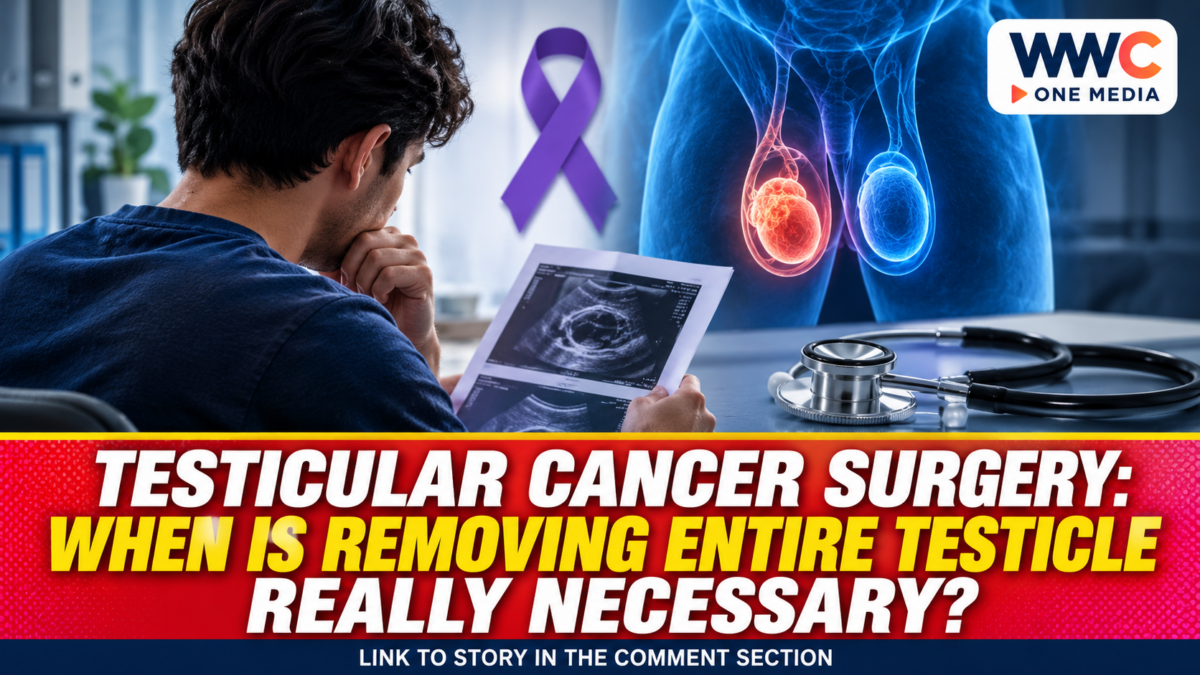
A diagnosis of testicular cancer does not mean every patient will receive exactly the same treatment, but surgery to remove the affected testicle remains the standard initial approach for many men with a suspected cancerous mass. Updated urological guidance also recognises carefully selected situations in which surgeons may preserve some testicular tissue, provided the risks and follow-up requirements are understood.
The distinction matters because treatment decisions involve more than removing a tumour. Doctors must consider the likelihood of cancer, its type and stage, the condition of the other testicle, future hormone production and fertility. Preserving tissue may be important to a patient, but it must not compromise cancer control.
Why testicular cancer surgery often involves orchiectomy
The operation commonly used to remove a testicle is called an inguinal orchiectomy. The procedure removes the affected testicle through an incision in the groin rather than through the scrotum.
The American Urological Association’s guideline, published in 2019 and amended in 2023, recommends radical inguinal orchiectomy for patients with a testicular lesion suspicious for malignancy when the other testicle is normal. It specifically advises against testis-sparing surgery in that situation.
This recommendation is not simply about removing visible abnormal tissue. The operation provides tissue for a definitive pathological diagnosis and helps establish the primary tumour stage. The surgical approach also matters for cancer control, which is why the guideline discourages removing a suspected cancer through a scrotal incision.
Before treatment, the same guideline recommends measuring three blood tumour markers: alpha-fetoprotein (AFP), human chorionic gonadotropin (hCG) and lactate dehydrogenase (LDH). These results help doctors assess the disease and interpret changes after surgery.
A suspected mass should therefore be investigated by qualified medical professionals rather than treated as a confirmed diagnosis based on appearance or symptoms alone.
When testis-sparing surgery may be considered
Removing the entire affected testicle is not the only possible surgical approach in every circumstance. A procedure known as testis-sparing surgery, or partial orchiectomy, removes the suspicious mass while retaining some healthy testicular tissue.
However, this is not a routine substitute for radical orchiectomy in patients with a normal opposite testicle.
The AUA guideline says testis-sparing surgery through an inguinal incision may be offered to highly selected patients with masses smaller than 2 centimetres. The circumstances include:
- An uncertain ultrasound or physical examination finding with negative AFP and hCG tumour markers.
- A congenital, acquired or functionally solitary testicle.
- Tumours occurring in both testicles at the same time.
The aim may be to preserve hormone production and reproductive function where removing the entire testicle could leave the patient with limited remaining testicular tissue.
The European Association of Urology’s testicular cancer guidance also recognises testis-sparing surgery in selected cases, including certain small or indeterminate masses and situations involving a solitary testicle.
But there are important conditions. The AUA recommends counselling patients about the higher risk of local recurrence, the need for physical examinations and ultrasound monitoring, and the possible effects of additional treatment on sperm and testosterone production.
Analysis: The existence of a tissue-preserving operation should not be interpreted as evidence that every patient can safely avoid complete removal. The decision depends on the characteristics of the mass, test results, the condition of the remaining testicle and the ability to maintain close follow-up.
Fertility and testosterone deserve attention before treatment
For some patients, concerns about having children or maintaining normal hormone production can be as important as the operation itself.
The AUA guideline recommends discussing the risks of hypogonadism and infertility before definitive treatment. It also says sperm banking should be offered when appropriate, particularly for men who are undecided about future parenthood or have an absent, abnormal or poorly functioning opposite testicle.
These discussions matter because reproductive effects can arise from the cancer itself as well as from treatment. The guideline notes that some men already have impaired semen parameters when testicular germ cell cancer is diagnosed. Chemotherapy, radiotherapy and certain additional operations can also affect reproductive function.
Removing one testicle does not automatically mean a man will become infertile or require testosterone replacement. The remaining testicle may continue producing hormones and sperm, but individual outcomes vary.
The AUA also recommends discussing the option of a testicular prosthesis before orchiectomy. This gives patients an opportunity to ask about reconstructive choices before surgery rather than discovering the option later.
Patients should raise fertility plans, sperm preservation and hormone concerns directly with their treating urologist or oncology team before treatment begins.
Surgery is not the entire treatment plan
The operation is often an important first step, but the treatment pathway does not end when the affected testicle is removed.
The US National Cancer Institute lists surgery, chemotherapy and radiation therapy among the treatments used for testicular cancer. Some patients may also need surgery involving lymph nodes, depending on the disease and its spread.
The appropriate plan depends on the tumour’s pathology, stage, tumour-marker results and other clinical findings. Testicular germ cell tumours are broadly divided into seminomas and nonseminomas, which have different treatment considerations.
For certain patients whose cancer is clinically confined to the testicle, surveillance after surgery may be an option. Surveillance means scheduled medical follow-up, not ignoring the diagnosis. It can involve examinations, blood tests and imaging to detect signs of recurrence.
Other patients may require additional treatment. The National Cancer Institute’s clinical guidance describes several approaches for different stages, including chemotherapy, radiotherapy, surgery and surveillance.
The important distinction is that treatment is tailored to the disease. A patient should not assume that removal alone will always be sufficient, or that chemotherapy or radiotherapy will automatically be necessary.
What the survival evidence says — and what it does not
Testicular cancer is generally considered highly treatable, particularly when diagnosed at an early stage.
The National Cancer Institute’s professional guidance describes testicular cancer as usually curable. It reports that the cure rate exceeds 90% for seminomas across all stages and approaches 100% for low-stage seminomas and nonseminomas.
Those figures are population-level clinical estimates, not a guarantee for an individual patient. Outcomes depend on factors such as tumour type, stage, response to treatment and the patient’s overall clinical circumstances.
The International Agency for Research on Cancer’s GLOBOCAN 2022 fact sheet recorded 72,040 new testicular cancer cases and 9,068 deaths worldwide in that year. The figures demonstrate that the disease remains a global health issue, even though it is less common than several other cancers.
For readers interested in how cancer care is changing, WWC has examined the development of digital tools designed to help patients organise cancer treatment and medical information. Such platforms may support care coordination, but they do not replace specialist diagnosis or treatment decisions.
Access to specialised treatment also matters. WWC previously reported on a cross-border proton therapy referral pathway for eligible Filipino cancer patients. That treatment is relevant to selected cancers and is not a standard substitute for surgery in testicular cancer.
More broadly, research into personalised cancer treatment illustrates how cancer care can involve different technologies and specialist decisions, depending on the disease.
What happens next
For someone facing a possible testicular cancer diagnosis, the immediate priority is a proper medical assessment. The AUA guideline recommends scrotal ultrasound with Doppler for a suspicious testicular mass and measurement of AFP, hCG and LDH before treatment.
Patients should ask their specialist about the likely diagnosis, the reason for the proposed operation, whether testis-sparing surgery is medically appropriate, and what the pathology results could mean for further treatment.
Fertility preservation, testosterone concerns and the possibility of a prosthesis should also be discussed before surgery when relevant.
The central message is not that every patient can keep the affected testicle. It is that treatment should be based on the individual clinical picture, with cancer control, long-term health and informed patient decisions considered together.
Frequently asked questions
Does every man with testicular cancer need to have a testicle removed?
No single operation applies to every clinical situation. Radical inguinal orchiectomy is the standard approach for many suspected testicular cancers, particularly when the other testicle is normal. Selected patients may be considered for testis-sparing surgery.
What is testis-sparing surgery?
It is an operation that removes a suspicious tumour while retaining some healthy testicular tissue. It is considered only in selected circumstances and requires careful assessment and follow-up.
Can a man have children after one testicle is removed?
Some men retain reproductive function after removal of one testicle, but fertility varies. The AUA recommends discussing fertility risks and sperm banking before treatment when appropriate.
Does removing one testicle affect testosterone?
The remaining testicle may continue producing testosterone, but hormone outcomes differ between individuals. Patients should discuss the possibility of low testosterone and follow-up testing with their medical team.
Is chemotherapy always required after testicular cancer surgery?
No. Further treatment depends on the tumour type, stage, pathology and other clinical findings. Some patients may undergo surveillance, while others may need chemotherapy, radiotherapy or additional surgery.