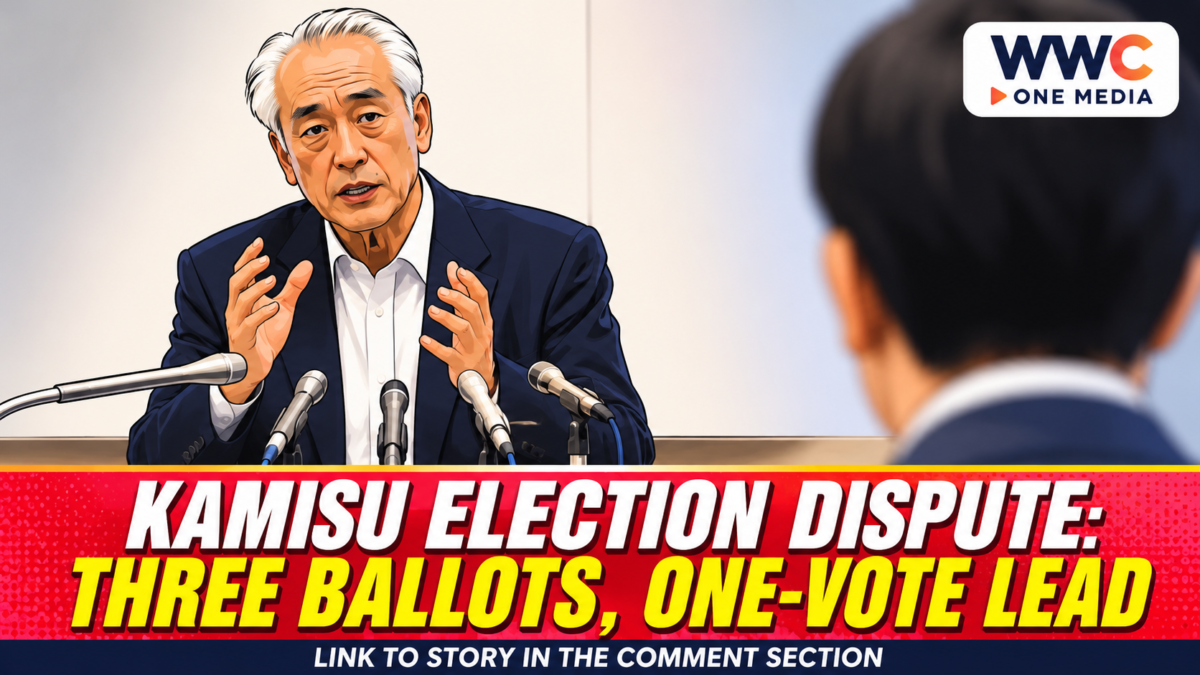
KAMISU, Ibaraki — November 24, 2026. A mayoral election in Japan’s Kamisu city that ended in a perfect tie has produced a different result after election authorities reviewed disputed ballots and invalidated three votes. The Ibaraki Prefectural Election Commission ruled on April 28 that the original winner, Toshiyuki Kiuchi, had not been validly elected, and the Tokyo High Court rejected his challenge on September 3.
The dispute illustrates how election rules can become decisive when candidates finish level. Two ballots contained descriptions associated with Kiuchi rather than his name, while a third ballot counted for his rival, Susumu Ishida, was also invalidated. After those changes, Ishida led by one vote. The case remains a reminder that the meaning of a ballot must be assessed under election law, not simply inferred from a candidate’s local reputation.
A Tie Put the Kamisu Election in an Unusual Position
Kamisu’s mayoral election took place on November 9, 2025. The city’s official count gave both candidates exactly 16,724 votes: Kiuchi, an independent newcomer, and Ishida, the incumbent. With the totals tied, the election administrator used a lottery to determine the initial winner, as provided under Japan’s Public Offices Election Act. Kiuchi was declared elected. 茨城県神栖市+1
The result was challenged by voters, and Ishida joined a later prefectural review. The city election commission initially rejected the objections after conducting its own ballot re-examination on November 26, 2025. That review left both candidates on 16,724 votes, with 219 invalid ballots. 茨城県神栖市+1
The dispute then moved to the Ibaraki Prefectural Election Commission. Its review mattered because the original margin was not merely narrow; it was zero. Any valid change to either candidate’s total could alter who finished ahead.
Why Two Nickname Ballots Were Rejected
The prefectural commission examined all ballots and selected 231 for closer review. The group included 114 ballots originally counted for Kiuchi, 114 for Ishida and three originally treated as invalid. Representatives connected with both sides attended the examination as observers. 茨城県
Two of the ballots counted for Kiuchi contained the Japanese expressions “だんごさん” and “まんじゅうや.” These can be rendered approximately as “Mr. Dango” and “manju shop,” referring to types of Japanese sweets and a shop selling them.
Kiuchi’s side argued that the expressions were recognisable local references to him because of his family’s confectionery business and his association with it. The city election commission had also accepted the ballots in its original count, reasoning that the descriptions pointed to Kiuchi rather than Ishida.
The prefectural commission applied a stricter test. It said a name or description other than a candidate’s formal name must be established as a customary designation for that candidate across the relevant election area before it can be accepted as a substitute. The commission concluded that the evidence did not establish that either expression was widely used as Kiuchi’s personal designation throughout Kamisu. It therefore treated both ballots as invalid. 茨城県
That distinction is important. The commission did not need to establish that nobody ever used those expressions for Kiuchi. The issue was whether the terms were sufficiently established as identifying him as a candidate across the city, rather than referring more generally to confectionery or a shop.
The Third Ballot Also Changed the Result
The review did not invalidate only the two ballots associated with Kiuchi. The commission also rejected one ballot originally counted for Ishida because it contained a circle around a printed numeral in the ballot’s margin.
The commission treated that mark as an additional intentional notation rather than part of the candidate’s name. Under the election-law provision it cited, a ballot containing an additional mark of that kind can be invalid if it amounts to prohibited writing beyond the candidate’s name. 茨城県
The resulting calculation was decisive:
| Candidate or ballot category | Original count | After prefectural review |
|---|---|---|
| Toshiyuki Kiuchi | 16,724 | 16,722 |
| Susumu Ishida | 16,724 | 16,723 |
| Invalid ballots | 219 | 222 |
The prefectural commission therefore concluded that Ishida had one more valid vote than Kiuchi. It cancelled the city commission’s decision rejecting the objections and declared Kiuchi’s election invalid. 茨城県
The outcome is not the same as simply transferring the two nickname ballots to Ishida. Those ballots were removed from Kiuchi’s total, but the separate ballot rejected from Ishida’s count also had to be deducted. The final one-vote difference reflects both adjustments.
Tokyo High Court Rejected Kiuchi’s Challenge
Kiuchi challenged the prefectural commission’s decision in the Tokyo High Court on May 27, 2026, seeking its cancellation. Kamisu City’s official election-dispute page records that the court ruled on September 3 and upheld the invalidation of his election. 茨城県神栖市
The prefectural commission’s April decision had also rejected a separate objection to the lottery procedure itself. It found no illegality in the election administrator drawing lots to decide the tie, explaining that the relevant statutory provision did not specify that a candidate or campaign representative had to draw the lot. The decisive issue in the commission’s revised result was the validity of the ballots, not the use of the lottery. 茨城県
For readers following other Japanese local-election developments, the case differs from Fukuoka’s recent mayoral contest, where the leading candidate failed to reach the statutory minimum vote threshold. WWC previously examined why Fukuoka’s top vote-getter could not claim the mayor’s office. In Kamisu, the problem was not a threshold or a crowded field; it was the legal status of individual ballots in a tied election.
The broader question of how election rules define participation also appears in Japan’s national debate over voting rights. WWC has covered the Supreme Court ruling on voting restrictions for people serving prison sentences, a separate case that demonstrates how statutory rules can shape who may vote and how electoral rights are applied.
What Happens Next
As of November 24, Kamisu City’s official page records the September High Court judgment but does not state that the case has become final. It says a further appeal to the Supreme Court is possible and that the city will provide another update once the proceedings are concluded. The public information reviewed for this update does not establish whether Kiuchi filed such an appeal. 茨城県神栖市
The prefectural commission’s April decision explained that a mayor does not lose office until the relevant ruling or decision becomes final. It also said that, if the election result changes definitively, the city must convene an election meeting to determine the corrected winner. 茨城県
For now, the important distinction is between a High Court ruling and a final resolution of the election dispute. The ruling has upheld the decision invalidating Kiuchi’s election, but the city’s own public notice has not confirmed finality.
The case also offers a practical lesson for voters: when writing a ballot, using a candidate’s official name is the clearest way to avoid uncertainty. A familiar nickname may make sense in a neighbourhood or among supporters, but election authorities must apply a consistent legal standard across the entire voting area.
For comparison, Philippine election administrators also issue detailed guidance on how voters should participate in separate electoral exercises. WWC’s coverage of the Batanes special election and Naga plebiscite explains why voters need to understand the specific ballot and rules attached to each poll.
Frequently Asked Questions
1. Who won the original Kamisu mayoral election?
Toshiyuki Kiuchi and incumbent Susumu Ishida each received 16,724 votes on November 9, 2025. Kiuchi was initially declared the winner after a lottery.
2. Why were two ballots for Kiuchi invalidated?
The ballots used “だんごさん” and “まんじゅうや” instead of his formal name. The prefectural election commission found insufficient evidence that these expressions were widely used as his personal designation throughout Kamisu.
3. Why was one of Ishida’s ballots also rejected?
The prefectural commission found that a circle around a printed numeral in the ballot margin constituted prohibited additional writing and invalidated that ballot.
4. What were the revised vote totals?
The prefectural commission’s revised count was 16,723 votes for Ishida and 16,722 for Kiuchi, with 222 invalid ballots.
5. Is the Kamisu election dispute over?
The Tokyo High Court rejected Kiuchi’s challenge on September 3, 2026. However, Kamisu City’s official page has not confirmed that the matter is final as of November 24, and it notes that an appeal to the Supreme Court is possible.