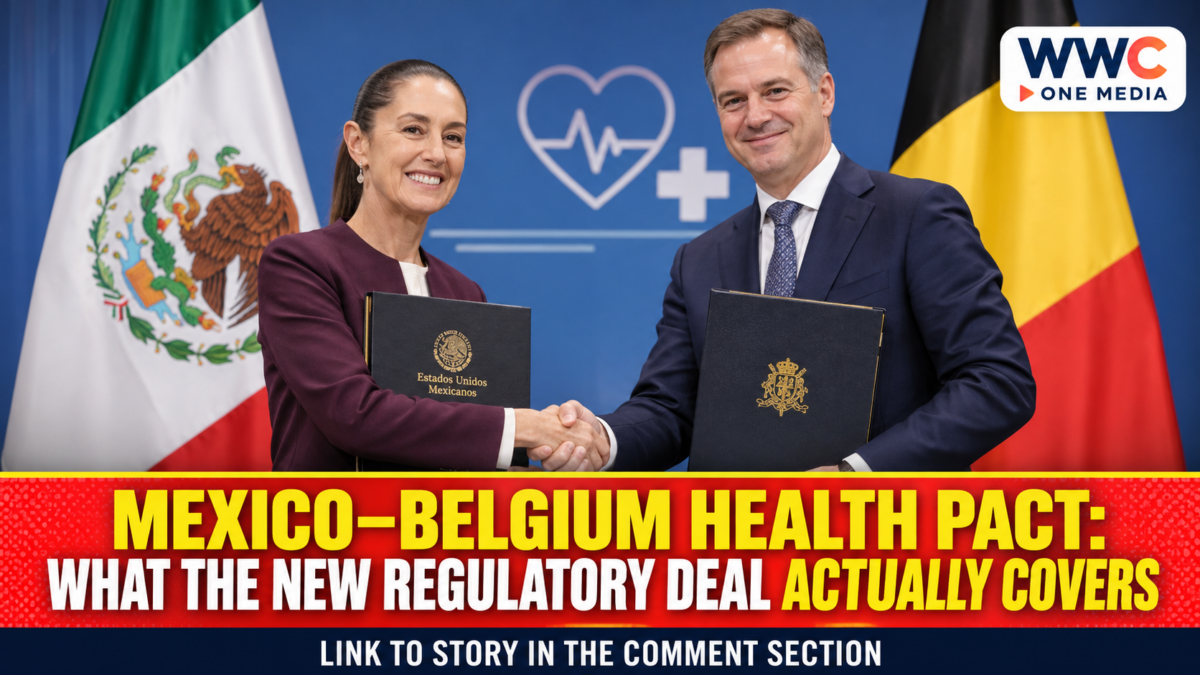
Mexico and Belgium signed a health cooperation memorandum on November 19, 2026, establishing a framework for closer work between their medicines regulators. The agreement covers technical information exchange and cooperation involving medicines, vaccines and medical devices, including safety monitoring, inspections, laboratory analysis and training.
The memorandum brings Mexico’s Federal Commission for the Protection against Sanitary Risks (COFEPRIS) and Belgium’s Federal Agency for Medicines and Health Products (FAMHP), also known by its French and Dutch acronyms AFMPS and FAGG, into a more structured bilateral relationship. Its significance lies in the regulatory work the agencies can pursue together, particularly as pharmaceutical supply chains and medical-product oversight increasingly cross national borders.
But the announcement should not be mistaken for the creation of a shared medicines approval system. The public statement describes cooperation and information exchange; it does not establish that a medicine approved in one country will automatically receive approval in the other.
What the health pact puts on the table
The memorandum was signed remotely by COFEPRIS Federal Commissioner Víctor Hugo Borja Aburto and FAMHP Administrator-General Hugues Malonne, according to the Mexican government’s joint announcement.
The stated areas of cooperation include technical, scientific and regulatory information concerning medicines, vaccines and medical devices. The agencies are also expected to work on pharmacovigilance, which concerns the monitoring of medicine safety, and technovigilance, which concerns the monitoring of medical devices.
Other areas identified in the announcement include evaluation criteria, verification of establishments throughout the supply chain, laboratory analysis and training programmes.
These are practical regulatory functions. A medicine or medical device does not become safe simply because it has passed one stage of review. Manufacturing quality, distribution conditions, product performance and reports of adverse events can all require continuing oversight.
Cooperation between regulators can help them exchange relevant technical knowledge and improve how they identify and assess potential risks. The memorandum provides a framework for that work, although the public announcement does not specify the detailed procedures or implementation timetable.
Why regulators are looking beyond national borders
Medical products often move through international networks involving manufacturers, suppliers, testing facilities, distributors and healthcare providers. A product may be developed in one country, manufactured in another and distributed across several markets.
That makes regulatory information important beyond the country where a product is first assessed.
For example, information about a manufacturing facility, a product-quality concern or a reported safety issue may be relevant to regulators in more than one jurisdiction. Better communication can help authorities understand whether a concern requires further examination in their own markets.
The importance of reliable oversight is also reflected in WWC’s coverage of counterfeit anti-rabies vaccines and weaknesses in pharmaceutical supply-chain controls. That issue is distinct from the Mexico–Belgium agreement, but it illustrates why product verification and effective regulatory monitoring matter to patients and health systems.
The memorandum’s reference to supply-chain establishment verification is therefore significant. It places attention not only on the product itself but also on the facilities and processes involved in getting medical goods to their destinations.
The wider European connection matters
The bilateral agreement comes as Mexico and the European Union are also developing a broader health relationship.
At the first EU–Mexico High-Level Dialogue on Health on October 14, 2026, both sides discussed cooperation on regulatory reliance and convergence with international standards and guidelines. They also announced plans to establish a working arrangement between the European Medicines Agency and COFEPRIS.
The dialogue covered more than regulatory matters. It included non-communicable diseases, pandemic preparedness, research and innovation, digital health and the security of critical-medicine supply chains.
The European Commission’s account also identified active pharmaceutical ingredients and other key inputs as areas where cooperation could help diversify supplies and support pharmaceutical production capacity.
The Mexico–Belgium memorandum should be understood within this broader context, but the two initiatives are not interchangeable. The EU–Mexico dialogue involves the European Union and Mexico, while the November memorandum specifically concerns cooperation between COFEPRIS and Belgium’s FAMHP.
The distinction matters because an arrangement involving one national regulator does not automatically establish obligations for every European regulator or create a common approval route across the European market.
What the agreement does not yet establish
The public announcement identifies the memorandum’s broad areas of cooperation, but it does not publish the complete signed text.
That leaves important implementation questions unanswered. The announcement does not provide a detailed timetable, a dedicated budget, measurable targets or a list of specific products and companies expected to participate.
It also does not say that the two agencies will automatically recognise each other’s marketing authorisations. Regulatory cooperation can involve exchanging information, learning from another authority’s assessments or aligning selected procedures. Those activities are different from granting automatic approval.
For businesses, that distinction is important. Pharmaceutical manufacturers and medical-device companies still need to understand the applicable requirements in each market. A cooperation memorandum does not, by itself, remove domestic regulatory obligations.
For patients, the potential value is more indirect. Better information exchange and more effective monitoring may strengthen the systems that oversee medical products, but the announcement does not promise immediate changes in medicine availability, prices or approval times.
WWC has also examined the broader challenge of medicine access in its report on drug-resistant infections and the gap between national plans and actual testing and treatment capacity. Regulatory cooperation is one part of a functioning health system; laboratory capacity, trained personnel, access to treatment and reliable supply remain important as well.
Why the pharmaceutical industry should pay attention
For the pharmaceutical and medical-device sectors, closer regulator-to-regulator communication can create opportunities for technical dialogue and more consistent understanding of regulatory expectations.
That does not mean the memorandum guarantees new contracts, investment or market access. Those outcomes would depend on subsequent decisions by regulators, manufacturers and other institutions.
The agreement also sits against a wider debate over medicine prices, production capacity and supply security. WWC’s examination of international medicine-pricing pressures and their potential effects across markets explores why pharmaceutical policy in one market can have implications beyond its borders.
In this context, the Mexico–Belgium memorandum is best viewed as a regulatory cooperation framework rather than a commercial agreement. Its practical value will depend on whether the agencies turn broad commitments into regular technical exchanges, useful safety information and workable cooperation procedures.
What happens next
The next step to watch is the publication of more detailed information about how the memorandum will be implemented.
A fuller document or subsequent agency announcements could clarify the responsibilities of each regulator, the frequency of technical exchanges, the handling of confidential information and the specific areas where joint work will begin.
It will also be important to distinguish between cooperation that improves regulatory knowledge and any future arrangement that changes how products are assessed or authorised. Those are separate developments and should be reported separately if they occur.
For now, the public record establishes that Mexico and Belgium have formalised a framework for cooperation in medicines, vaccines and medical devices. It does not yet establish a shared approval system or guarantee faster access to products.
The real test will be whether the agreement produces practical improvements in oversight, information exchange and the reliability of medical-product supply chains.
Frequently asked questions
1. What did Mexico and Belgium sign?
They signed a memorandum of understanding on November 19, 2026, to strengthen cooperation between Mexico’s COFEPRIS and Belgium’s FAMHP in health-product regulation and safety oversight.
2. Which medical products are covered?
The announced areas of cooperation include medicines, vaccines and medical devices.
3. Does the agreement mean Belgian-approved medicines are automatically approved in Mexico?
No such automatic recognition is established in the public announcement. The memorandum describes cooperation and information exchange, not a shared marketing-authorisation system.
4. What regulatory activities are included?
The announced areas include pharmacovigilance, technovigilance, evaluation criteria, supply-chain establishment verification, laboratory analysis and training.
5. Could the agreement affect patients?
It could support stronger regulatory cooperation and product-safety oversight over time. However, the announcement does not promise immediate changes in medicine prices, availability or approval times.