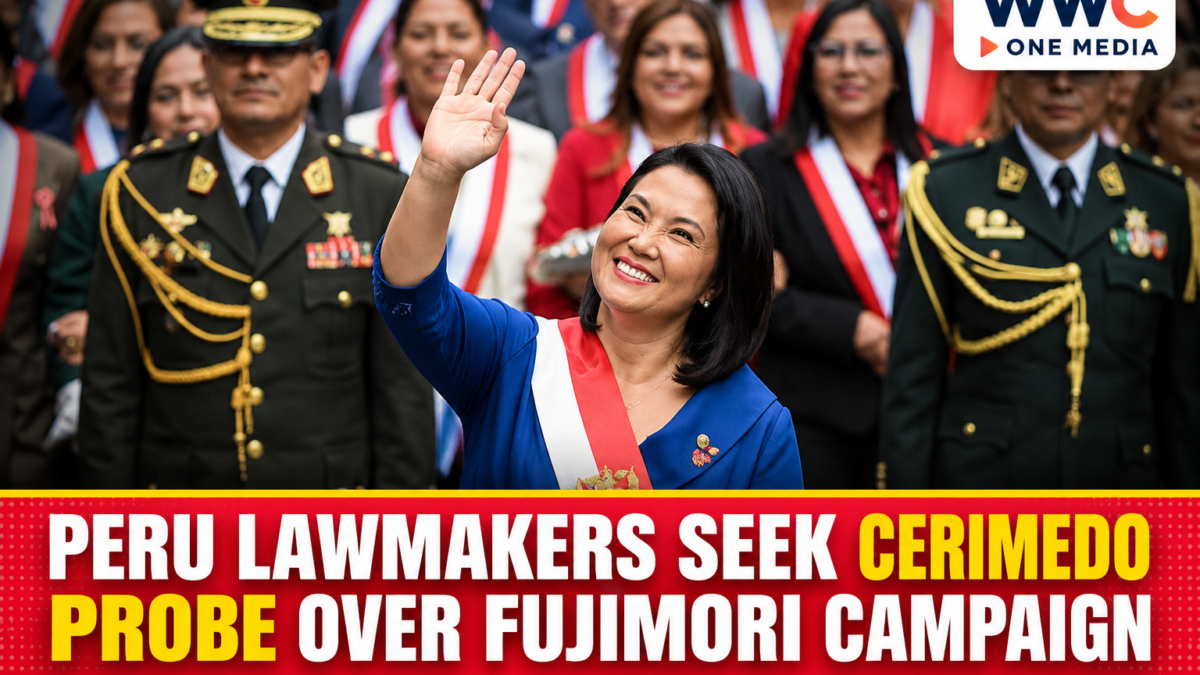
Peru’s Chamber of Deputies has placed a proposal to investigate Argentine political consultant Fernando Gabriel Cerimedo’s alleged links to President Keiko Sofía Fujimori Higuchi’s 2026 election campaign on its parliamentary agenda. The proposal, filed on October 7, seeks a 120-working-day inquiry into the nature and extent of any relationship or involvement, but the official record reviewed does not establish that Cerimedo worked for Fujimori’s campaign.
The distinction matters because Peru’s presidential election was closely contested, and questions about campaign influence carry consequences for public confidence. A parliamentary motion can open the way to scrutiny, but it does not prove that the conduct it describes occurred.
What the Cerimedo probe proposal actually says
Motion 605 was submitted by deputies López Letona and Piñán Mamani of the Partido Cívico Obras parliamentary group.
The motion asks the Chamber of Deputies to establish an investigative commission examining the “naturaleza, alcance y características” — or nature, scope and characteristics — of alleged links, relationships or possible intervention by Cerimedo in Fujimori’s presidential campaign during the 2026 general elections.
The official plenary agenda records October 7 as the filing date. It also says the Junta de Portavoces took note of the proposal on October 20 and included it in the plenary agenda.
The requested investigation period is 120 working days, counted from the day after the commission is installed.
Those procedural details establish that lawmakers formally proposed an inquiry. They do not establish that a commission was ultimately created, that evidence was tested, or that any finding was made against Cerimedo or the president.
The difference between a motion and an approved investigation is important. A proposal requests parliamentary action; the chamber must still take the relevant steps before an investigative body can carry out its work.
The election result was decided by a narrow margin
The political significance of the proposal is easier to understand against the official election result.
Peru’s National Jury of Elections proclaimed Fujimori president-elect on July 3, 2026. Its published result gave the Fuerza Popular presidential ticket 9,223,396 votes, while the Juntos por el Perú ticket led by Roberto Helbert Sánchez Palomino received 9,173,755.
The difference was 49,641 votes.
The JNE later delivered Fujimori her presidential credential on July 15 for the 2026–2031 term.
A close result makes transparency about campaign activity especially important. But the margin does not demonstrate that any particular adviser, digital strategy or outside actor changed the outcome. Establishing such an effect would require evidence that connects specific activity to measurable voter exposure or behaviour.
The official election result confirms who won and by how many votes. It does not identify who designed the campaign’s messaging, managed its online operations or provided outside consulting services.
A separate motion raises broader foreign-interference questions
Motion 605 is not the only proposal in the Chamber’s November 10 agenda concerning election integrity.
Motion 475, submitted on September 29, proposes a broader investigation into alleged foreign interference in the 2026 general elections. Its stated scope includes possible illicit campaign financing, organised dissemination of false information and coordinated manipulation of digital public discussion.
The proposal describes a wide potential field of inquiry, including public officials, political organisations, campaign representatives, advisers, service providers and individuals or companies, whether domestic or foreign.
The two motions should not be treated as interchangeable.
Motion 605 specifically names Cerimedo and asks lawmakers to examine his alleged links or possible intervention in Fujimori’s campaign. Motion 475 addresses a broader set of alleged election-related activities and does not, by itself, prove that Cerimedo participated in any of them.
That distinction is particularly relevant when discussing digital political influence. WWC’s earlier report on Google’s removal of Indonesia-linked YouTube channels examined how evidence of coordinated online activity differs from proof of who financed or directed it. The Indonesian case is separate and provides no evidence about Peru; the broader lesson is that attribution requires specific supporting records.
What the public record does — and does not — establish
The official parliamentary agenda provides a documented basis for reporting that lawmakers sought an investigation. The JNE’s published results provide the certified electoral context.
However, those records do not establish whether Cerimedo was paid by Fuerza Popular, had a formal campaign role, advised individual campaign officials, operated digital networks or influenced voters.
They also do not provide campaign contracts, payment records, advertising invoices, platform data or communications that would independently prove such activity.
The absence of those details in the records reviewed should not be interpreted as proof that no relationship existed. It means the claims require further documentary support before they can be presented as established facts.
For readers following Fujimori’s presidency, the question also sits within a broader political environment. WWC previously examined the administration’s early approval challenges and the pressure surrounding its governing agenda in its coverage of Fujimori’s public approval and political difficulties. That political context does not resolve the allegations in Motion 605, but it helps explain why questions of public trust and accountability matter.
Fujimori’s foreign-policy orientation has also drawn attention as Peru balances relations with Washington and Beijing. WWC’s analysis of Latin America’s political shift and economic ties with China explores that separate policy issue. It should not be confused with evidence about the consultant’s alleged campaign role.
What happens next
The next decisive development would be an official record showing whether the Chamber of Deputies approved Motion 605, rejected it, referred it for further action or otherwise disposed of it.
The Chamber’s November 17 plenary agenda reviewed for this report focused on the institutional budget and did not list Motion 605. That absence does not establish that the proposal was rejected or withdrawn. No final vote or disposition was identified in the official records reviewed as of November 24, 2026.
If an investigation is authorised, its value will depend on the evidence it obtains. Relevant records could include campaign-service agreements, financial disclosures, payments, digital advertising documentation, communications and testimony that can be independently checked.
For now, the responsible conclusion is narrower: Peru lawmakers formally proposed an inquiry into alleged Cerimedo links to Fujimori’s campaign, while the public records reviewed do not establish that he performed a campaign role or affected the election result.
Frequently asked questions
Did Fernando Cerimedo work for Keiko Fujimori’s 2026 campaign?
The parliamentary motion asks lawmakers to investigate alleged links or possible intervention. The official records reviewed for this report do not establish that Cerimedo worked for the campaign.
What is Peru’s Motion 605?
Motion 605 is a proposal by deputies López Letona and Piñán Mamani to create an investigative commission examining the alleged nature and extent of Cerimedo’s links to Fujimori’s 2026 presidential campaign.
Was the Cerimedo investigation approved?
The official agenda records the proposal’s inclusion in the plenary agenda, but no final approval or rejection was established in the records reviewed as of November 24, 2026.
How close was Keiko Fujimori’s 2026 election victory?
The JNE published 9,223,396 votes for Fujimori’s Fuerza Popular ticket and 9,173,755 for Juntos por el Perú, a difference of 49,641 votes.
Does the motion prove election interference?
No. A motion is a request for parliamentary action, not a finding of wrongdoing. Any claim of interference would require supporting evidence and an appropriate official assessment.