
Latin America is moving politically to the right — but its economic relationship with China may prove much harder to change.
That tension is becoming increasingly visible after the 2026 presidential elections in Peru and Colombia, where voters elected leaders expected to pursue closer relations with Washington while inheriting economies deeply connected to Beijing. The Diplomat argues that the region’s latest political shift does not automatically translate into a strategic break with China.
The result is a complicated geopolitical balancing act: governments can move closer to the United States politically while continuing to rely on China for trade, infrastructure, investment and critical commodities.
PERU: A PRO-U.S. PRESIDENT WITH A CHINA-HEAVY ECONOMY
Peru provides perhaps the clearest example.
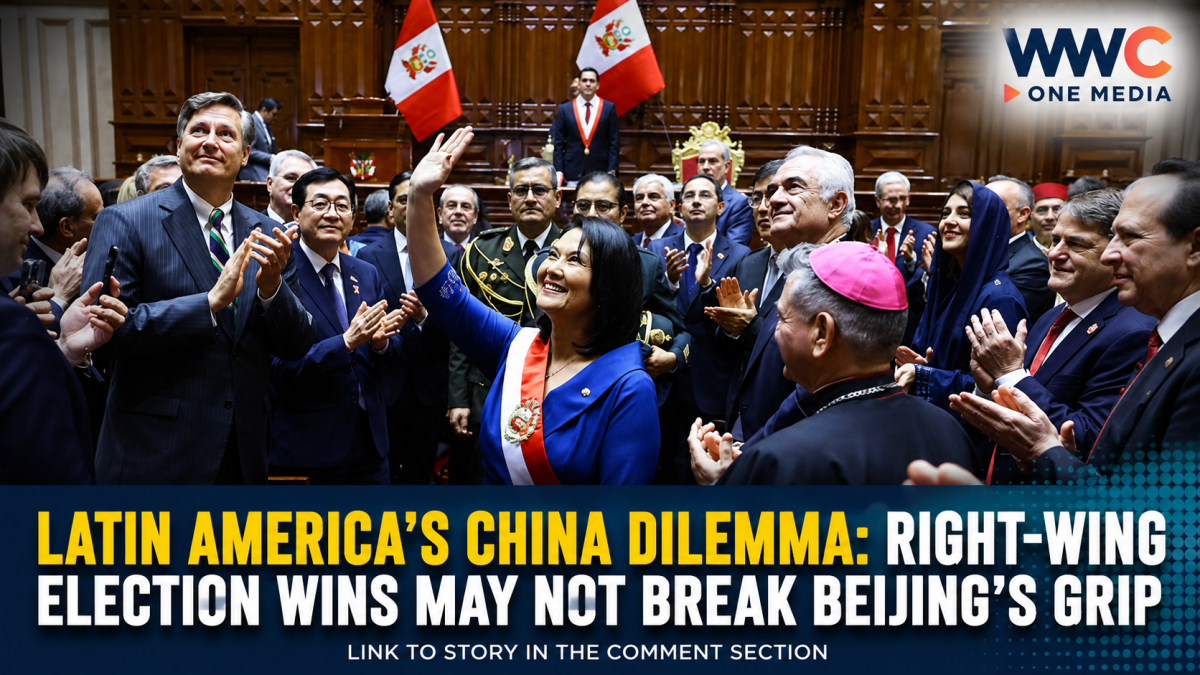
Keiko Fujimori was sworn in as president on July 28, 2026, after narrowly defeating left-wing candidate Roberto Sánchez in the June runoff. Her victory was part of a broader conservative shift across Latin America, and Fujimori has signaled strong interest in expanding cooperation with U.S. President Donald Trump.
But dramatically reducing Peru’s dependence on China would be difficult.
China remains Peru’s largest trading partner, accounting for about 32% of Peru’s exports in 2025. Peru’s exports reached a record $90.08 billion that year, with shipments to China increasing by roughly 30%.
Then there is Chancay Port.
The Chinese shipping giant COSCO is deeply involved in the $1.3-billion megaport on Peru’s Pacific coast, which began operations in late 2024 and created a direct maritime connection between Asia and South America. The port has become one of the most strategically important symbols of China’s economic presence in the region.
That creates a dilemma for Fujimori.
Washington may want Lima to move closer to the United States, particularly on strategic infrastructure and critical minerals. But Peru’s economic interests give its new government strong reasons to maintain working relations with Beijing.
Political alignment with Washington does not necessarily mean economic decoupling from China.
COLOMBIA: ANOTHER RIGHTWARD TURN — BUT BEIJING ISN’T GOING AWAY
Colombia is facing a similar contradiction.
Abelardo de la Espriella was inaugurated president on Aug. 7, 2026, after defeating left-wing candidate Iván Cepeda in a very close runoff. His administration has pledged to rebuild relations with Washington after years of friction between former President Gustavo Petro and the Trump administration.
De la Espriella has also promised a strongly pro-market economic agenda and closer cooperation with the United States, including Colombia’s participation in Trump’s Shield of the Americas initiative.
Yet Beijing has already signaled that it intends to maintain relations with Colombia.
After de la Espriella’s election victory, China’s Foreign Ministry said Beijing was ready to work with the incoming government and viewed China-Colombia relations from a long-term strategic perspective.
That is significant because China’s economic relationship with Colombia is not simply a government-to-government relationship. Chinese companies are increasingly involved in major infrastructure and commercial projects, including the Bogotá Metro, while Chinese trade has become increasingly important across Latin America.
The Diplomat argues that de la Espriella’s proposed approach may therefore be less about cutting China out and more about compartmentalizing politics from economics — strengthening Washington ties while continuing to pursue trade and investment with Beijing.
THE BIGGER BATTLE ISN’T JUST ABOUT POLITICS
The developments in Peru and Colombia fit into a much larger regional trend.
China’s economic footprint in Latin America has expanded enormously over the past two decades. A recent Los Angeles Times/Bloomberg report noted that goods trade between China and Latin America grew from roughly $14 billion in 2000 to more than $500 billion in 2024. China has also overtaken the United States as South America’s largest trading partner.
Beijing’s influence now stretches across mining, energy, infrastructure, ports, electricity, automobiles, technology and consumer markets.
That makes a political pivot much easier than an economic one.
A president can campaign on closer U.S. relations. A government can criticize Beijing. A foreign minister can emphasize democratic alliances.
But when China is buying major quantities of a country’s commodities, financing infrastructure or operating strategically important commercial assets, economic reality becomes a powerful constraint.
WASHINGTON HAS A SIMILAR PROBLEM
The United States is trying to regain influence across its traditional sphere of interest.
Reuters reported ahead of Peru’s election that Washington was making one of its strongest pushes in years to strengthen ties with Lima, particularly because Peru is a major producer of copper and other critical minerals and has become strategically important to China.
But China’s advantage is that it has already spent years building commercial relationships across the region.
The result is an increasingly common Latin American strategy:
Stay close to Washington on security and diplomacy — while keeping Beijing close on trade and investment.
That approach allows governments to avoid choosing one superpower completely.
NOW ALL EYES TURN TO BRAZIL
The next major test could come from Brazil, Latin America’s largest economy.
The Diplomat identifies Brazil’s October 2026 presidential election as potentially crucial to China’s future position in the region. President Luiz Inácio Lula da Silva is seeking reelection, while Senator Flávio Bolsonaro has positioned himself much closer to Trump-aligned forces and has sharply criticized Brazil’s dependence on China.
For Beijing, Brazil matters enormously.
It is a major supplier of agricultural products and minerals to China and one of the most important economies in the Global South.
So the question confronting Beijing is no longer simply whether Latin America will become more conservative.
It is whether a conservative political wave can actually overcome two decades of economic integration with China.
So far, the evidence suggests it won’t be easy.
THE BOTTOM LINE
Peru and Colombia may be moving closer to Washington politically, but their economic maps still point strongly toward Beijing.
And that could be the defining feature of the next phase of U.S.-China competition in Latin America: not countries choosing one side or the other, but governments trying to extract economic benefits from China while securing political and security advantages from the United States.
The real test may come when Washington demands that its Latin American partners choose between the two.
Because when that moment arrives, campaign rhetoric may matter far less than who controls the ports, buys the minerals and finances the infrastructure.
WWC ONE MEDIA G.A




Leave a Reply