
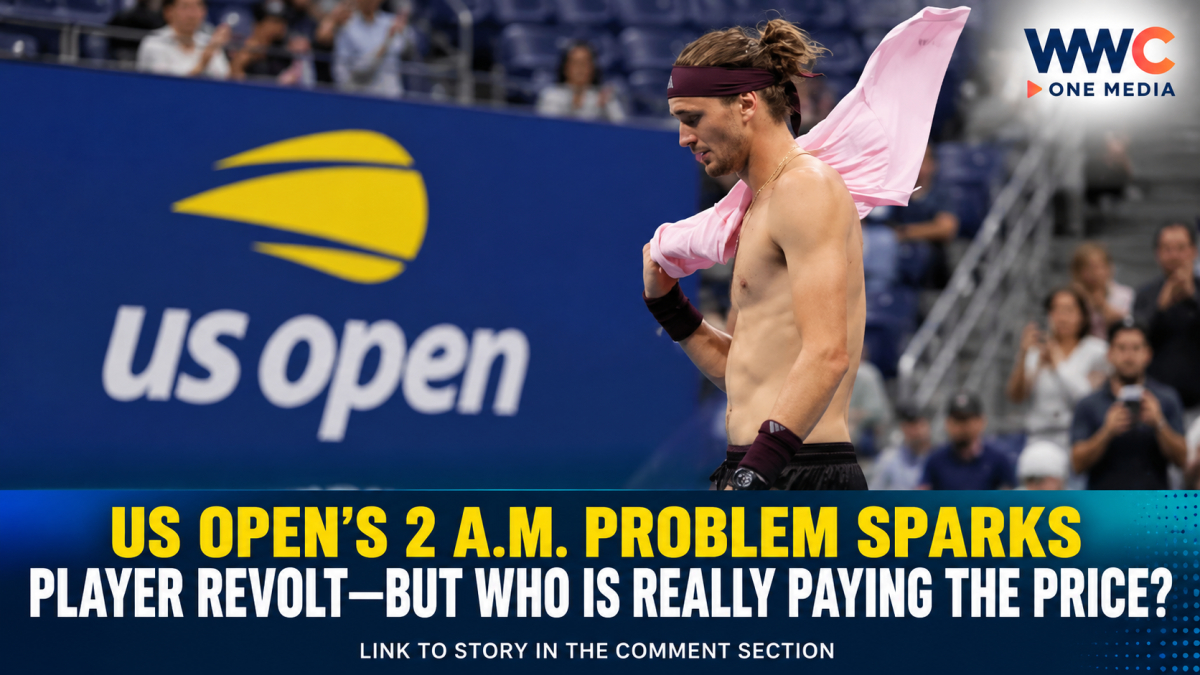
NEW YORK — The U.S. Open is famous for its electric night sessions, packed stands and marathon matches under the lights.
But this year, the tournament’s trademark late-night drama is increasingly becoming a source of frustration—with players, fans and critics questioning whether the spectacle has gone too far.
The 2026 tournament recorded three finishes after 2 a.m. during its first six days, while two other matches also ended after 1 a.m., according to Associated Press coverage. The unusually late schedule has left players exhausted and stadium sections noticeably empty as matches stretch deep into the morning.
Alexander Zverev experienced the problem firsthand. His opening two matches ended at 1:55 a.m. and 2:15 a.m., with the German becoming the first top-seeded man in the Open Era to play back-to-back five-set matches at the start of a major tournament.
After one of those late finishes, Zverev summed up the mood bluntly: players were tired and simply wanted to sleep.
Venus Williams caught in another late-night scheduling controversy
One of the most striking examples came on the tournament’s opening night.
Venus Williams and Sofia Kenin did not begin their first-round match until 12:13 a.m., the latest start for a match in U.S. Open history.
The delay followed Novak Djokovic’s marathon first-round battle against Mariano Navone, which lasted 4 hours and 36 minutes before the scheduled Williams-Kenin match could begin.
Kenin eventually defeated Williams, 6-2, 7-6 (6), with the match ending at approximately 2:01 a.m.
For Williams, who was playing what could potentially be her final Grand Slam singles match, the experience was far from ideal.
She acknowledged the difficulty of trying to produce her best tennis in the early hours of the morning and said there was clearly room for improvement in scheduling.
The scene was equally striking for spectators, with large numbers of empty seats visible by the end of the match.
Players question whether television is coming before recovery
The criticism isn’t coming from just one player.
Jessica Pegula questioned whether it is appropriate for athletes to finish matches at 2 a.m., pointing to the reality that many spectators have already gone home by then.
The issue has also drawn concern from world No. 1 Aryna Sabalenka, who has warned that extremely late finishes can disrupt a player’s entire routine.
When a match ends after 2 a.m., the player’s night is far from over. Post-match media obligations, treatment, food, recovery and travel can push bedtime toward dawn.
BBC Sport reported that players have previously described potentially not getting to sleep until 5 a.m., 6 a.m. or even later after particularly late matches.
Ben Shelton experienced the problem during his second-round match against Denis Shapovalov. His contest ended at 2:07 a.m., and Shelton said it was his first experience playing that late at the US Open.
He estimated that he might not get to sleep until around 5 a.m.
Why does the US Open keep scheduling night matches?
There is a major financial reason.
The US Open’s day-and-night session structure allows organizers to sell the same stadium seats twice in a single day—once for the day session and again for the evening session.
Night-session tickets can also command premium prices, while major evening matches are attractive to television broadcasters and advertisers.
BBC Sport reported that ESPN’s current U.S. Open broadcasting agreement, announced in 2024, is worth approximately $2.04 billion through 2037, underscoring the enormous commercial value attached to the tournament’s television schedule.
That creates a difficult balancing act.
Organizers want high-profile matches during prime television hours. Players, meanwhile, need reasonable recovery periods and predictable schedules.
And tennis has one unique problem: nobody can guarantee how long a match will last.
A five-set men’s match can consume four or five hours. Add a lengthy women’s match, changeovers and breaks, and a match scheduled for the evening can quickly move into the early morning.
That is essentially what happened before the Williams-Kenin match.
Other Grand Slams have taken different approaches
The US Open is not the only Grand Slam to deal with late-night tennis, but other tournaments have adopted different solutions.
Wimbledon has an 11 p.m. curfew, meaning matches cannot continue indefinitely into the early morning.
The French Open, meanwhile, has generally limited its night session to one match, reducing the likelihood of a second contest being pushed deep into the night.
The US Open has historically defended its night-session structure, arguing that the unpredictable length of tennis matches makes scheduling difficult.
But the 2026 tournament is intensifying the debate because of the sheer number of matches finishing after midnight.
Four of the 17 latest finishes in U.S. Open history have now occurred this year, according to AP reporting. The tournament record remains 2:50 a.m., set when Carlos Alcaraz defeated Jannik Sinner in their 2022 quarterfinal.
Is a scheduling overhaul coming?
The pressure comes at a time when tennis players are already demanding a greater say in how the sport’s biggest tournaments are operated.
The broader player-organizer dispute has included concerns over revenue sharing, media obligations, recovery time and working conditions.
According to BBC Sport, the Grand Slams increased player prize money in 2026 and agreed to create a Grand Slam players advisory council, which is expected to give players greater input into major-tournament issues after the US Open.
That could give players a new avenue to push for changes to scheduling.
Possible solutions being discussed include starting evening sessions earlier, reducing the number of matches scheduled at night or establishing a firm cutoff time.
Tennis commentator Christopher Clarey also highlighted the frequency of the late finishes, while former Spanish player Carlos Moyá suggested an alternative approach: starting play earlier and avoiding late-night sessions altogether.
The bigger question: entertainment or athlete welfare?
The US Open’s late-night atmosphere is undeniably part of its identity.
There is something uniquely New York about thousands of fans watching elite tennis beneath the lights long after midnight.
But when the stands begin emptying, players are finishing at 2 a.m. and athletes are facing another match only a day or two later, the question becomes harder to ignore:
How late is too late?
The 2026 US Open has turned that question from an old tennis debate into one of the tournament’s biggest stories.
For fans, late-night tennis can be unforgettable entertainment.
For the players expected to perform at the highest level the following day, however, the price of that entertainment may be measured in lost sleep, disrupted recovery—and potentially, performance.
WWC ONE MEDIA J.M.S




Leave a Reply