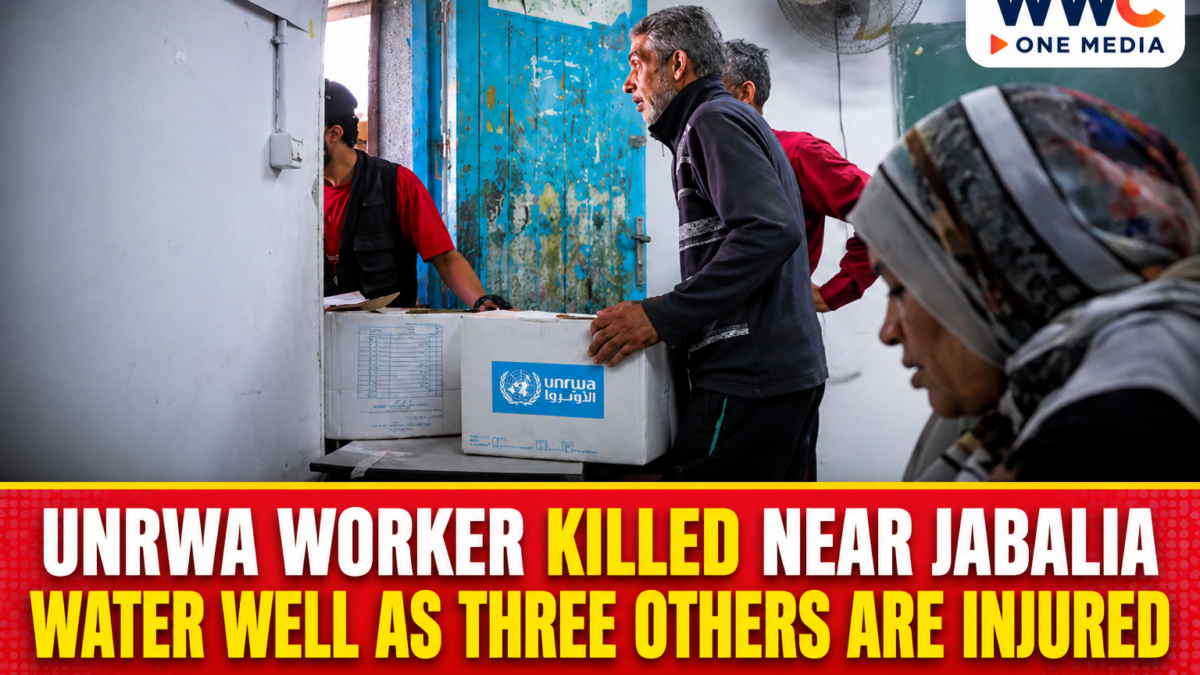
A staff member of the United Nations agency for Palestine refugees was killed and three others were injured near a water well in Jabalia, northern Gaza, on November 23, the agency said. UNRWA said the workers were performing their regular duties when an Israeli strike occurred near their work site.
The incident adds to the risks facing humanitarian personnel who continue to provide essential services in Gaza. UNRWA’s statement raised the number of its personnel and people supporting its activities killed since the war began to 397, underscoring the continuing danger to the workforce maintaining basic services in the territory.
UNRWA identifies Jabalia water well as the workers’ location
In a statement published on November 23, UNRWA Commissioner-General ad interim Christian Saunders said he was deeply saddened by the death of the staff member and the injuries suffered by three others following an Israeli strike near their workplace in Jabalia.
The agency said the workers were carrying out their regular duties at a water well and described their work as providing critical services to the community.
UNRWA did not identify the deceased employee in the statement. It also did not provide the names or medical conditions of the three injured people.
The wording of the statement is important: it places the strike near the workers’ location. It does not say that the water well itself was struck, nor does it identify the specific object or person targeted. Those details should not be assumed without further official information.
The agency called for humanitarian workers to be protected at all times.
Why a water well matters to Gaza’s civilian services
The location of the incident gives the event significance beyond the loss of one employee. Water infrastructure is part of the basic service network on which displaced families and other residents depend.
UNRWA’s own operational reporting describes its work in Gaza as including the operation and maintenance of water wells and desalination systems, alongside the delivery of water and sanitation services. The agency has also documented the rehabilitation of a well in Jabalia during an earlier phase of the ceasefire, demonstrating the importance of local water infrastructure to its response.
Its November 4 situation report recorded 395 UNRWA personnel and people supporting the agency’s work killed in Gaza since the war began. The November 23 statement increased that cumulative figure to 397. The agency’s figures include both its personnel and people who support its activities, so the total should not be described as a count of employees alone.
For residents, a functioning well can support access to water for drinking, cooking and hygiene. Damage, disruption or insecurity around such facilities can complicate the delivery of those services, although UNRWA has not said that the Jabalia well was damaged in this incident.
The wider humanitarian picture remains difficult
The killing comes as humanitarian agencies continue to report insecurity, damaged infrastructure and shortages affecting Gaza.
In its November 18 humanitarian situation report, the United Nations Office for the Coordination of Humanitarian Affairs said airstrikes, shooting and shelling continued to affect populated areas during the November 10–16 reporting period. The report also described humanitarian operations as constrained by insecurity, access restrictions, shortages of supplies and equipment, and funding shortfalls.
The same report said 38 fatalities and 144 injuries were reported by Gaza’s Ministry of Health during that period. Those figures cover the reporting week and are not a casualty count for the November 23 Jabalia incident.
OCHA also reported that 433 humanitarian trucks were offloaded on the Israeli side of the Kerem Shalom crossing between November 9 and 15. Although that represented an increase from the preceding week, the report said the entry of sufficient winter supplies remained constrained.
The distinction between supplies reaching a crossing and assistance reaching households remains important. Humanitarian organisations must still be able to move staff, operate facilities and distribute essential services in areas where people need them.
WWC has previously examined the fragile implementation of the Gaza ceasefire and the obstacles affecting humanitarian operations. Its earlier report on the ceasefire’s unresolved implementation challenges provides context for the continuing pressure on civilian services. A separate report on aid shipments waiting to reach Gaza examined the difference between supplies being prepared for delivery and assistance reaching people inside the territory.
The ceasefire has not removed risks to humanitarian personnel
A ceasefire agreement does not, by itself, guarantee that humanitarian workers can operate safely. Staff may still face danger while maintaining facilities, transporting supplies or carrying out routine services.
The November 23 statement is a specific account from UNRWA about an incident affecting its workers. It should not be treated as a complete investigation into the strike or as a legal determination about responsibility.
The agency’s account also comes against a wider pattern of reported insecurity. In its November 13 report, OCHA documented continued strikes and other armed incidents affecting populated areas during the preceding reporting period. WWC’s earlier examination of reported Israeli military activity during the ceasefire explains why individual incidents and the broader ceasefire record must be assessed separately.
For now, the public information released by UNRWA establishes the reported death, the three injuries, the Jabalia location and the workers’ stated assignment. It does not answer every question about the circumstances of the strike.
What happens next
Further information is needed to establish the precise circumstances of the incident, including the identity of the deceased worker, the nature of the injuries, the intended target and whether the water facility sustained any damage.
An official response from the Israeli military specifically addressing the Jabalia incident was not identified in the primary records reviewed for this report. No conclusion about the legality of the strike can therefore be drawn from the information currently available here.
The immediate concern is the safety of humanitarian personnel and the continuity of services for civilians. Any further official statement or investigation could clarify what happened and whether operational changes are needed to protect workers at essential facilities.
Frequently asked questions
What happened to the UNRWA worker in Jabalia?
UNRWA said one staff member was killed and three others were injured following an Israeli strike near where they were working at a water well in Jabalia, Gaza, on November 23, 2026.
Were the workers operating the water well when the strike happened?
UNRWA said the workers were carrying out their regular duties at the water well. The agency did not say that the well itself was hit.
How many UNRWA personnel and support workers have been killed since the war began?
UNRWA’s November 23 statement put the cumulative number at 397. The figure includes agency personnel and others supporting its activities.
Did the Israeli military confirm the Jabalia strike?
No specific Israeli military statement addressing this Jabalia incident was identified in the primary records reviewed for this report.
Was the Jabalia water well damaged?
UNRWA’s public statement did not report damage to the well. Its wording places the strike near the workers’ location, not necessarily on the water facility.