Miyagi Prefecture’s latest published agricultural inspection summary recorded 34 paddy-rice samples, with every sample below Japan’s national standard for radioactive caesium. The results, covering inspections reported between April 2025 and March 2026, offer a current official snapshot of a region whose food production was affected by the March 2011 earthquake, tsunami and nuclear emergency in neighbouring Fukushima.
The figures matter because they provide measurable evidence about the food-safety checks being carried out today. But they answer only one part of a much larger question: testing can establish whether inspected samples meet a regulatory limit, while public confidence and the commercial reputation of a regional product are separate matters that cannot be read from a laboratory table.
For Miyagi’s rice industry, the distinction is important. A product’s recovery depends not only on production and inspection, but also on whether buyers understand what the available evidence does—and does not—show.
What the latest Miyagi rice inspection found
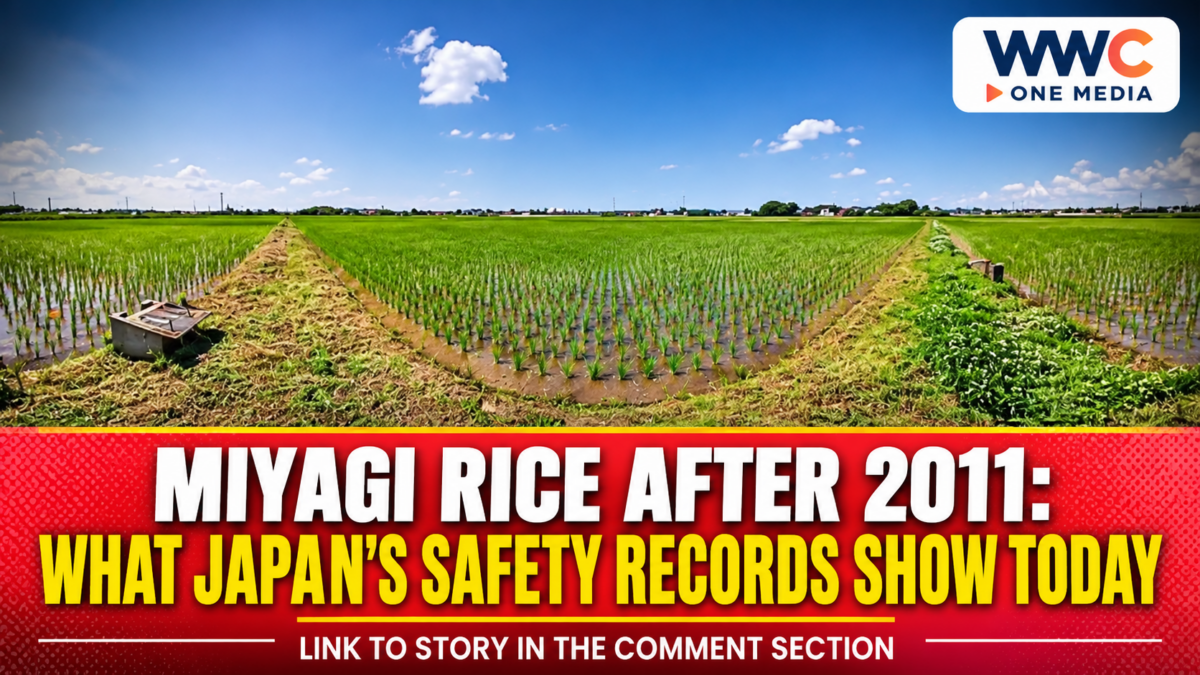
Miyagi Prefecture’s FY2025 inspection summary lists 34 paddy-rice items under its precise-inspection results. All 34 were below the standard value, representing 100% of the inspected paddy-rice samples in that category. None was recorded above the standard.
The prefecture’s wider agricultural, forestry and fisheries inspection programme covered more than rice. Its FY2025 summary reported 4,824 inspected items across the categories shown in the report, with 4,804 below the applicable standard and 20 above it. The above-standard results were recorded in forestry products, not agricultural products, livestock products or fishery products.
That distinction matters. The 20 results above the standard should not be presented as rice findings. The report’s agricultural-products category recorded 302 inspected items, all below the standard.
Japan’s general-food standard for radioactive caesium is 100 becquerels per kilogram. Rice is included in the general-food category.
The 34 paddy-rice samples are a defined inspection result, not proof that every bag of Miyagi rice has been individually tested. The figures should be read as evidence about the samples examined under the prefecture’s stated inspection programme.
Why the 2011 disaster changed the food-safety question
The Great East Japan Earthquake struck on March 11, 2011, triggering a tsunami and the nuclear accident at Fukushima Daiichi. Miyagi was among the prefectures affected by the earthquake and tsunami, while the nuclear emergency created a wider food-monitoring challenge across parts of northeastern Japan.
Japan’s response combined controls on rice production with testing and measures intended to limit the uptake of radioactive materials by crops. The agriculture ministry says the system includes cultivation restrictions, measures to reduce absorption and testing after harvest.
The national standard is designed around the government’s stated annual exposure limit from food. The ministry sets the radioactive-caesium limit for general foods at 100 Bq/kg, while drinking water, milk and infant food have separate standards.
These rules are important because they provide a common benchmark. They also mean that a test result should be interpreted against the applicable food category and the sampling method, rather than treated as a general statement about every product from an entire prefecture.
National rice monitoring shows a long-term change
The Ministry of Agriculture, Forestry and Fisheries provides a longer view of rice monitoring across 17 prefectures, including Miyagi.
Its published figures show that the proportion of rice samples exceeding the national standard fell from 2.2% for the 2011 crop to 0.0008% for 2012, 0.0003% for 2013 and 0.00002% for 2014. The ministry reports no exceedances from the 2015 crop through the 2025 crop in the monitored dataset.
For the 2025 crop, the ministry lists 29,294 inspected bags and an exceedance rate of 0%.
This is a significant change in the official monitoring record. It indicates that the rice samples covered by the programme have not produced results above the national standard in the years identified.
It does not mean that monitoring has become irrelevant. Japan’s agriculture ministry says local authorities determine the need for testing based on factors that include rice consumption and regional production conditions. The approach can therefore vary by area and year.
Reconstruction is broader than a laboratory result
Food safety is only one part of the recovery of an agricultural region. Farms also need functioning infrastructure, stable buyers, distribution channels and the ability to maintain production.
The Reconstruction Agency’s public data portal says the value of agricultural production in Miyagi and Iwate moved in line with national trends and stood above pre-disaster levels in the period covered by its comparison. It separately notes that Fukushima’s agricultural production value had not yet returned to its pre-disaster level, although it had been trending upwards.
Those are prefecture-level agricultural indicators, not rice-only figures. They should not be used to claim that every Miyagi farm or rice producer has recovered equally.
The same reconstruction portal also identifies sales-channel development and recruitment as common management issues among small and medium-sized businesses that used group subsidies. This provides a useful reminder that rebuilding an industry involves commercial challenges as well as physical restoration.
Why food reputation cannot be measured by testing alone
A laboratory result answers a technical question: whether the tested sample was above or below a specified limit. It does not reveal how consumers perceive the product, whether retailers are willing to stock it, or whether a regional brand has regained its previous market position.
Those questions require different evidence, such as sales figures, prices, distribution data, consumer surveys and export records. Without those records, it would be misleading to claim that Miyagi rice has fully recovered its reputation—or that consumers still reject it.
The distinction also matters in the wider rice market. Japan’s recent national supply and price movements show how production, inventories and farm economics can affect the value of rice even when food-safety concerns are not the central issue. WWC has examined those pressures in its report on Japan’s shift from rice shortages to a surplus.
For Philippine readers, the issue has a wider food-security dimension. Rice is both a staple and a commodity whose supply depends on farming conditions, trade and public policy. WWC has also covered the country’s exposure to changing import requirements and domestic harvest risks in its report on the Philippines’ possible rice imports and food-security concerns.
Emergency food assistance offers another perspective on how rice connects production with resilience. WWC previously reported on South Korea’s delivery of rice aid to disaster-affected Philippine communities, illustrating a different role for the staple in regional food security.
What happens next
Miyagi’s published inspection records provide evidence that the paddy-rice samples listed in its FY2025 precise-inspection summary were below the national radioactive-caesium standard. Japan’s national rice-monitoring figures also show no recorded exceedances from the 2015 crop through the 2025 crop in the 17-prefecture dataset.
The next question is not simply whether the latest tests were passed. It is whether producers, distributors and public authorities can maintain transparent monitoring while strengthening the commercial value of regional agricultural products.
For readers and buyers, the most reliable approach is to look at the actual inspection period, product category, number of samples and applicable standard. A clear record is more useful than either blanket reassurance or an unsupported claim that a region’s food remains unsafe.
Frequently asked questions
Is Miyagi rice currently above Japan’s radioactive-caesium limit?
The 34 paddy-rice samples in Miyagi’s FY2025 precise-inspection summary were all below the national standard. This describes those inspected samples, not every rice product.
What is Japan’s radioactive-caesium limit for rice?
Rice falls under Japan’s general-food category, which has a standard of 100 becquerels per kilogram.
When did rice monitoring results stop showing exceedances in the national dataset?
The agriculture ministry reports no exceedances from the 2015 crop through the 2025 crop in its monitored 17-prefecture dataset.
Does passing inspection mean Miyagi rice has fully recovered its reputation?
No. Inspection results measure compliance with food-safety standards. Consumer confidence and commercial reputation require separate evidence, such as sales, market access and consumer research.
Was Miyagi directly affected by the 2011 Fukushima nuclear accident?
Miyagi was affected by the Great East Japan Earthquake and tsunami. The nuclear accident occurred at Fukushima Daiichi in neighbouring Fukushima Prefecture, and the resulting food-monitoring response covered multiple prefectures, including Miyagi.