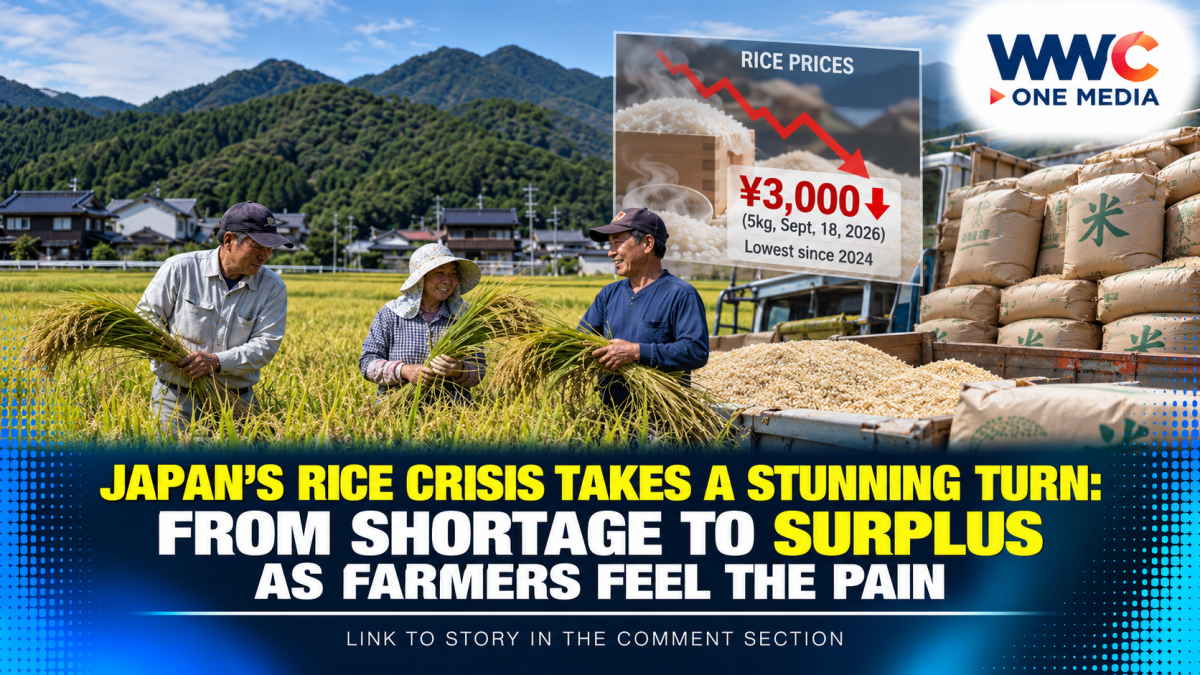
TOKYO — Japan’s rice market has undergone a dramatic reversal.
After consumers faced soaring prices and shortages, the country is now dealing with an unexpected rice glut, sending prices downward and creating new financial pressure for farmers already struggling with rising costs, extreme weather and an aging workforce.
The reversal has been especially striking. In January 2026, the average retail price for 5 kilograms of rice exceeded ¥4,400. By Sept. 20, the figure had fallen to about ¥2,934, its lowest level in more than two years, according to Japan’s agriculture ministry.
For households, cheaper rice is welcome news. For producers, however, the sudden drop is becoming a serious challenge.
How Japan Went From Rice Shortage to Glut
The story began with a severe supply squeeze.
Extreme heat in 2023 contributed to a poor harvest, while demand increased as restaurants recovered after the COVID-19 pandemic. A government warning about a possible earthquake also contributed to consumer stockpiling.
As rice became harder to find, prices surged. The government responded by releasing emergency stockpiles — ultimately putting about 590 million kilograms onto the market in 2025.
But the market then moved sharply in the opposite direction.
Production increased, while consumption weakened amid higher prices, changing eating habits and Japan’s aging population. The 2025 harvest exceeded demand, leaving private-sector inventories at about 2.43 million tons, according to data reported in July.
That has created the unusual situation Japan faces today: a country that recently struggled to find enough rice is now trying to manage too much of it.
Falling Prices Are Welcome for Shoppers — But Not Farmers
The decline in prices is easing pressure on consumers.
The average supermarket price for a 5-kilogram bag fell below ¥3,000 in September, the first time since September 2024.
But lower retail prices are squeezing producers.
One Chiba farmer, Hiroshi Asano, told Bloomberg that he expects to make a loss in 2026. He also said some smaller farmers are considering leaving the industry.
Farmers are confronting the price decline at the same time that machinery and other operating costs remain high. Extreme weather, including heavy rainfall, has added another layer of uncertainty.
The pressure is particularly significant because Japan’s agricultural workforce is already shrinking. The number of farmers fell from about 2.4 million in 2000 to fewer than 1 million in 2026, while roughly 70% of people whose primary occupation is farming are over 65, according to Japan’s agriculture ministry data cited by Bloomberg.
Government Tries to Stop the Market From Swinging Again
Tokyo is now attempting to stabilize the market.
The agriculture ministry has announced plans to buy back about 210 million kilograms of rice to replenish government reserves that were depleted during last year’s shortage. The government had about 320,000 tons remaining after releasing 590,000 tons, well below the roughly 1 million tons considered appropriate.
Officials are also changing how they forecast rice demand. The updated model incorporates factors such as population trends, inbound tourism and milling yields.
Under a revised food law, food processors and food-service businesses are also required to report inventory and sales information, giving the government greater visibility into how rice is moving through the market.
Japan’s Bigger Problem Goes Beyond Rice Prices
The immediate question is where prices go next.
Researchers cited by Bloomberg expect downward pressure to continue because of the scale of the surplus. That creates a difficult balancing act: consumers benefit from affordable rice, but persistently low prices could make farming financially unsustainable for some producers.
That matters beyond individual farmers.
As Japan’s agricultural workforce ages and fewer young people take over family farms, continued pressure on farm incomes could accelerate the abandonment of farmland and raise longer-term questions about domestic food security.
Japan’s rice market has therefore entered a new phase — one where the problem is no longer simply finding enough rice, but finding a price and production system that can keep farmers in business while protecting consumers.
The rice shortage may be fading, but Japan’s next food-security challenge could already be taking shape.
WWC ONE MEDIA G,A