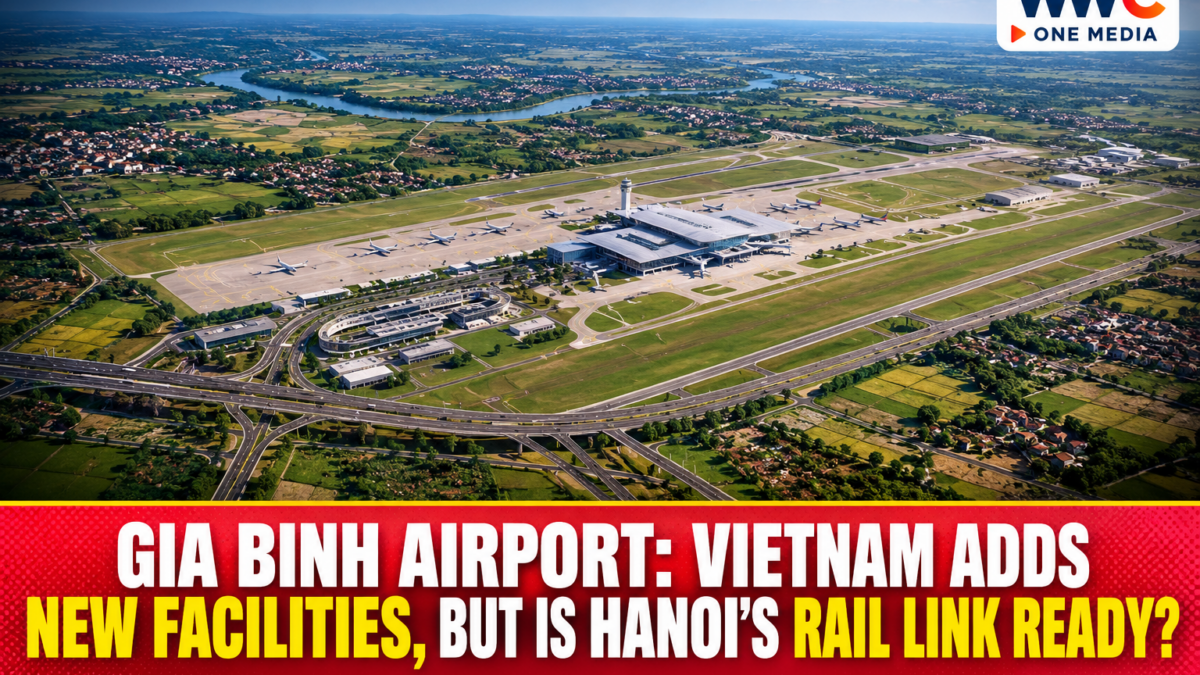
Vietnam is reviewing the detailed development plan for Gia Binh International Airport, with proposed additions covering aircraft maintenance, in-flight catering, energy storage and a metro connection. The Ministry of Construction was still collecting comments on the revised planning dossier as of Nov. 23, 2026, meaning the changes should not yet be treated as a finally approved airport layout.
The proposed adjustments come as the government pushes to develop Gia Binh into a major northern aviation gateway, with ambitions extending beyond passenger flights to cargo handling, aircraft servicing and international connectivity. Yet the transport network needed to connect the airport efficiently with Hanoi and neighbouring centres remains a separate planning challenge.
Gia Binh Airport’s revised plan adds operational capacity
The Civil Aviation Authority of Vietnam said the Ministry of Construction was seeking comments on the revised detailed plan for Gia Binh International Airport covering 2021–2030, with a vision to 2050.
The update follows a proposal by Masterise Aviation Infrastructure, identified by the authority as the airport project’s investor. The Civil Aviation Authority said it had worked with the investor to complete the adjustment dossier.
The proposed changes address several parts of the airport’s operating layout. They include standardising the aircraft parking apron to match the passenger terminal design, adjusting the ground-transport centre and adding an aircraft maintenance area, an energy storage facility and an in-flight catering building on the airport’s western side.
The plan also reviews facilities supporting flight and ground operations, as well as the locations of government agencies operating at the airport.
These additions are not simply passenger conveniences. Aircraft maintenance, repair and overhaul facilities—commonly called MRO—can support inspections, servicing and repairs. Catering infrastructure supports the preparation and delivery of meals for flights, while energy storage can contribute to the airport’s operational power requirements.
The proposed facilities indicate that planners are considering the airport as an operating base with several aviation-related functions, rather than only a passenger terminal and runway complex. <Cite refs={[“turn592319view0”]}/>
The airport’s headline capacity targets remain substantial
The revised planning exercise does not change the capacity figures stated in the existing airport plan.
The Civil Aviation Authority says Gia Binh is planned as a 4F-class airport under the International Civil Aviation Organization’s classification system. Its planned capacity for 2030 is approximately 30 million passengers and 1.6 million tonnes of cargo annually.
By 2050, the long-term targets rise to approximately 50 million passengers and 2.5 million tonnes of cargo per year.
The authority also lists aircraft types the airport is expected to accommodate, including the Boeing 747, 777 and 787, as well as the Airbus A380, A350 and A321.
Those figures describe planned capacity, not traffic already being handled. The distinction is important because an airport’s eventual throughput depends on completed infrastructure, operating approvals, airline demand, staffing and the supporting transport network.
The government has also linked the airport’s strategic role to the development of northern Vietnam and the country’s preparations for major international events, including the 2027 Asia-Pacific Economic Cooperation summit.
A separate government implementation resolution divides the development into stages, with an initial construction phase intended to provide facilities needed for APEC 2027 and a later phase intended to complete the wider airport capacity. <Cite refs={[“turn592319view0″,”turn681084search6″,”turn592319view1”]}/>
The metro connection is proposed, but the wider network needs work
One of the most consequential proposed changes is the addition of a metro alignment and station locations to the airport’s detailed plan.
That could eventually give passengers another way to travel between Gia Binh and Hanoi, reducing reliance on private vehicles and road transfers. However, the inclusion of a proposed route in an airport planning document does not mean that a railway has been fully designed, funded, approved and scheduled for construction.
A Nov. 6 government notice makes that distinction clear. Following a meeting chaired by Standing Deputy Prime Minister Pham Gia Tuc on Oct. 29, the government said a comprehensive transport-connectivity plan for Gia Binh had not yet been developed.
The notice asked Hanoi to review its urban railway network and prioritise a direct connection serving Gia Binh and Noi Bai airports with the city centre. It also called for coordination with Bac Ninh, Hai Phong and Quang Ninh on wider regional connections.
Hanoi and Bac Ninh were instructed to submit their reviews and proposals to the Ministry of Construction before Nov. 25. The ministry was then tasked with preparing an overall connectivity proposal, including priority projects, required resources, implementation schedules and the responsibilities of the agencies involved.
This means the airport’s proposed metro provision is progressing alongside a broader transport-planning exercise that still needs to establish how the different routes and transport modes will work together. <Cite refs={[“turn592319view1″,”turn377510view0”]}/>
Why the supporting infrastructure matters to airlines
An airport’s commercial value is not measured only by the number of passengers its terminal can accommodate.
Airlines also need aircraft parking positions, ground-handling services, catering, maintenance arrangements, fuel and energy systems, cargo facilities and reliable access for passengers and employees.
The proposed MRO area could help support aircraft servicing activity at the airport. If developed and operated successfully, such facilities could make Gia Binh more attractive to aviation businesses that need maintenance capacity in the region.
The cargo target is also significant. A planned annual capacity of 1.6 million tonnes by 2030 would position freight as a major part of the airport’s intended role, although actual cargo volumes will depend on logistics demand, airline participation and the availability of efficient road and rail connections.
Vietnam’s wider airport programme provides useful context. WWC has reported on Long Thanh International Airport’s preparations for its planned commercial opening, where terminal readiness and transport arrangements are also central to the transition from construction to operations.
For Philippine readers, the same infrastructure questions arise in domestic airport development. WWC’s coverage of the proposed Sangley Point International Airport investment examines why terminal capacity, access, financing and supporting facilities must progress together.
What the planning revision does not yet establish
The current public information does not provide a final approved metro route, confirmed station list, construction budget or railway completion date for the proposed Gia Binh connection.
Nor does the publication of additional airport facilities mean that the revised detailed plan has completed its approval process. The Civil Aviation Authority says the Ministry of Construction is collecting comments, after which the authority is expected to review submissions, explain how feedback is addressed and complete the dossier for the ministry.
The distinction between a proposal and an approved project matters to investors, airlines and future passengers. A planning document can establish the intended location and function of facilities, but implementation still depends on approvals, funding, construction and operational preparation.
The scale of airport development also makes cargo and logistics infrastructure important. WWC’s report on UPS’s Clark International Air Hub expansion illustrates how dedicated cargo facilities can strengthen an airport’s role in international supply chains.
What happens next
The immediate planning milestones are the completion of the consultation process and the submission of the wider transport-connectivity proposals.
Hanoi and Bac Ninh were given a Nov. 25 deadline to send their transport reviews to the Ministry of Construction. The ministry was also directed to report an overall connection proposal to the prime minister during November.
For the airport’s detailed plan, the next step is to process comments, explain revisions and submit the completed dossier to the Ministry of Construction.
The larger test is whether airport construction, railway planning, road access and operational facilities can advance in a coordinated way. Gia Binh’s passenger and cargo targets are ambitious, but their practical value will depend on more than the airport itself.
Frequently Asked Questions
Where is Gia Binh International Airport?
Gia Binh International Airport is being developed in northern Vietnam, in the area administered by Bac Ninh. The project is intended to serve the wider Hanoi capital region.
What new facilities are proposed for Gia Binh Airport?
The revised plan includes an aircraft maintenance area, an in-flight catering facility, an energy storage facility, changes to the ground-transport centre and updates to aircraft parking and operational facilities.
Will Gia Binh Airport have a metro connection?
The revised airport plan proposes adding the metro alignment and station locations. However, the wider transport network still requires coordinated planning, and the public records reviewed do not establish a final construction timetable.
How many passengers can Gia Binh Airport handle?
The current plan targets approximately 30 million passengers annually by 2030 and approximately 50 million by 2050.
When is Gia Binh Airport expected to be fully developed?
The airport plan covers 2021–2030, with a longer-term vision to 2050. The government has identified facilities needed for APEC 2027 as an early development priority, while the wider airport is planned in stages.