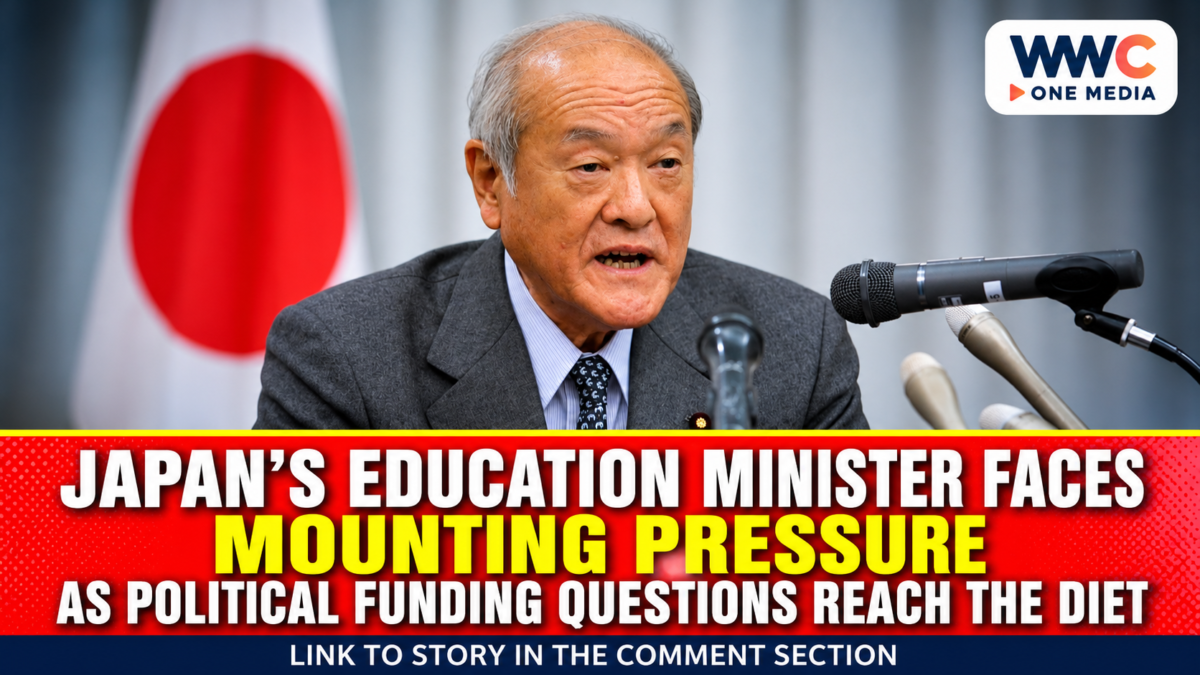
Japan’s Education, Culture, Sports, Science and Technology Minister Yoshihiro Seki is facing renewed scrutiny over political fundraising activities involving government officials, putting pressure on Prime Minister Sanae Takaichi’s administration as parliament considers major legislation. The dispute has raised a broader question for the government: how can it maintain legislative momentum while addressing concerns about ministerial accountability?
The issue matters beyond the position of one Cabinet member. Any change in the education portfolio could affect the administration’s ability to manage parliamentary business, while the handling of political fundraising questions may influence public confidence in the government’s standards of transparency.
Japan Education Minister Yoshihiro Seki Admits Holding Fundraising Events Inside Parliament Buildings
Japan’s Education, Culture, Sports, Science and Technology Minister Yoshihiro Seki has acknowledged holding political fundraising events inside buildings used by the country’s House of Representatives, including one in June 2024. In an October 2026 ministerial press conference, he said he had misunderstood the rules governing the use of parliamentary facilities and apologised after receiving clarification from the House of Representatives Secretariat.
The disclosures put renewed attention on political accountability within Prime Minister Sanae Takaichi’s administration. They also raise a practical question about how political fundraising activities are supervised when elected officials use facilities provided for parliamentary work.
The official record establishes that Seki acknowledged two events, one in December 2020 and another in June 2024. It does not, by itself, establish that he committed a criminal offence. The distinction is important: the issue described in his public explanation concerned restrictions imposed by the parliamentary facility’s management rules.
What Seki acknowledged about the fundraising events
During a press conference on Oct. 13, Seki confirmed that he had held a gathering in the International Conference Room of the House of Representatives Members’ Office Building in December 2020.
He also confirmed a second gathering in June 2024, held in a meeting room in his own office in the same parliamentary building.
Seki said the financial receipts and expenses for both gatherings had been recorded in political funds reports.
His initial understanding was that the events did not fall under the prohibited activities listed in the decisions of the Members’ Office Building Management Committee. He said he had interpreted the restrictions as covering activities such as coercive solicitation of meetings or donations, aggressive selling and unauthorised commercial transactions.
After the issue was raised, however, he said he checked the rules again and received an explanation from the House of Representatives Secretariat that the provisions were intended to prohibit political fundraising parties inside the buildings.
Seki apologised and said he would take greater care to prevent a recurrence. 文部科学省ホームページ
The admission is significant because it came from the minister himself and was recorded in the Ministry of Education’s published press conference transcript.
It also establishes a distinction between the reporting of political funds and the permitted use of parliamentary facilities. Recording a gathering’s income and expenses does not automatically mean that the location used for the event complied with the building’s separate rules.
The minister apologised but defended the treatment of the proceeds
Questions about the financial arrangements continued during the Oct. 13 press conference.
A journalist raised the reported difference between the income and expenses associated with the June 2024 event and asked whether the remaining amount should be treated as a political donation.
Seki responded by referring to the definition of a political fundraising party under Japan’s Political Funds Control Act. He described it as an event for which participants pay consideration, with the remaining proceeds after expenses used for political activities.
He maintained that the event had been conducted in accordance with that legal framework.
When asked why he had initially believed the parliamentary restrictions did not apply, Seki explained that he had personally interpreted the event as different from a commercial transaction. After checking with the parliamentary secretariat, he said he understood that the restriction did cover the gathering.
He also said the funds had already been used in his ordinary political activities. 文部科学省ホームページ
These statements should be read within their proper limits. The minister’s explanation describes his understanding of the political-fundraising law and the use of the proceeds. It does not independently settle every question about the event’s compliance with all applicable rules.
Seki declined to disclose attendance and ticket details
The issue returned during Seki’s Oct. 16 press conference.
A journalist asked how many people had been invited to the June 2024 event, how many actually attended and how much participants paid.
Seki apologised again for holding the event inside the parliamentary building. However, he declined to provide the requested details, describing them as matters concerning individual political activities.
He reiterated that the gathering had been conducted in accordance with the law. 文部科学省ホームページ
That response leaves an important information gap for readers seeking a fuller picture of the event.
The ministry’s published transcript records the question and Seki’s answer, but it does not provide the attendance figures or individual payment details requested by the journalist.
The distinction between information included in a political funds report and details not disclosed in the press conference is relevant to the wider debate about political transparency.
WWC has examined the broader challenge in its coverage of political donations and the limits of financial disclosure. Public reporting can make political money easier to examine, but the quality of oversight also depends on what information is available and how rules are enforced.
Why parliamentary building rules matter
The Members’ Office Building is part of Japan’s parliamentary infrastructure. Its facilities support lawmakers in carrying out their official responsibilities, including meetings and legislative work.
Restrictions on political fundraising inside these premises serve a separate purpose from the national rules governing political contributions and expenditures.
The distinction matters because an event can have its financial transactions recorded while still raising a question about whether the venue was permitted for that activity.
In Seki’s case, his Oct. 13 explanation acknowledged that he had misunderstood the relevant restriction. He said the parliamentary secretariat clarified that the rule covered political fundraising parties inside the buildings.
This is not merely a technical distinction. Clear facility rules help maintain a separation between the use of public parliamentary premises and the private or party-political activities of individual lawmakers.
The same principle applies more broadly to political finance: transparency requires both accurate financial reporting and compliance with the rules governing how political activities are conducted.
Japan’s political funding debate has remained a significant issue for the ruling Liberal Democratic Party. The wider political environment is also relevant to the government’s ability to maintain public confidence, as explored in WWC’s earlier report on Takaichi’s Cabinet reshuffle and the administration’s political priorities.
The controversy reaches beyond one minister
Seki’s explanation comes against the background of broader questions about political fundraising and accountability in Japan.
For public officials, the central issue is not simply whether money was recorded in a report. It is also whether the activities surrounding that money followed the applicable laws, internal party standards and rules governing public facilities.
A political fundraising event is not automatically unlawful because it generates proceeds. Nor does a minister’s acknowledgement of a rules violation involving a venue establish that every financial transaction connected to the event was illegal.
Those distinctions are necessary to avoid turning an administrative or procedural admission into a broader allegation unsupported by the official record.
At the same time, the use of parliamentary facilities for activities that the management rules prohibit can reasonably attract scrutiny. Public confidence depends partly on whether lawmakers understand and follow the conditions attached to the use of public premises.
The LDP’s political standing and its efforts to maintain support have also been shaped by wider questions of party organisation and public accountability, including the electoral challenges examined in WWC’s coverage of the ruling party’s political campaign in Okinawa.
What happens next
The available published records establish Seki’s acknowledgement of the two gatherings, his explanation of how he interpreted the rules and his apologies.
They do not provide a complete account of the attendance and payment details he declined to disclose at the Oct. 16 press conference. Nor do the published statements establish a criminal conviction or a finding that every aspect of the events violated national political-finance law.
The Ministry of Education’s Nov. 20 press conference page also identifies political fundraising as one of the subjects discussed, but its written transcript was still marked as pending publication when reviewed. The contents of that discussion therefore cannot be treated as independently confirmed through a published transcript.
For now, the central issue supported by the public record is straightforward: Seki acknowledged holding political fundraising gatherings inside parliamentary premises, accepted that he had misunderstood the facility rules and apologised.
Further developments will depend on what additional official records or explanations become available.
Frequently asked questions
Who is Yoshihiro Seki?
Yoshihiro Seki is Japan’s Minister of Education, Culture, Sports, Science and Technology. He is a member of the House of Representatives.
What did Seki admit?
He acknowledged holding gatherings in the House of Representatives Members’ Office Building in December 2020 and June 2024. He said he later learned that parliamentary facility rules prohibited political fundraising parties inside the buildings.
Did Seki admit to committing a crime?
No. The published press conference records show that he acknowledged misunderstanding the rules governing the use of parliamentary facilities. They do not establish a criminal conviction.
Did Seki disclose how many people attended the 2024 event?
He was asked about the number invited, actual attendance and participant fees during his Oct. 16 press conference. He declined to provide those details, describing them as matters concerning individual political activities.
What happened to the money raised?
During the Oct. 13 press conference, Seki said the proceeds had been used in his ordinary political activities. The published transcript does not provide a complete breakdown of the event’s individual receipts and expenditures.