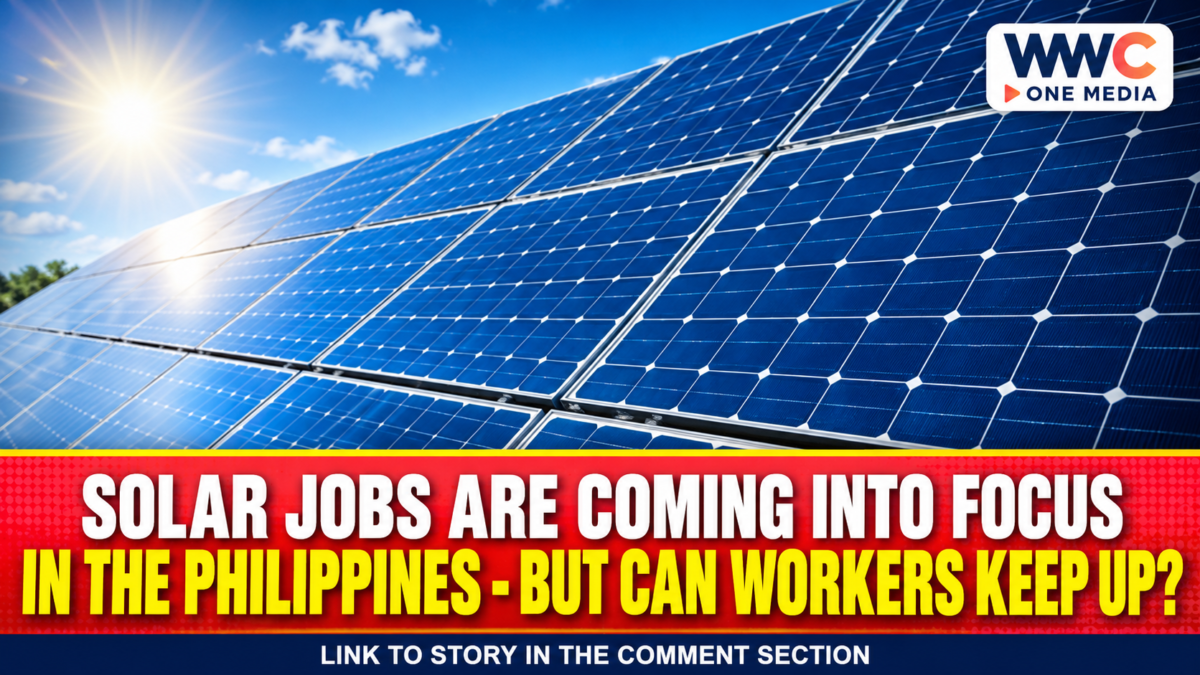
The Philippines’ push to expand renewable energy is bringing a new workforce challenge into view: whether enough Filipino technicians and specialists will be ready to build, connect and maintain the country’s growing solar capacity. A regional agreement between the ASEAN Centre for Energy (ACE) and the Asian Photovoltaic Industry Association (APVIA), formalised in October 2026, puts skills development and professional recognition on the regional cooperation agenda.
The partnership arrives as the Department of Energy (DOE) pursues a long-term renewable-energy expansion and the International Energy Agency (IEA) identifies a skills mismatch among Philippine solar photovoltaic workers. The central issue is no longer just how many solar projects can be proposed. It is whether training systems, industry standards and actual hiring needs can move at a comparable pace.
The ASEAN agreement is about skills, not a Philippine hiring guarantee
ACE announced on Oct. 15 that it had formalised five memoranda of understanding during the 26th ASEAN Energy Business Forum in Manila. The agreements were signed on Oct. 8 with industry associations, academic institutions and non-government organisations.
One agreement involved APVIA. Its stated areas of cooperation with ACE include renewable-energy workforce development across ASEAN, skills standardisation, recognition of professional qualifications, training programmes and regional knowledge exchange. ASEAN Centre for Energy (ACE)
The distinction is important. The announcement confirms a regional framework for cooperation, but it does not publish a Philippine recruitment target, a guaranteed number of trainees, a funding allocation or a schedule for specific local training courses.
For Filipino workers, the agreement could create opportunities if it eventually leads to training that employers recognise across borders. But those benefits will depend on the programmes actually developed, the institutions delivering them and the qualifications that participating employers accept.
ACE describes itself as an intergovernmental organisation supporting energy cooperation and policy coordination among ASEAN member states. Its role as a regional energy think tank gives the partnership a platform for coordination, but does not make it a Philippine licensing or employment agency. ASEAN Centre for Energy (ACE)
The Philippines already has a solar training framework
The country is not starting from zero. TESDA’s published training regulations for PV Systems Installation NC II set out a qualification for technicians who assess installation sites, check photovoltaic components, install systems and carry out testing and commissioning.
The document specifies a nominal training duration of 284 hours: 18 hours for basic competencies, 72 hours for common competencies and 194 hours for core competencies. It also identifies PV Systems Installation Technician and PV Systems Commissioning Technician as occupational outcomes. Tesda+1
This provides a useful domestic reference point for the regional skills discussion. A recognised qualification can help define what a competent installer should know and demonstrate, rather than leaving employers and training providers to rely on inconsistent descriptions of experience.
However, a qualification framework alone cannot guarantee that enough people will complete training or find suitable work. Training access, assessment capacity, equipment, instructor expertise and employer demand all influence whether a standard produces a larger skilled workforce.
IEA identifies a skills mismatch among Philippine solar workers
The workforce challenge is not merely theoretical. An IEA report published on June 30, 2026, said around 25% of solar PV workers in the Philippines reported a mismatch between their skills and job requirements.
The report also identified shortcomings across the region in solar-specific technical competencies, digital skills and workplace abilities such as communication and teamwork. It noted that solar installers must explain equipment and technical details to customers, while utility-scale projects require effective coordination between field and office teams. IEA+1
The figure should be read carefully. It does not mean that one-quarter of all Filipino workers are unqualified, nor does it establish that every solar employer faces the same problem. It indicates a reported gap between some workers’ existing capabilities and the requirements of their jobs.
That gap matters because solar work extends beyond attaching panels to rooftops. Installation requires site assessment, electrical knowledge, component checks, safe working practices, testing and commissioning. Larger projects also need engineers, project managers, grid specialists and personnel who can monitor and maintain equipment.
Renewable-energy targets create a longer workforce pipeline
The DOE’s February 2026 announcement set out a 10-year Green Energy Auction plan offering at least 25 gigawatts of additional renewable-energy capacity through annual competitive auctions from 2026 to 2035. Project deliveries were expected to begin as early as 2027.
The programme supports national targets for renewable energy to account for 35% of the power generation mix by 2030 and 50% by 2040. The department also identified solar, rooftop solar and solar paired with battery energy storage among the technologies covered by upcoming auction rounds. Department of Energy Philippines
These targets provide a reason to plan workforce needs over several years. Solar projects require different capabilities at different stages: site assessment and design before construction, electrical and civil works during installation, and operations and maintenance after commissioning.
The scale of the project pipeline should not be mistaken for an equivalent number of jobs already created. Auctioned or proposed capacity must still pass through development, financing, permitting, construction and grid-connection stages before it becomes operating electricity infrastructure.
WWC has previously examined what must happen before Philippine renewable-energy targets translate into actual power generation. The same distinction applies to employment: planned capacity is not a confirmed hiring total.
Why training must connect directly to real projects
A useful workforce programme needs to do more than increase the number of people who attend short courses. It must prepare trainees for the actual work employers need completed and give them qualifications that can be assessed consistently.
That means linking technical education with project developers, equipment suppliers, contractors, utilities and certification bodies. It also means ensuring that courses cover both basic installation work and the more specialised requirements of larger solar plants, storage systems and grid integration.
The practical connection between training and construction can be seen in projects already moving through the Philippine development pipeline. WWC’s coverage of PetroGreen’s financed Isabela solar project illustrates how a project requires more than panels: financing, power arrangements and transmission connections are also part of the process.
The workforce discussion also sits alongside other regional cooperation efforts. A separate Philippines–Indonesia–Vietnam island solar initiative has focused on solar and battery storage for remote communities. That initiative is distinct from the ACE–APVIA workforce agreement, but both show why technical capacity will matter as regional clean-energy plans develop.
What happens next
The next meaningful test is whether the ACE–APVIA agreement produces public, measurable programmes. Useful details would include the countries and occupations covered, training partners, qualification standards, assessment arrangements, implementation dates and funding responsibilities.
For the Philippines, coordination with TESDA and local employers would help show whether regional standards complement existing national qualifications or require additional training pathways. Employers should also identify the technical roles they expect to recruit, rather than relying on broad estimates of future green jobs.
The opportunity is real, but it is not automatic. Solar expansion can create demand for skilled work; only accessible training, credible certification and actual project implementation can turn that demand into sustained employment for Filipino workers.
Frequently asked questions
What is the ACE–APVIA partnership?
It is a regional cooperation agreement focused on renewable-energy workforce development across ASEAN, including skills standardisation, professional qualification recognition, training programmes and knowledge exchange.
Does the agreement guarantee solar jobs in the Philippines?
No. The public announcement confirms areas of cooperation but does not specify a guaranteed number of Philippine jobs or trainees.
Does TESDA offer a solar installation qualification?
Yes. TESDA’s published PV Systems Installation NC II training regulations describe a 284-hour qualification covering site assessment, component checks, installation, testing and commissioning.
What skills are needed for solar installation work?
Core capabilities include site assessment, electrical and component knowledge, safe installation, testing and commissioning. Larger projects can also require engineering, project management, grid integration and maintenance skills.
Why is the solar workforce issue important now?
The Philippines is pursuing renewable-energy targets of 35% of its power generation mix by 2030 and 50% by 2040. Delivering more projects will require workers with skills suited to construction, installation and long-term operations.