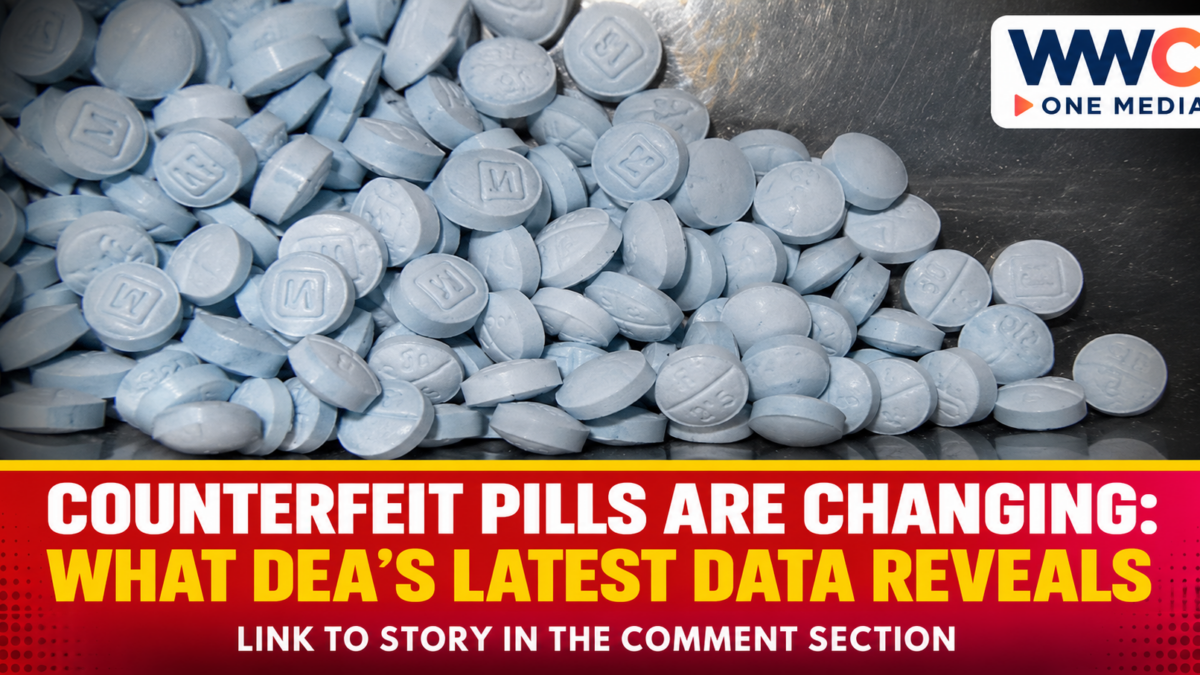
Counterfeit pills remain a major public-safety concern in the United States, with laboratory testing showing that tablets designed to resemble prescription medicines can contain combinations of illicit substances rather than the drugs their appearance suggests. A Drug Enforcement Administration (DEA) report covering seizures between Jan. 1, 2024, and Dec. 31, 2025, documents the scale and composition of counterfeit pills identified in the country’s illicit drug supply.
The data highlights a problem beyond the presence of fentanyl alone: counterfeit tablets may contain multiple substances, making their contents and effects difficult to predict. The findings also underline why a pill’s appearance cannot establish its authenticity or safety.
What the counterfeit pills data actually shows
The DEA’s report examines counterfeit pills seized across the United States during 2024 and 2025. The agency’s laboratory analysis identifies substances found in tested pills and records how frequently counterfeit versions of particular tablet types were seized.
The report says illicitly manufactured fentanyl remains the dominant substance identified in counterfeit pills. It also lists methamphetamine, xylazine, nitazenes and benzodiazepines among substances frequently found in the counterfeit-pill supply.
That matters because people may believe they are taking a medication with a known ingredient and dosage when the pill has actually been manufactured illegally.
The laboratory findings show why identifying a tablet by colour, shape or imprint alone can be unreliable.
Why familiar-looking tablets can carry different risks
Counterfeit tablets are designed to resemble legitimate medicines. Their appearance may imitate prescription products, but their actual contents can differ substantially.
The DEA’s report explains that counterfeit pills can contain synthetic substances and combinations of ingredients that may pose serious risks. Laboratory analysis—not appearance—is what establishes what substances were identified in seized samples.
For consumers, the distinction is especially important when medicines are obtained outside legitimate medical and pharmacy channels.
A pill that looks identical to a familiar prescription product should not be assumed to contain the same medicine, strength or ingredients.
Fentanyl is not the only substance investigators are tracking
Fentanyl continues to dominate many counterfeit-pill findings, but the broader synthetic-drug landscape is becoming more complex.
The DEA’s emerging-drug-trends information identifies substances such as xylazine, nitazenes, cychlorphine and medetomidine as drugs law-enforcement and public-health officials are monitoring. The agency warns that some substances may be present in mixtures without the user’s knowledge.
This complicates the response to suspected drug poisoning.
Different substances can affect the body in different ways. When several drugs are involved, responders may have to consider more than one cause of the person’s symptoms, and treatment may require medical assessment beyond what a single intervention can address.
This is why drug identification and overdose response should remain the responsibility of trained medical personnel.
What laboratory testing can—and cannot—tell the public
The DEA’s seizure report is based on samples associated with pills seized during the stated period. It is not a complete inventory of every pill circulating in the United States.
The report’s findings therefore describe the substances identified in tested and seized material. They should not be interpreted as proof that every counterfeit pill contains the same ingredients or that every pill in circulation has been examined.
The distinction is important when interpreting percentages.
Laboratory results can help authorities identify trends, compare substances and guide investigations. But they cannot establish the contents of an individual pill that has not been tested.
The wider lesson is that illicit drug supplies may be inconsistent. A person cannot reliably determine the chemical contents of a pill simply by comparing it with an image or a previous tablet.
Why the issue matters beyond the United States
The DEA report covers seizures in the United States, so its statistics should not be treated as Philippine drug-market data.
However, counterfeit medicine and illegal drug distribution are also issues relevant to Philippine public safety and enforcement. WWC ONE MEDIA previously reported on counterfeit medicines discovered in Davao, a separate case involving the safety and traceability of products entering the supply chain.
The Philippines also faces ongoing enforcement efforts against illegal drug shipments. In a separate report, authorities’ interception of a large shipment at Manila Port demonstrated the role of inspections and investigation in tracing suspicious cargo.
Another WWC report examined PDEA’s work with coastal communities in Quezon to encourage reporting of suspicious activity along coastal areas.
These cases are separate from the US counterfeit-pill findings and should not be taken as evidence that the substances documented in the DEA report are circulating in the Philippines. The connection is the broader public-safety challenge of identifying illegal products and tracing distribution channels.
Why prevention cannot rely on appearance alone
The CDC’s overdose-prevention guidance warns that people can be exposed to more than one substance without knowing it, including through counterfeit pills. It recommends taking only prescribed medicines and warns that illegally purchased pills may contain highly potent substances.
This makes consumer awareness important, but awareness alone cannot eliminate the risk.
Medical professionals, pharmacies, public-health authorities and law-enforcement agencies each have roles in preventing counterfeit products from reaching people. Legitimate prescription and dispensing channels provide safeguards that illicit purchases do not.
For people concerned about a possible overdose, emergency medical assistance should be sought immediately. Suspected poisoning should not be managed by waiting to see whether symptoms improve.
What happens next
The DEA’s ongoing monitoring and laboratory analysis will help determine which substances are appearing in seized counterfeit pills and how the composition of the illicit supply may be changing.
Future data will be important in assessing whether particular substances are becoming more common, whether mixtures are changing and how enforcement and public-health responses should adapt.
The latest findings support one clear conclusion: a counterfeit pill is not simply a fake version of a prescription medicine. It may be a product with unknown ingredients, inconsistent composition and serious health risks.
That is why legitimate prescriptions, licensed pharmacies and professional medical guidance remain critical safeguards.
FAQ
What are counterfeit pills?
Counterfeit pills are illegally manufactured tablets designed to resemble legitimate prescription medications but may contain different ingredients or substances.
Can counterfeit pills contain fentanyl?
Yes. DEA laboratory findings have identified fentanyl in counterfeit pills, alongside other substances.
Can a pill be identified as safe by its appearance?
No. Appearance alone cannot confirm its ingredients, authenticity or safety.
What should someone do if they suspect a drug overdose?
Seek emergency medical help immediately. Suspected overdose or poisoning requires urgent professional assessment.
Does the DEA report prove these counterfeit pills are present in the Philippines?
No. The report covers US seizures. Its findings should not be used as Philippine drug-market statistics.