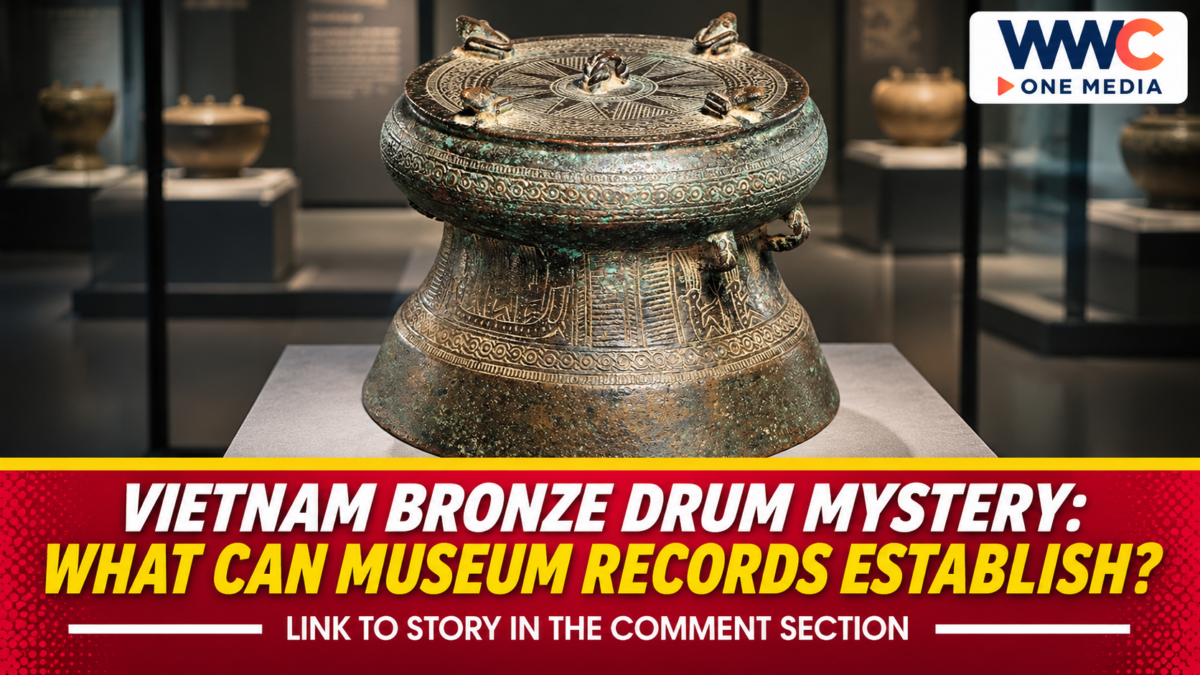
NINH BINH, Vietnam — Nov. 22, 2026. A reported new identification of a bronze drum associated with a decades-old discovery in northern Vietnam has revived questions about how cultural objects are documented and safeguarded. The original forensic conclusion behind the reported identification was not available for independent examination, but Ninh Binh Museum’s own published collection history provides an important, independently verifiable starting point.
The central distinction is between a museum record confirming that an object was recorded and preserved and a forensic finding establishing that it is the same object shown in decades-old photographs. Those are different propositions, requiring different evidence.
Vietnam Bronze Drum Records: What the Museum Documents
In a July 14, 2022 article about its Dong Son bronze collection, Ninh Binh Museum recorded a bronze drum discovered by three school pupils in 1998 in a water-filled cave in Thach La hamlet, Thach Binh commune, in the former Nho Quan district. That statement is a first-party museum publication, rather than a later recollection attributed to a witness.
The museum’s chronology is important because more recent public reporting concerns a drum reportedly found in 1994. The museum’s published 1998 discovery date cannot simply be silently changed to match that account. Whether an earlier date reflects a different object, an error in a record, or a different stage in the object’s transfer requires documentary clarification.
The museum’s public collection history does not, by itself, reproduce the forensic examination described in recent accounts. Nor does it establish the chain of custody for every year between an initial discovery and later museum registration.
Why the Collection Has Wider Historical Importance
The museum describes Dong Son culture as a major archaeological tradition associated with communities in northern and north-central Vietnam roughly 2,000 to 3,000 years ago. It identifies bronze casting and ornamentation as important parts of that material heritage.
Its published collection comprises 127 bronze items across five categories: musical instruments, weapons, production tools, jewellery and household objects. In the museum’s classification, musical instruments include drums and bells. Other items range from spearheads and axes to vessels and ornaments.
This context explains why the identity of a single drum deserves careful treatment. A bronze object’s archaeological value does not rest solely on its age or monetary worth. Its original discovery location, associated records and history of transfer help researchers interpret it alongside other finds.
The museum also describes an earlier drum found in Mong hamlet in 1969, reinforcing that bronze drums have been documented at more than one site in the former Nho Quan area. Similar object types within a collection are not necessarily the same physical artifact.
What Would Prove a Match After Decades?
To verify the reported identification to a publishable standard, editors would need the dated conclusion of the forensic authority, or an official release reproducing its relevant findings. The record should specify which photographs were compared, which museum object was examined and the conclusion’s precise scope.
A finding that two sets of images depict the same object is significant, but it would not automatically fill every gap in custody records. A full account would also need inventories, handover receipts and any available conservation or accession files.
Analysis: These distinctions protect both historical accuracy and public confidence. A reliable identification can answer what an object is without necessarily explaining where it was held during every intervening year. Reporting a chain of custody as complete before reviewing the documents would turn a limited conclusion into a larger unsupported claim.
Museums Need More Than a Display Label
Ninh Binh Museum’s public research article demonstrates the value of maintaining collections as documented groups, rather than isolated exhibits. It identifies archaeological locations, categories and collection totals, allowing readers to understand the objects within a regional history.
The museum’s 2025 publication on nationally ranked heritage sites also describes three Dong Son bronze drums—Le Chan, But Son I and But Son II—preserved at its third facility. Those are separate named pieces in a separate discussion; they should not be confused with the drum now at the centre of reported identification work.
Good records also matter when a question surfaces long after the people originally responsible for a transfer may have changed jobs. An accession identifier and photographs can support an inquiry, but a missing handover form can still leave a historical gap.
Analysis: Digitised inventories, dated photographs and secure retention of original transfer documents would make future checks more straightforward. This is a general records-management implication, not evidence that any particular official mishandled this drum.
What a Separate Repatriation Shows About Heritage Policy
Vietnam’s government announced in September 2026 that France had handed over a Dong Son bronze drum during an official visit. That was a separate cultural-property event, not evidence about the Ninh Binh museum object.
The government described the international handover in the context of preserving heritage and cooperation against illicit trafficking. By contrast, the Ninh Binh question is primarily one of identification and documentary history within Vietnam. Both show the importance of provenance, but the cases should not be combined or presented as one investigation.
What Happens Next
A publication-ready update on the reported November identification requires an official dated forensic conclusion, a statement from Ninh Binh’s culture authorities or a new museum record explicitly linking the relevant images and artifact. Any statement about recognition or rewards for the original finders would likewise need an applicable official decision or legal record.
Until then, one part of the story is independently established: the museum has a substantial documented Dong Son bronze collection and previously published a specific account of a drum found by three pupils at Thach La. The newly reported identification remains a lead rather than a claim verified here from its original forensic document.
Frequently Asked Questions
Did Ninh Binh Museum record a bronze drum discovered by pupils?
Yes. In its July 2022 collection history, the museum described a drum discovered by three pupils in a water-filled cave in Thach La in 1998.
Has the reported identification of a 1994 drum been independently verified here?
No. The original forensic conclusion was not available for direct examination, so the new identification is not presented as an established finding in this article.
What is Dong Son culture?
It is an archaeological tradition associated with ancient communities in northern and north-central Vietnam and well known for bronze artifacts, including drums.
Why do museum handover records matter?
They help establish an artifact’s chain of custody, distinguish similar objects and connect later scientific findings to the original discovery.