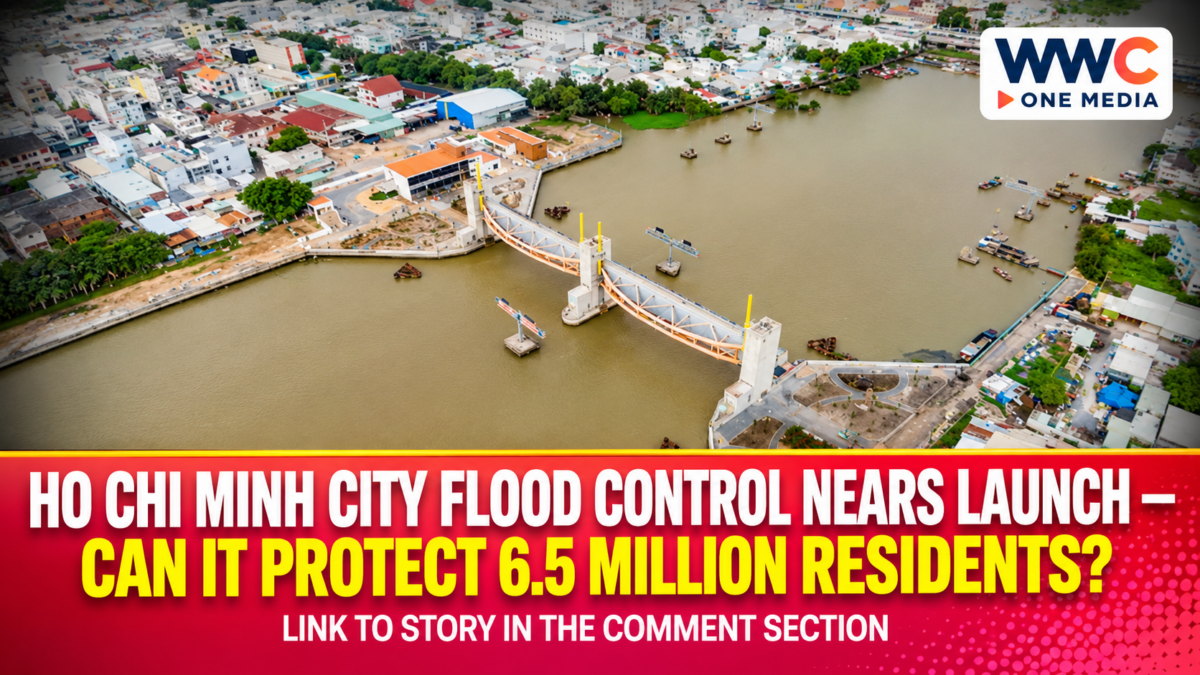
HO CHI MINH CITY, Vietnam — Vietnam’s largest southern city is approaching its November 2026 target for completing a long-delayed tidal flood-control project, following an October government inspection that recorded construction progress above 95%. The VND10 trillion scheme is intended to limit tidal flooding across a 570-square-kilometre area associated with approximately 6.5 million residents.
The next test is not simply finishing the concrete and steel. It is whether a network of gates, embankments, pumps and monitoring equipment can work together while the city’s drainage infrastructure handles rainfall that tidal barriers cannot eliminate on their own.
Flood control reaches a critical handover stage
The project formally addresses tidal flooding in Ho Chi Minh City while taking climate change into account. Construction began in 2016, with completion initially expected in 2018.
An official government inspection on Oct. 13, 2026, documented repeated interruptions linked to legal issues and arrangements for paying the investor.
The inspection reported progress above 95%, with approximately 1,500 personnel mobilised to help reach the November completion target.
That percentage is a construction-progress snapshot, not confirmation that the entire system has completed testing or entered service.
Ho Chi Minh City and investor Trung Nam Group formally restarted project work on Feb. 2, 2026. At that event, the city reported overall progress of approximately 92% and outlined the remaining inspection, equipment adjustment, system integration, trial operation and acceptance work.
These stages matter because flood-control infrastructure must work as a connected system. Completed gates and embankments cannot deliver their full intended benefit without coordinated control, inspection and maintenance.
What the VND10 trillion tidal barriers are designed to do
The official project design includes six large gated sluices, two smaller sluices, approximately seven kilometres of protective embankments and associated high-capacity pumping equipment.
Monitoring and automated control facilities are also intended to support coordinated operations.
The basic operating principle is straightforward. During high tides, gates restrict river water from entering protected waterways. When external water levels permit, operators can release water towards the rivers.
The city outlined this approach during the February restart of the Bến Nghé gate.
The intended benefits extend beyond blocking incoming tidal water. Managing canal levels could provide additional capacity for urban drainage systems, particularly when heavy rainfall coincides with elevated tides.
The project also aims to limit saltwater intrusion within its controlled area and preserve inland waterway access.
However, these design objectives are not guarantees that every road or neighbourhood will remain dry. Actual results depend on operating procedures, rainfall conditions and the wider drainage network.
Why years of delays matter for infrastructure investment
A project originally expected to finish in 2018 but still undergoing completion work in 2026 illustrates how administrative and financing difficulties can postpone public benefits even when much of the physical infrastructure has been built.
Official government accounts identify legal and investor-payment obstacles among the causes of the interruptions.
National authorities subsequently introduced measures intended to address those obstacles and support project completion. Those administrative complications should not, by themselves, be interpreted as proof of wrongdoing.
The project’s financing structure also deserves attention.
The government describes it as a build-transfer, or BT, investment led by Trung Nam Group. This structure makes it particularly important to distinguish construction completion from formal handover and continuing operation.
Similar implementation questions arise across Southeast Asia.
WWC ONE MEDIA previously examined a Metro Manila flood-control project’s extended completion deadline, highlighting why infrastructure testing and turnover matter alongside physical construction.
The two projects are separate, but both illustrate the importance of evaluating infrastructure beyond its announced completion date.
Why tidal barriers cannot replace citywide drainage
A tidal gate controls one route through which water can enter a neighbourhood. Heavy rainfall, however, produces water inside the protected area.
That water still needs a route through drains, canals, pumps or storage facilities.
Ho Chi Minh City’s wider flood-management programme recognises this challenge.
The city’s published 2026–2030 programme envisages 87 flood-related projects with total planned investment exceeding VND142 trillion.
It includes efforts to identify drainage bottlenecks, improve existing infrastructure and develop smarter monitoring systems for rainfall, tides and water levels.
The tidal-control scheme therefore forms part of a wider infrastructure strategy rather than a complete solution on its own.
This need for coordinated planning also has relevance for the Philippines.
WWC has examined the challenge of incomplete flood-control master planning and the importance of updating Philippine flood-management strategies.
The common policy question is whether individual projects fit into a broader system that can manage water across connected urban areas.
What success could mean for households and businesses
The government’s project description associates the intended protection area with approximately 6.5 million residents across central and southern parts of Ho Chi Minh City.
That is a projected beneficiary population, not a verified count of people already protected by a fully operational system.
For households, successful tidal control could reduce instances of river water entering local waterways during peak tides.
For businesses, more reliable flood management could support transport, deliveries and access to commercial premises.
These remain potential benefits rather than measured economic outcomes.
The more meaningful test will be whether flooding becomes less frequent, shallower or shorter in the locations the system is intended to protect.
A credible assessment would compare performance before and after commissioning while accounting for rainfall and river levels.
Public reporting on gate operations, maintenance arrangements and flood outcomes would help establish whether the investment is delivering practical protection.
What happens next?
November 2026 remains the completion target recorded during the October government inspection.
The official records reviewed for this article do not establish a final system-wide acceptance date, the start of full commercial operation or independently measured reductions in flooding.
The milestones to monitor are final construction, integrated testing, official acceptance, handover and sustained operation during periods of elevated tides and heavy rainfall.
For Ho Chi Minh City, the defining achievement will not be announcing the completion of a long-delayed project. It will be demonstrating that the infrastructure works with the wider drainage system when communities need it most.
Frequently asked questions
What is the Ho Chi Minh City flood-control project?
It is a VND10 trillion tidal-control scheme involving sluice gates, embankments, pumping facilities and monitoring equipment intended to reduce tidal flooding in a defined part of the city.
Is the tidal flood-control project already operational?
A November 2026 completion target was identified in the October government inspection. The reviewed official records do not establish full system-wide operation as of Nov. 22, 2026.
How many people could benefit?
The government associates the intended 570-square-kilometre protection area with approximately 6.5 million residents. This figure represents projected beneficiaries rather than a measured result.
Will the project eliminate flooding across Ho Chi Minh City?
No such outcome has been established. Tidal barriers can restrict tidal inflows, but rainfall, drainage capacity and ongoing maintenance will continue to influence urban flooding.
4. WordPress-ready HTML
The HTML should be pasted into WordPress’s Code Editor or a Custom HTML block. It preserves the article’s headings, paragraphs, FAQs and three inline WWC links.