KUALA LUMPUR, Malaysia — Malaysia’s airbase drug investigation has put military baggage screening and access controls under closer scrutiny after air force personnel identified suspicious luggage at Subang Air Base on Nov. 17, 2026. A statement by the Royal Malaysian Air Force chief, reproduced by Malaysia’s public broadcaster on Nov. 20, describes an internal detection followed by a referral to police for investigation.
The central question is no longer simply whether an irregular shipment was intercepted. It is whether Malaysia can preserve the screening controls that worked in this instance while establishing how the luggage entered the transport process and whether any wider institutional improvements are necessary.
Malaysia Airbase Drug Probe: What the Military Has Said
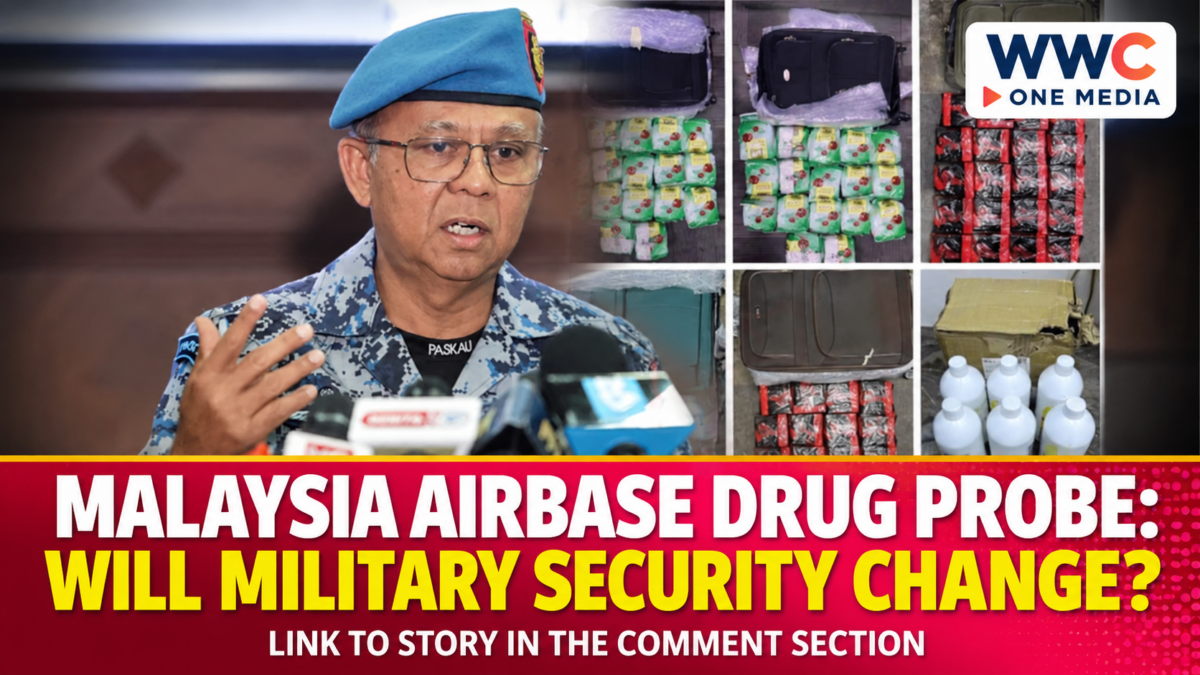
The air force’s publicly reported position is that its personnel identified luggage lacking the security-screening confirmation normally associated with the required checks. Ground-defence personnel then carried out additional screening, identifying items that required closer investigation. The matter was transferred to the police narcotics division.
This sequence is significant because it separates detection from criminal adjudication. A missing inspection marker can justify asking questions, checking documentation and examining baggage. It does not, by itself, establish what a bag contains or who may have committed an offence.
The air force chief’s Nov. 20 statement, as reproduced by the public broadcaster, also emphasised cooperation with police and action against personnel found responsible. Such statements describe an institution’s announced response, not a court finding against any individual.
Why the Screening Process Matters
Military transport depends on predictable procedures as well as trusted personnel. An effective process should make it possible to establish whether an item has been inspected, who authorised its movement and what happens when the required confirmation cannot be found.
In this case, the absence of visible security confirmation reportedly brought the luggage to the attention of personnel conducting checks. That makes the screening procedure itself an important subject of examination, separate from the criminal allegations being investigated.
A useful review would consider whether the same requirements apply consistently across different personnel and journeys, whether unscreened baggage can be separated from cleared baggage, and whether irregularities are recorded in a way investigators can later reconstruct.
These are questions for investigators and military managers. The public record reviewed for this draft does not establish that particular supervisors knowingly ignored an alert, that a system-wide bypass existed, or that any proposed reform has already been adopted.
A Broader Question About Aviation and Border Controls
The case also raises a policy distinction between civilian airport security and military aviation. Civilian passengers encounter formal security checks as part of a public transport network. Military transport may involve different missions, controlled facilities and operational exceptions, but it still requires auditable safeguards against unauthorised items.
WWC previously examined Malaysia’s stronger screening arrangements at Kuala Lumpur International Airport. That earlier discussion provides useful context for how the country has approached more intensive passenger and baggage checks in selected circumstances.
Another WWC report on planned body scanners at the Johor–Singapore RTS Link checkpoint shows that screening technology is only one part of a broader border-control framework. Clear accountability and follow-up examination matter just as much as the equipment itself.
Neither civilian initiative proves that the procedures at Subang were identical or that an already approved civilian measure will automatically be extended to military bases.
What This Could Mean for Regional Enforcement
For countries connected by trade, passenger routes and aviation networks, an investigation involving suspected prohibited cargo is also a reminder of the value of coordination between agencies. Suspected substances may be discovered in one jurisdiction while questions about ownership, movement and intended destination require additional evidence.
For a Philippine readership, WWC’s earlier coverage of a suspected illegal-drug shipment discovered at Manila’s port is a separate example of why transportation records and inspections can matter to cross-border investigations.
The Manila incident and the Subang inquiry should not be presented as linked operations. No primary record examined for this draft establishes a connection between them, and a shared general subject is not evidence of a common network.
Nor should arrests or investigative detention be treated as convictions. Each person’s alleged role would need to be established through admissible evidence and the applicable legal process.
What an Independent Review Should Establish
Analysis: A credible institutional review would examine several layers of control without assuming that the interception itself proves either comprehensive success or comprehensive failure.
First, investigators would need a clear chronology: how the luggage reached the relevant area, which checks were required, and when personnel identified the discrepancy. Second, the military would benefit from testing how accurately its screening documentation can be traced back to the item and the person responsible for verifying it.
Third, officials would need to determine whether the incident illustrates an isolated attempted breach or a more general vulnerability. That distinction cannot be resolved from the discovery alone.
The strongest immediate conclusion is narrower: personnel noticed a warning sign, additional checks were undertaken, and the matter became a police investigation. Any claim of organised complicity, an established smuggling route or a proven breakdown across the wider service requires more specific evidence.
What Happens Next?
The immediate next step is the police investigation and any further official disclosures about the status of the case. The public also has an interest in whether the military announces changes to baggage-screening procedures, staff supervision, access controls or internal reporting.
The crucial distinction will be between measures under discussion and measures formally implemented. Unless an agency publishes an operative instruction or announces a confirmed change, a proposal should not be described as a new rule.
For WWC, the most useful follow-up is not another retelling of the initial interception. It is a documented account of any new arrests, court proceedings or operational reforms, with dates and details verified from the relevant original government or judicial records before publication.
Frequently Asked Questions
What triggered scrutiny of luggage at Subang Air Base?
The Nov. 20 air force statement, as reproduced by Malaysia’s public broadcaster, describes luggage that lacked the required screening confirmation, prompting further checks.
Does the discovery prove military personnel were guilty?
No. Investigation and detention are not proof of guilt. Responsibility must be determined through evidence and the legal process.
Have new screening rules for military bases been confirmed?
The primary documents needed to confirm any newly adopted military-wide rule were not obtained for this draft. Such a measure should not be presented as implemented without an official record.
Is the Subang investigation connected to the Philippines?
A direct operational connection has not been established by the primary records examined for this draft. Separate regional incidents should not be conflated.