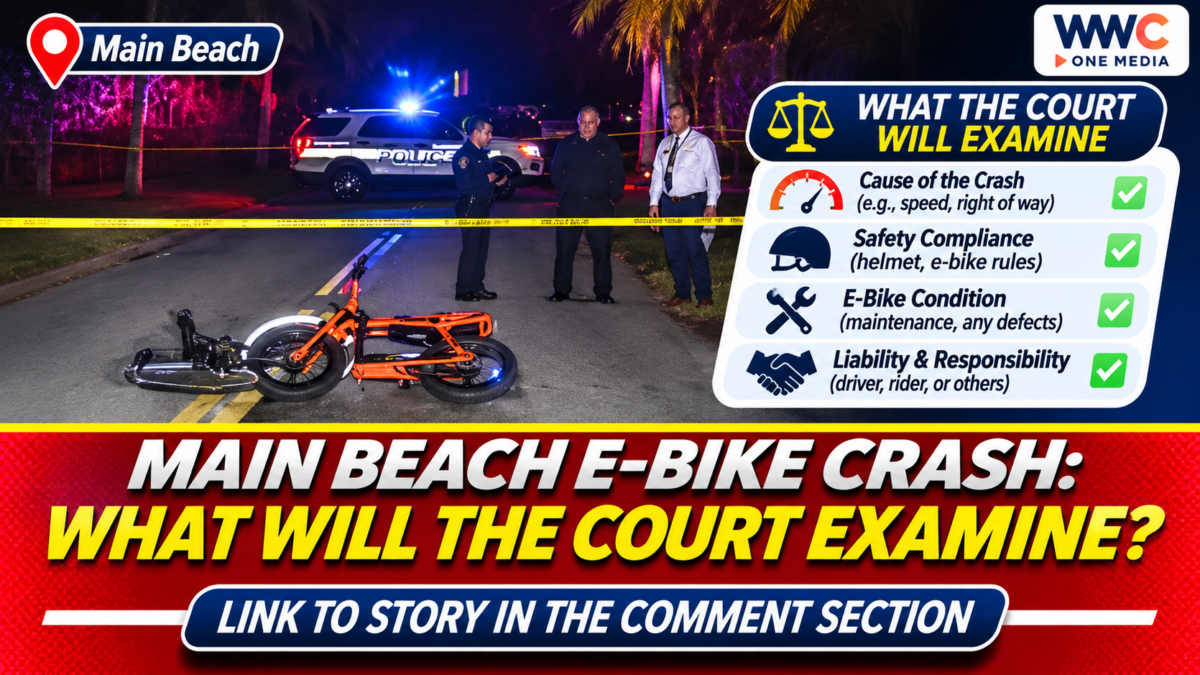
GOLD COAST, Australia — Queensland police charged an 18-year-old woman following a Nov. 17, 2026 collision involving a vehicle and five e-bike riders on Seaworld Drive at Main Beach. The police announcement, issued the following day, identifies a drink-driving charge and a scheduled appearance before Southport Magistrates Court on Dec. 14.
The proceedings raise two separate issues: what prosecutors can establish about the driver’s conduct, and how Queensland’s rules protect people travelling by bicycle or e-bike alongside motor traffic. A charge is not a finding of guilt, and the court will have to assess the evidence rather than rely on the public description of the incident.
What the Main Beach e-bike crash record establishes
The police account places the collision at approximately 10 p.m. on Nov. 17 on Seaworld Drive. It describes a Suzuki Jimny carrying two female occupants and five male e-bike riders travelling in a parking lane. Police said the group comprised four 17-year-olds and one 18-year-old.
The riders were thrown from their bicycles. The 18-year-old rider was taken to hospital with injuries described as not life-threatening. The statement also records that a 17-year-old passenger in the vehicle fell from it and received treatment for minor injuries.
Those details identify the people involved and the reported immediate consequences. They do not, on their own, establish the precise movements of the vehicle and bicycles immediately before impact or decide responsibility in a criminal proceeding.
That distinction matters for any public discussion of a crash involving young riders. Public concern about cycling behaviour cannot replace evidence about a particular driver’s actions. WWC has previously examined a separate incident involving teenage cyclists and e-bike riders in Singapore, but that incident provides no evidence about what occurred at Main Beach.
What the drink-driving allegation means
The police announcement says the woman driving the Jimny allegedly returned a breath-alcohol reading of 0.102 per cent. It records one drink-driving charge and an infringement notice for driving without due care and attention.
The reported reading is an allegation in an enforcement record, not a court determination. It would be wrong to treat it as proof that alcohol caused the collision, or to anticipate a conviction before a hearing.
The police also reported infringement notices involving the 17-year-old passenger, relating to a seatbelt and travelling with part of the body outside the vehicle. Those allegations are distinct from the charge against the driver. They should not be combined into a single claim of proven wrongdoing.
For comparison rather than a factual connection, WWC earlier reported on a drink-driving arrest following a three-car collision in Singapore. Different laws and evidence apply to different cases, but both illustrate why an arrest or charge must be distinguished from a judicial finding.
Queensland’s e-bike rules are a separate safety question
Queensland’s official transport guidance defines a legal e-bike principally as a pedal-powered bicycle with limited electrical assistance. The published specifications include a maximum continuous rated motor output of 250 watts and motor assistance that stops at 25 kilometres per hour.
The same guidance requires helmets, compliance with bicycle road rules and safe treatment of pedestrians. From Aug. 31, 2026, Queensland introduced a general requirement for e-bike riders to be at least 16 and hold a valid driver licence, subject to published exemptions.
These requirements form useful background but should not be misapplied. The police announcement about Main Beach does not establish whether any of the five bicycles were non-compliant, whether their riders breached an e-bike rule or whether any such issue contributed to the crash.
It is also important to distinguish rules for riders from the separate obligations imposed on motorists. The presence of an e-bike does not, by itself, establish a cycling offence or excuse unsafe driving.
Why evidence matters more than early assumptions
A criminal case arising from a traffic collision can involve questions about the vehicle’s path, the road layout, the positions of other road users and the reliability of testing. These are possible evidentiary questions, not findings about this incident.
The reported location in a parking lane may become relevant to the account of how the collision happened. But the publicly available summary does not provide enough detail to reconstruct the vehicle’s trajectory or the riders’ movements. WWC cannot responsibly supply a reconstruction that the record itself does not contain.
This restraint matters especially where minors are involved. Identifying young people unnecessarily, drawing conclusions about their behaviour or circulating unverified visuals would add little to the public’s understanding of road safety.
WWC has also covered a separate case in which a driver’s conduct and a cyclist’s safety violations were assessed independently. The lesson for this case is methodological: different potential breaches must be evaluated on their own evidence. The earlier case does not determine responsibility at Main Beach.
What this could mean for road safety
Analysis: The Main Beach case shows why the expansion of e-bike use requires attention to both rider compliance and motorists’ obligations. Training, clear road design, alcohol enforcement and predictable rules can complement one another; no single measure can resolve every risk.
Queensland’s published e-bike rules address vehicle specifications and rider behaviour. They do not answer the criminal questions raised by this collision. Likewise, a drink-driving charge does not establish that the riders failed to follow the law.
A useful public discussion therefore keeps three questions apart: what happened on the roadway, what conduct can be proved under the law and what improvements might reduce the likelihood of another collision. Blurring them could mislead readers about a pending case.
What happens next
The police release lists Dec. 14, 2026 as the driver’s scheduled appearance at Southport Magistrates Court. As of Nov. 22, that date is still ahead. A listing is not a judgment, and further procedural developments would need to be checked against a current court record before the story is updated.
The immediate newsroom priority is to confirm the latest court listing, obtain any available primary case information and preserve the presumption of innocence. Until then, the incident should be reported as a charge arising from an alleged set of circumstances, not as a concluded determination of blame.
Frequently asked questions
Where did the Main Beach e-bike crash happen?
Queensland Police placed the Nov. 17 collision on Seaworld Drive at Main Beach on the Gold Coast.
How many e-bike riders were involved?
The police announcement identified five male riders: four aged 17 and one aged 18.
What charge was announced?
Police announced a drink-driving charge against the 18-year-old motorist, together with an infringement notice for driving without due care and attention. The charge is not a conviction.
When is the court appearance?
The police release listed Dec. 14, 2026 at Southport Magistrates Court. That scheduled date requires fresh confirmation before publication or later updates.