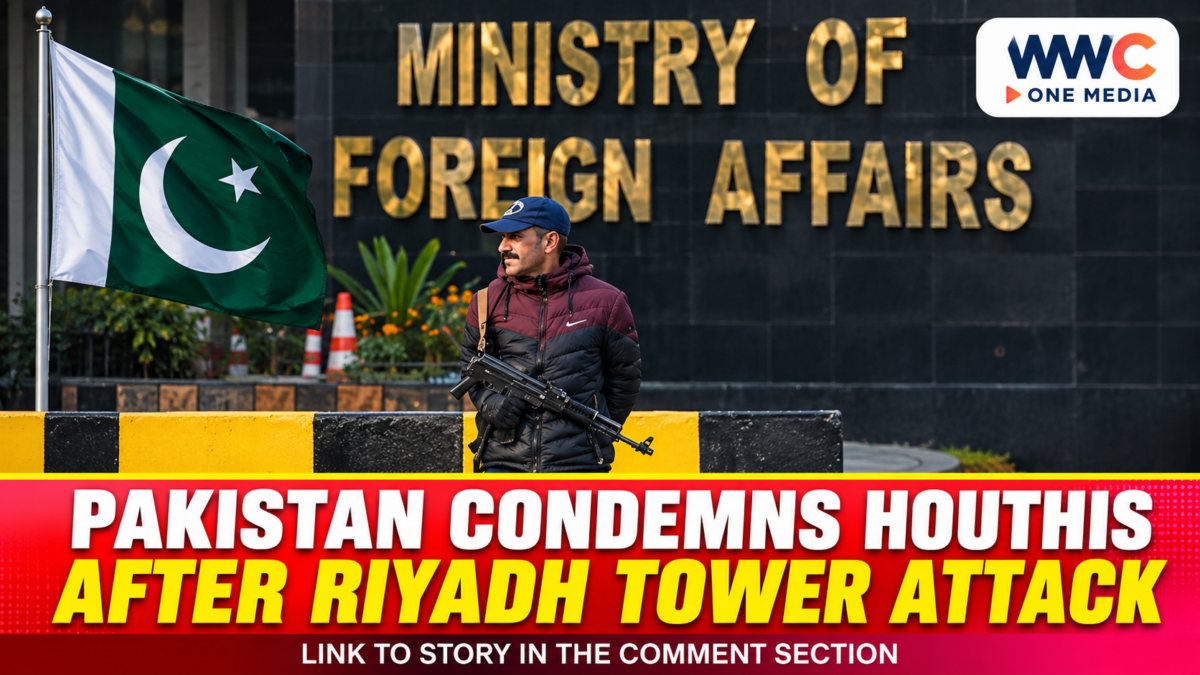
akistan condemned the Houthi attack on a tower in Riyadh’s King Abdullah Financial District on Nov. 20, a day after Saudi authorities reported damage to several floors of the building and neighbouring structures. Prime Minister Shehbaz Sharif repeated Pakistan’s support for Saudi Arabia on Nov. 21, describing attacks on civilian and economic facilities as unacceptable.
The diplomatic response followed an incident that Saudi Civil Defense said caused material damage but no injuries. The statements from Riyadh and Islamabad establish the reported damage and Pakistan’s position; they do not, by themselves, provide a complete account of the weapon used, the operational sequence or any wider military response. Saudi Press Agency+2
The distinction matters as governments respond to attacks on civilian and economic sites. A formal condemnation signals a country’s diplomatic position, but it should not automatically be interpreted as an announcement of military action.
What Pakistan officially said about the Riyadh attack
Pakistan’s Foreign Office condemned the attack on Nov. 20. The statement was delivered by Foreign Office Spokesperson Sajjad Haider Khan and described the incident as a violation of Saudi Arabia’s sovereignty and a threat to regional peace and security.
The statement said Pakistan stood with the Saudi government and people. It also supported the Kingdom’s right to defend its sovereignty and territorial integrity and to protect its citizens and residents.
The wording established Islamabad’s diplomatic position without announcing a new military operation or specifying any operational commitment in response to the incident. Radio Pakistan+1
The following day, Sharif issued a separate condemnation through his official public statement. He reaffirmed Pakistan’s solidarity with Saudi Arabia and said Islamabad would continue supporting efforts aimed at lasting peace and stability in the region. Radio Pakistan
What Saudi authorities confirmed about the damage
Saudi Arabia’s General Directorate of Civil Defense said emergency teams responded on Nov. 19 after one of the towers in Riyadh’s financial district was targeted. Its statement reported material damage to several floors of the tower and neighbouring buildings, with no injuries reported.
The agency also said the relevant authorities responded immediately and implemented the procedures used to handle such incidents and protect people and property. Saudi Press Agency
Saudi Arabia’s Foreign Ministry separately condemned attacks targeting civilian and economic facilities in Riyadh. Its statement said the incidents had caused material damage in the King Abdullah Financial District and asserted the Kingdom’s right to take measures to defend its sovereignty and protect national assets. Saudi Press Agency
The public Saudi records reviewed for this report do not provide a full technical account of the attack. They do not establish the precise weapon trajectory, the total cost of repairs, or whether financial services in the district were interrupted.
That limit is important. Physical damage to a building is confirmed in the civil-defence statement, but broader claims about economic losses or disruption require separate evidence.
Why Pakistan’s response carries diplomatic weight
Pakistan’s statements place the incident within its established diplomatic relationship with Saudi Arabia. Islamabad publicly reaffirmed support for the Kingdom’s security and territorial integrity, while also calling for regional peace and stability.
This is not the first time Pakistan has addressed attacks affecting Saudi territory. In October, Pakistan joined Saudi Arabia, Egypt and Türkiye in a joint statement condemning continuing Houthi attacks, including an attack on King Khalid International Airport in Riyadh. The four governments called for the attacks to stop and expressed support for measures to protect Saudi territory and civilians. Ministry of Foreign Affairs Pakistan+1
The wider diplomatic and security background has also featured in WWC’s previous coverage of Saudi Arabia’s regional partners and their discussions on responding to Houthi attacks.
Analysis: Pakistan’s public condemnation reinforces its diplomatic alignment with Saudi Arabia. However, a statement of solidarity is not the same as a decision to enter a military operation. Any claim that the latest condemnation activates a defence commitment would require an official announcement or agreement establishing that specific action.
The wider security concern for the region
The attack also adds to the security concerns surrounding Riyadh and other locations in Saudi Arabia. The Kingdom’s official statements describe the targeted sites as civilian and economic facilities, placing the protection of residents, businesses and infrastructure at the centre of the response.
The implications extend beyond the two governments. Saudi Arabia hosts a large overseas workforce, including Filipinos. WWC previously reported on the Department of Migrant Workers’ monitoring of overseas Filipino workers in Saudi Arabia following earlier missile and drone incidents.
That earlier monitoring report concerned separate incidents in September. It should not be treated as evidence of the current safety status of Filipino workers after the Nov. 19 tower attack. No new injury or evacuation information about Filipino workers from this specific incident is established by the Saudi and Pakistani records reviewed here.
The security situation also has implications for regional diplomacy. WWC has previously examined Pakistan, Saudi Arabia and Türkiye’s planned discussions on the Houthi conflict, including the diplomatic options being considered alongside security concerns.
What the official statements do not establish
The available records confirm Saudi reports of building damage and Pakistan’s condemnation. They do not provide independent forensic findings identifying the precise weapon, a detailed account of how the attack was carried out, or a complete assessment of damage to the affected buildings.
They also do not establish that Pakistan has announced a new military deployment, retaliatory action or a change in its existing defence arrangements because of this incident.
The distinction between a government’s political position and a concrete security decision is essential. Readers should not interpret diplomatic language as proof that a new military confrontation has begun.
What happens next
Further official updates from Saudi authorities may clarify the damage assessment, the investigation and any additional security measures. Pakistan may also issue further diplomatic statements as the regional situation develops.
For now, the confirmed public record is narrower than some broader claims about escalation: Saudi authorities reported material damage and no injuries at the tower, while Pakistan condemned the attack and reaffirmed support for Saudi Arabia.
The next meaningful development will be any documented investigation finding or formal policy decision, not speculation about what either government might do.
Frequently asked questions
1. When did Pakistan condemn the Riyadh financial district attack?
Pakistan’s Foreign Office condemned the attack on Nov. 20, 2026. Prime Minister Shehbaz Sharif reiterated the condemnation on Nov. 21.
2. What was damaged in Riyadh?
Saudi Civil Defense reported material damage to several floors of a tower in Riyadh’s financial district and to neighbouring buildings.
3. Were there casualties?
Saudi Civil Defense reported that no injuries occurred in the Nov. 19 tower incident.
4. Did Pakistan announce military action against the Houthis?
The Pakistani statements reviewed for this report condemned the attack and reaffirmed support for Saudi Arabia. They did not announce a new military operation in response to this incident.
5. Did the attack disrupt Saudi financial services?
The official statements reviewed confirm physical damage but do not establish whether financial services or business operations in the district were interrupted.