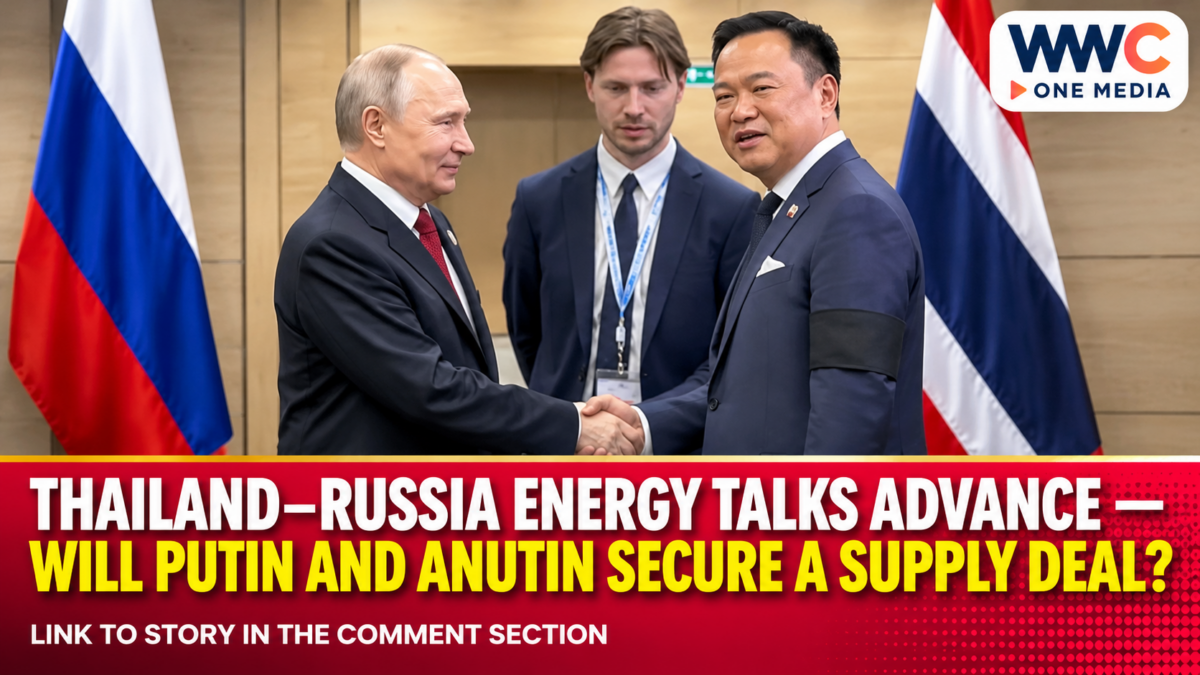
Thai Prime Minister Anutin Charnvirakul met Russian President Vladimir Putin in Shenzhen on Nov. 18, 2026, with energy among the areas discussed during their bilateral talks alongside the APEC leaders’ gathering. Thailand’s official account, released on Nov. 19, confirms the discussion but does not announce a signed oil or liquefied natural gas (LNG) purchase agreement.
The distinction matters for a country seeking more dependable fuel supplies. A diplomatic meeting can open a commercial channel, but actual energy security depends on contracted volumes, shipping arrangements, prices and the ability to receive and distribute the fuel.
Thailand–Russia energy talks: what the governments confirmed
Thailand’s Ministry of Foreign Affairs recorded the meeting between Anutin and Putin, attended by Deputy Prime Minister and Foreign Minister Sihasak Phuangketkeow, on Nov. 18. The two sides considered opportunities in trade, investment, agriculture, energy, tourism and education. They also discussed steps towards negotiations on a free-trade agreement between Thailand and the Eurasian Economic Union, of which Russia is a member.
A Thai government gallery separately places the bilateral meeting at the Conrad Shenzhen hotel on Nov. 18. These records establish that the meeting happened and identify its broad agenda. They do not disclose a fuel supplier, buyer, cargo volume, contract value, delivery timetable or an executed energy agreement.
Analysis: A constructive conversation may reduce uncertainty about political willingness to cooperate. It cannot, by itself, establish whether a proposed trade would be commercially viable or legally executable.
June discussions provide a clearer picture of the supply offer
The latest talks followed a June 18 meeting in Kazan, Russia. Thailand’s foreign ministry said at that time that Russia expressed readiness to supply oil, LNG and fertilisers to Thailand. The leaders also discussed defence, security, trade and the possibility of negotiations on an agreement with the Eurasian Economic Union.
The June discussion is significant because it names the energy products under consideration. Even so, the official language described readiness to supply, not a concluded sales contract. A buyer and seller would still need to agree on pricing, volume, quality specifications, delivery terms and other obligations.
At the wider ASEAN–Russia summit in June, the participating leaders adopted a joint statement on energy cooperation and a strategic partnership action plan covering 2026–2030. Those diplomatic documents demonstrate an ongoing policy framework. They should not be represented as evidence of particular fuel cargoes ordered by Thailand.
WWC previously examined Thailand’s long-term gas arrangements with Malaysia’s PETRONAS. That separate production-sharing and gas-sales framework shows the difference between documented commercial arrangements and preliminary government-to-government discussions.
Why Thailand is looking at multiple energy partners
In an Aug. 26 statement to Parliament, Anutin described pressure on Thailand from disruptions to energy supply and transport in the Middle East. His government outlined a decree allowing borrowing of up to 400 billion baht to address energy-related costs and support a transition towards alternative energy and greater efficiency.
The government’s stated borrowing ceiling comprised up to 200 billion baht for affected households, farmers and businesses, with another 200 billion baht for energy efficiency, renewables and related measures. A borrowing authorisation is not the same as proof that the entire amount has been drawn or spent.
This policy context makes a discussion with Russia understandable: countries exposed to imported fuel have reason to examine alternative sellers and routes. But diversification is not automatically achieved by naming another prospective supplier. Reliability depends on how any additional source fits existing infrastructure and contractual commitments.
The regional challenge also appears in WWC’s report on ASEAN energy security and Philippine fuel cooperation, which distinguishes announced cooperation from operational access to petroleum stocks.
A free-trade negotiation is not an energy contract
Thailand and Russia have repeatedly discussed the prospect of negotiations between Thailand and the Eurasian Economic Union. During an Oct. 14 meeting in Bangkok, Russian Deputy Prime Minister Alexei Overchuk and Anutin discussed trade, investment, energy and efforts to advance that trade initiative.
The same Thai government release described Russian willingness to share knowledge concerning small modular reactor technology. That is an expression of possible future cooperation, not evidence that Thailand has approved a reactor project, selected a vendor or committed construction funding.
Analysis: Trade negotiations may eventually influence market access, but they cannot substitute for a specific fuel contract or for any approvals and practical steps a transaction requires. The technical and financial questions for LNG, crude oil and nuclear technology differ substantially.
For energy buyers, a binding agreement must also survive the realities of payment processing, shipping and applicable legal restrictions. The material reviewed here does not establish which firms, banks or vessels would participate in a potential Thailand–Russia supply arrangement.
What the talks could mean for the Philippines
The discussion has regional relevance because Thailand and the Philippines both participate in efforts to strengthen ASEAN fuel resilience. At the Nov. 17 ASEAN Plus Three summit in Manila, Anutin called for greater energy integration through the ASEAN Power Grid and more investment in the energy transition.
That strategy operates alongside bilateral discussions with possible fuel suppliers. One addresses regional infrastructure and long-term resilience; the other may create additional commercial options if concrete contracts eventually emerge.
WWC’s coverage of proposed ASEAN fuel-sharing pilots explains why proposed access to petroleum stocks cannot be equated with immediate delivery during an emergency.
Analysis: Philippine policymakers can watch whether Thailand converts diplomatic outreach into enforceable supply arrangements, but there is no basis to claim that this meeting will lower Philippine pump prices, change the country’s fuel contracts or deliver additional oil to Manila.
What happens next
The next verifiable milestone would be an official announcement identifying parties to a proposed fuel purchase, its commercial scope and any conditions before delivery. Progress on Thailand–Eurasian Economic Union trade negotiations would be a separate milestone, not confirmation that energy supplies have been secured.
As of Nov. 19, the record establishes a high-level meeting, an existing cooperation agenda and Russia’s earlier willingness to discuss oil and LNG supply. It does not yet establish a new Thai–Russian energy supply contract.
FAQ
Did Anutin meet Putin in November 2026?
Yes. Thailand’s official records confirm that the two leaders met in Shenzhen on Nov. 18 during APEC leaders’ week.
Did Thailand sign a Russian oil or LNG deal?
The official meeting summary reviewed does not announce a signed supply contract, contracted quantities or delivery schedule.
What energy products did Russia previously offer to discuss?
Thailand’s June government account identified oil and LNG, alongside fertilisers, when describing Russia’s readiness to supply.