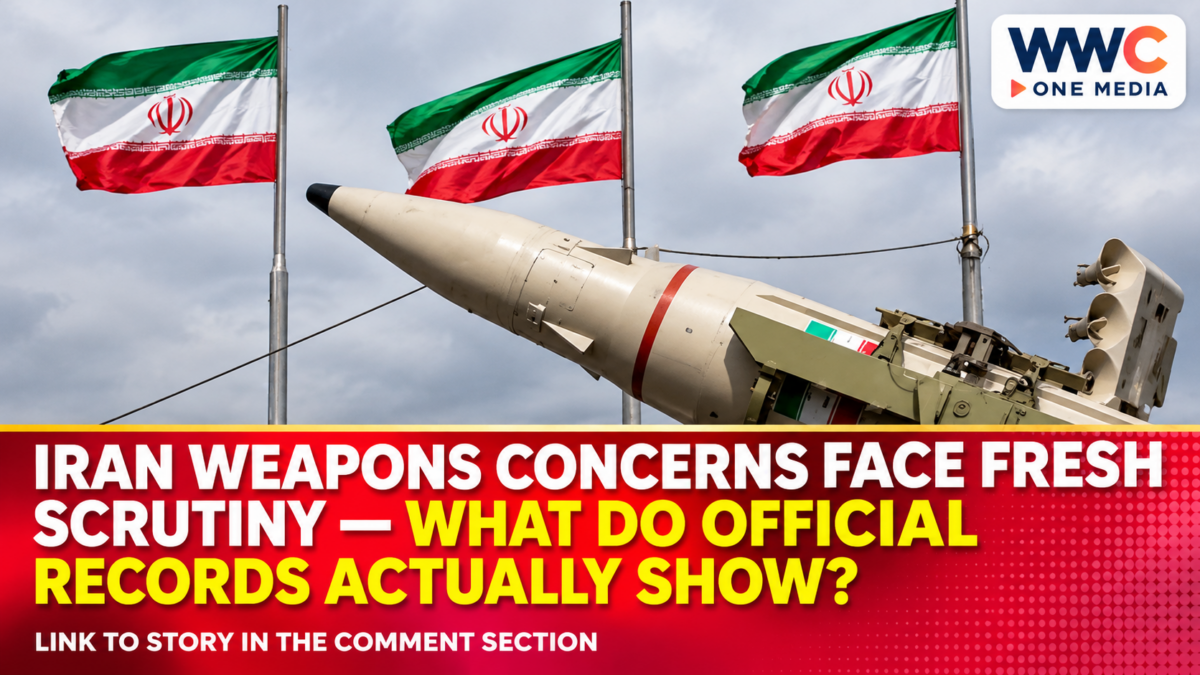
WASHINGTON — Nov. 19, 2026. Questions about possible chemical and biological weapons activity in Iran have returned to the centre of US security discussions, but the public record establishes serious compliance concerns rather than proof of a newly confirmed attack plan. A US government arms-control assessment describes uncertainty over Iranian biological research, while international treaty records confirm that Tehran is bound by prohibitions on chemical and biological weapons.
The distinction matters as the United States and Iran confront one another militarily and diplomatically. A historical intelligence concern, a current allegation, an independently verified weapons programme and an imminent threat are different propositions; treating them as interchangeable would mislead readers.
Iran Weapons Concerns: What Washington Has Put on Record
The US State Department’s 2024 arms-control compliance report states that Iran’s activities raise concerns about compliance with the Biological Weapons Convention. It assesses that Tehran has not abandoned the intention to pursue research and development of biological agents and toxins for offensive purposes.
But the report also acknowledges a significant limit: US officials said they could not differentiate some public-health and defensive research from activities prohibited by the treaty. It did not establish a newly discovered operational biological attack or provide proof that a specific weapon would be used in November 2026.
This uncertainty is not a trivial qualification. Some biological research has legitimate public-health and protective applications. The question for treaty compliance is whether the activity serves prohibited weapons purposes, rather than whether a country possesses scientific expertise.
The public report identifies concerns requiring clarification. It cannot, on its own, substantiate a claim that an attack against US civilians has been ordered or is imminent.
Chemical Weapons Rules Apply to Iran
Iran joined the Chemical Weapons Convention in 1997. The convention prohibits states parties from developing, producing, acquiring, stockpiling, retaining, transferring or using chemical weapons and requires relevant declarations and verification arrangements.
In December 2025, the head of the Organisation for the Prohibition of Chemical Weapons met Iran’s foreign minister and reiterated the organisation’s willingness to engage with all states parties under the convention. An official organisation record also confirms that Iran has been a member since 1997.
The United States has separately published allegations of shortcomings in Iran’s chemical-weapons declarations and expressed concern over certain research. Such findings are US government assessments, not proof that every allegation is accepted by Iran or independently confirmed by an international inspection.
It would also be incorrect to equate the worldwide destruction of declared chemical-weapons stockpiles with a guarantee that no prohibited activity could ever occur. Verification and compliance monitoring remain necessary.
What the Biological Weapons Treaty Establishes
Iran is also a party to the Biological Weapons Convention. The United Nations treaty record confirms its ratification in 1976. The agreement bars weapons-related biological agents and toxins that lack legitimate peaceful justification.
The US compliance report discusses Iran’s biotechnology research and its limited confidence-building submissions. It says the available information raises concerns, while identifying unresolved questions about the purposes of particular activities.
Those statements demonstrate why policymakers seek transparency. They do not provide a publicly verified chain of evidence linking a particular laboratory, specific delivery device, target or planned attack to the latest reports circulating about Iran.
The standard should remain consistent: acknowledge an official allegation when a primary document makes it, distinguish its confidence and limitations, and avoid presenting suspicion as an established event.
Nuclear Questions Are Separate From Chemical and Biological Claims
The Congressional Research Service’s October 2026 assessment describes uncertainty surrounding Iran’s nuclear facilities following military strikes and interruptions to international inspection access. It does not conclude that a reduction in nuclear capabilities necessarily causes a shift towards chemical or biological weapons.
Different weapons categories have distinct treaty frameworks, technical requirements and verification questions. A political assertion that pressure in one area drives activity in another would require additional evidence.
WWC has previously examined US–Iran negotiations, including disputes over military action and the nuclear programme. That diplomatic background is relevant here, but it is not independent proof of a chemical or biological programme.
In particular, no official transcript or first-party recording reviewed for this article independently established the exact wording of the latest remarks attributed to President Donald Trump about gas and biological weapons. Those reported words and any related assertion of an imminent threat have therefore been excluded from the verified news lead.
Why the Distinction Matters for Security and Diplomacy
The existing confrontation gives any weapons allegation considerable political weight. An assertion of imminent danger can influence military preparations, public confidence and negotiations. It should therefore be evaluated against the strength of the evidence, not merely the prominence of the person making it.
Previous US–Iran military warnings illustrate the wider climate of confrontation, while WWC’s examination of the economic costs of the Iran war discusses the consequences for government budgets and energy markets.
What this could mean: More detailed, publicly releasable findings might clarify whether older compliance concerns have developed into a specific new threat. In the absence of those findings, responsible coverage should preserve the difference between an assessment, an allegation and independently demonstrated conduct.
The same principle protects both security reporting and legitimate scrutiny of governments: a credible warning deserves attention, but it does not become proof merely through repetition.
What Happens Next
The most useful developments would be an attributable official transcript of the latest presidential remarks, an updated US intelligence or treaty-compliance statement, a formal international inspection finding, or a documented Iranian government response to a specific allegation.
Until such records become available, the public evidence supports a limited conclusion: Washington has longstanding, explicitly qualified concerns about Iranian chemical and biological activities; Iran is bound by both relevant treaties; and the material reviewed does not establish that a new attack has been authorised or is imminent.
Frequently Asked Questions
Has Iran been proven to be preparing a biological attack on the United States?
No such specific attack plan was established by the primary documents reviewed. A US government report describes concerns about research and treaty compliance, not a verified November attack order.
Is Iran a party to the Chemical Weapons Convention?
Yes. The Organisation for the Prohibition of Chemical Weapons records Iran’s entry into force under the treaty on Dec. 3, 1997.
Has Iran ratified the Biological Weapons Convention?
Yes. The United Nations treaty record documents its ratification in 1976.
Do US compliance concerns prove that Iran has an operational chemical or biological weapon?
No. Official compliance concerns require investigation, but the publicly reviewed records do not establish a newly identified operational weapon or imminent attack.