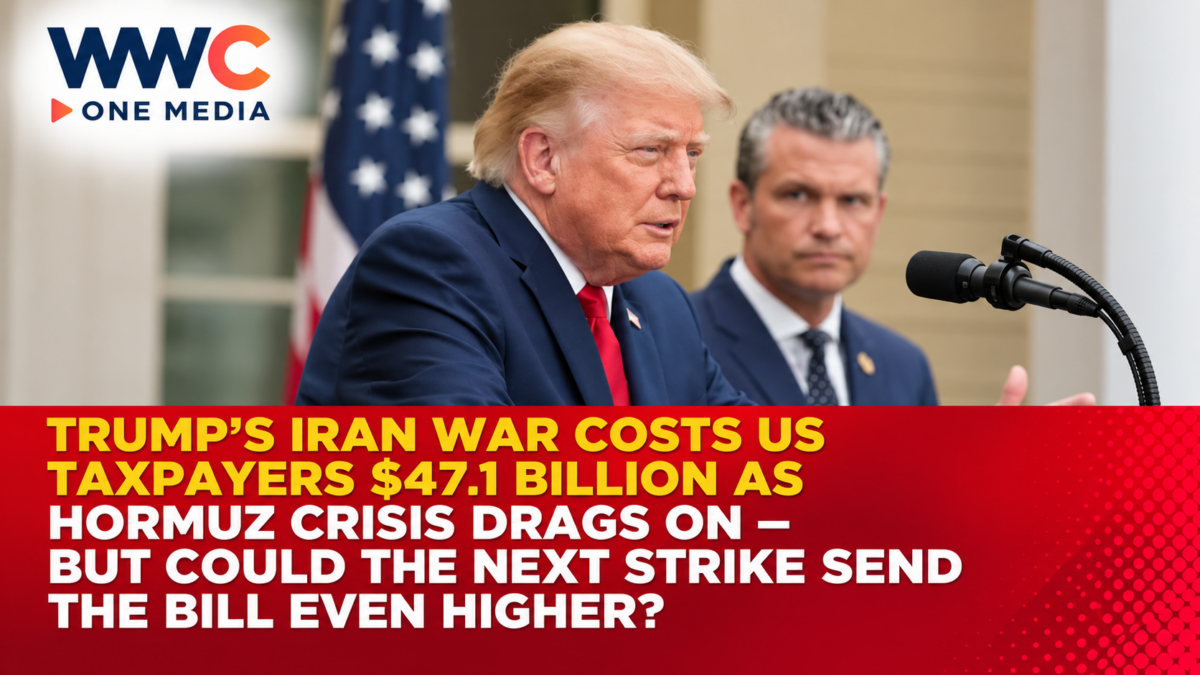
WASHINGTON, D.C. — October 30, 2026. The financial cost of President Donald Trump’s military confrontation with Iran has reached a staggering $47.1 billion, according to the latest estimate from U.S. Central Command, raising fresh questions about the sustainability of American military operations and the risks of renewed fighting in the Middle East.
The cost estimate, covering operations through October 16, was provided to members of Congress and reported by CBS News, the Associated Press and other US news organizations.
It comes nearly eight months after American and Israeli forces launched strikes on Iran on February 28, triggering Iranian retaliation, disruptions to international shipping and a prolonged confrontation over the strategically vital Strait of Hormuz.
The growing expense is becoming a major issue in Washington as the Trump administration considers further military action and seeks additional defense funding.
But the $47.1-billion figure tells only part of the story.
The estimate excludes some damage to US military facilities and does not fully capture the wider economic effects of higher energy prices, shipping disruptions, lost trade and inflation.
With the United States and Iran still struggling to reach a lasting settlement, the biggest question is whether Washington can contain the conflict’s financial and strategic costs—or whether another round of attacks could produce an even more damaging crisis.
CENTCOM estimates Iran war costs at $47.1 billion
The latest assessment from U.S. Central Command puts the direct military cost of the conflict at $47.1 billion as of October 16.
That represents an increase from the approximately $43.6-billion estimate reported in early September.
It also exceeds an earlier $37.5-billion figure discussed by US Defense Secretary Pete Hegseth.
The rising bill reflects months of military operations, the use of expensive precision weapons and the need to replace equipment damaged or lost during the conflict.
According to the CENTCOM breakdown, about $29 billion is associated with replacing munitions expended during the fighting.
Another $11.9 billion covers incremental operational expenses, including the additional costs of supporting military personnel and operations.
Approximately $6.1 billion is attributed to replacing lost equipment.
These figures are rounded and should not be mistaken for a comprehensive accounting of every economic consequence of the war.
The estimate also excludes damage to US military bases in the Middle East.
That means the eventual financial burden could be higher once additional repair costs and other obligations are included.
Nearly $29 billion spent on replacing weapons
The most striking element of the CENTCOM estimate is the enormous cost of replenishing ammunition and other weapons.
At approximately $29 billion, munitions account for more than 60% of the reported direct military bill.
The spending reflects the intensity and expense of modern warfare.
Operations involving advanced aircraft, missiles and air-defense systems can require substantial resources, particularly when military forces must respond to repeated drone and missile threats.
A prolonged conflict also creates a continuing requirement to replenish stockpiles.
The Pentagon has acknowledged pressure on certain weapons inventories.
A Defense Department inspector general report issued in September identified strategic inventory shortfalls associated with the conflict, prompting efforts to accelerate production.
The United States maintains extensive military capabilities, but replacing sophisticated weapons can take time.
This is particularly important when defense manufacturers must satisfy multiple domestic and international requirements.
The longer the confrontation continues, the more difficult it could become to balance immediate operational needs with future readiness.
The cost of war could continue rising by billions every month
The Congressional Budget Office previously estimated that US military operations connected to the Iran conflict had cost more than $38 billion through August 1.
The nonpartisan budget agency also warned that continued operations could cost approximately $2 billion to $3 billion per month, depending on the intensity of the fighting.
Those figures do not represent a guaranteed monthly expense.
Costs can fluctuate considerably as military operations expand, diminish or change in character.
Periods of intensive missile exchanges may result in higher expenditure.
Quieter periods could reduce immediate operating costs without eliminating the need to maintain troops, equipment and regional deployments.
The October CENTCOM estimate demonstrates how the financial burden has continued accumulating even as diplomacy and intermittent reductions in fighting have complicated the conflict.
For lawmakers, the concern extends beyond the amount already spent.
Congress must also consider whether future military operations will require additional appropriations, changes to existing defense spending or delays to other priorities.
Trump faces growing pressure ahead of US midterm elections
The rising war bill is increasingly intertwined with American domestic politics.
The November 3, 2026 midterm elections are approaching as the Trump administration confronts questions about the conflict’s objectives, duration and costs.
Critics argue that the war has continued far longer than early public expectations suggested.
Supporters of the administration emphasize the need to protect US forces, deter Iranian attacks and prevent Tehran from expanding its military capabilities.
The White House has maintained that the president must retain options for responding to Iranian threats.
But Congress remains divided over additional military funding and the appropriate limits on presidential war powers.
The administration has sought substantial supplemental defense appropriations related to the conflict.
Not all of the requested funding has received congressional approval.
This is a separate issue from the CENTCOM cost estimate, which measures military expenditures rather than the value of a newly enacted funding bill.
Congress questions Trump’s authority to continue the conflict
The controversy has also reached Congress through repeated efforts to restrict unilateral military action.
WWC ONE MEDIA previously examined those disputes in US House Votes for Third Time to Limit Trump’s Iran War Powers as Conflict Drags On.
That report discussed lawmakers’ attempts to impose limits on military operations without additional congressional authorization.
Supporters of restrictions emphasize legislative oversight and accountability for extended military involvement.
Opponents argue that limiting the president’s ability to respond could weaken military flexibility and deterrence.
The debate reflects a longstanding constitutional dispute over the division of war powers between Congress and the executive branch.
The latest financial figures are likely to intensify demands for greater transparency about the conflict’s costs and future objectives.
Strait of Hormuz remains the world’s critical oil flashpoint
Beyond the direct military expenditure, the Strait of Hormuz remains one of the most important sources of economic risk.
The waterway connects the Persian Gulf with the Gulf of Oman and provides an essential route for international oil and liquefied natural gas shipments.
Before the conflict, a substantial share of globally traded petroleum passed through the strait.
Disruptions since February have affected shipping activity and contributed to volatility in energy prices.
Restrictions, attacks and the threat of further military action have complicated efforts to restore normal commercial traffic.
The United States has also used naval restrictions targeting Iranian maritime trade, while Iran has sought leverage over the movement of vessels through the region.
The two sides disagree over how restrictions should be lifted and what security guarantees should accompany any settlement.
For international energy markets, the danger extends far beyond the volume of Iranian oil exports.
Any serious disruption involving the wider Persian Gulf could affect shipments from several major energy-producing countries.
This makes Hormuz central to negotiations over the conflict’s future.
Iran has warned that Gulf energy infrastructure could become a target
Iranian officials have repeatedly warned that further American attacks could trigger retaliation against energy assets and other interests across the Gulf.
Those threats have contributed to concern among regional governments, shipping companies and energy traders.
WWC ONE MEDIA previously reported the escalation in Iran Warns US Gulf Energy Assets Are Vulnerable as Strait of Hormuz Tensions Escalate.
The earlier report examined warnings by Iranian officials and the risks posed to energy infrastructure.
It is important to distinguish threats from confirmed attacks.
The existence of an Iranian warning does not establish that a particular energy facility has been struck or damaged.
Nevertheless, the possibility of attacks can affect commodity prices and shipping costs even before damage occurs.
Energy traders often respond to perceived risks by adjusting prices and seeking alternatives.
For oil-importing countries, the resulting increases can add pressure to transport costs, electricity prices and inflation.
September tanker attacks demonstrated the danger at sea
The Strait of Hormuz has already witnessed major incidents involving military and commercial vessels.
In September, US Central Command reported strikes against Iranian oil tankers following missile attacks directed at American naval assets.
Iran disputed elements of the American account.
WWC ONE MEDIA covered these events in Iran Says It Struck a US Drone Boat in Hormuz — But Washington’s Attack on Three Oil Tankers Raises the Stakes Far Higher.
The incident demonstrated how rapidly an exchange involving military assets can threaten commercial shipping routes.
Even when there is no sustained naval battle, threats to tankers can disrupt port operations, shipping schedules and insurance arrangements.
The commercial consequences can continue well after an individual incident ends.
As of October 28, CENTCOM publicly disputed Iranian media claims that vessels had struck naval mines in internationally recognized shipping lanes.
The US military said the principal transit routes remained free of mines.
That statement concerns mine threats specifically.
It should not be interpreted as a guarantee that all security risks to commercial shipping have disappeared.
Oil prices remain elevated as negotiations stall
The energy market continues to price in the possibility of renewed hostilities.
Reuters reported on October 29 that Brent crude was trading near $115 a barrel as investors monitored the latest diplomatic developments.
The price was approximately $10 higher than its September average.
Oil prices can also move because of demand conditions, production decisions and other factors.
However, the continuing uncertainty around Hormuz has remained a major source of market concern.
The effects extend to countries that do not directly participate in the military confrontation.
Higher crude prices can increase the cost of fuel, transportation and petroleum-based products.
For energy-importing economies, the impact may also feed into broader consumer prices.
The Congressional Budget Office previously identified conflict-related energy disruptions as a factor likely to increase US inflation relative to earlier forecasts.
The economic cost of the war is therefore not limited to Pentagon expenditures.
Saudi Arabia’s oil supply problems show how the crisis spreads
The disruption has also placed additional pressure on oil producers attempting to keep international markets supplied.
Saudi Arabia and other exporters have sought alternative shipping and logistics arrangements where possible.
But rerouting energy shipments can involve additional costs, longer journeys and new security risks.
WWC ONE MEDIA explored the problem in Saudi Arabia Is Offering More Oil to Asia Through Oman — But the Crude Still Has to Survive the Strait of Hormuz First.
The report explained why some alternative arrangements still depend on oil passing through vulnerable maritime routes.
For Asian economies, the challenge is especially significant because the region relies heavily on imported petroleum and natural gas.
Sustained disruption may force buyers to seek alternative suppliers, draw down inventories or pay higher transportation costs.
Those adjustments can increase the overall cost of energy even when some shipments continue moving.
Why the war could affect Filipino consumers
The Philippines is not a direct participant in the US–Iran war, but its economy remains exposed to developments in global energy markets.
The country imports most of its petroleum requirements.
Changes in international oil prices and foreign exchange rates can affect domestic gasoline and diesel prices.
Higher transport costs may eventually be reflected in the prices of food and other consumer goods.
Businesses that depend on shipping, aviation or fuel-intensive operations may also face additional expenses.
WWC ONE MEDIA previously examined this connection in Fuel Shock Looms: Oil Prices Could Jump by Up to ₱5 per Liter.
That earlier report described price expectations for a specific September fuel adjustment cycle.
The figures should not be interpreted as an October 30 fuel-price forecast.
The broader lesson remains relevant: prolonged instability in the Middle East can quickly affect Filipino consumers through petroleum costs and imported inflation.
For businesses and policymakers, managing those risks requires monitoring international markets, securing adequate supply and maintaining appropriate contingency plans.
US military losses add another dimension to the cost
The consequences of the conflict are not measured exclusively in dollars.
American service members have been killed and wounded during the months of fighting.
As of the latest October reporting, Pentagon figures cited by the Associated Press indicated 21 US service members killed and approximately 865 wounded, although not every reported death was necessarily directly attributable to combat.
Earlier public reporting had identified a smaller fatality count.
The differing figures partly reflect changes in reporting dates and casualty classifications.
For families affected by the conflict, the long-term consequences include medical care, rehabilitation and the loss of loved ones.
Some expenses associated with veterans’ services and future care are not captured by the immediate military operations estimate.
Civilian casualties and damage affecting populations throughout the Middle East also form part of the conflict’s broader human cost.
These consequences cannot be adequately summarized through a single military spending figure.
Washington and Tehran face another difficult diplomatic test
Diplomatic discussions continue amid warnings of renewed military action.
Recent reporting indicates that Vice President JD Vance contacted Iranian officials as regional mediators sought a possible path toward resuming talks.
However, President Trump has publicly disputed the suggestion that formal peace negotiations had already restarted.
The parties remain divided over the sequencing of sanctions relief, shipping access and security commitments.
Iran has sought changes to American naval restrictions, while Washington has emphasized conditions involving maritime access and Iranian military and nuclear activities.
Regional governments have urged both sides to avoid another major escalation.
But the risk remains that renewed strikes could produce retaliation affecting US facilities, neighboring countries or commercial infrastructure.
The absence of a confirmed comprehensive peace agreement leaves the situation uncertain.
Could another escalation make the financial burden much worse?
The CENTCOM estimate demonstrates that even a period without continuous large-scale fighting can carry enormous financial costs.
Military deployments require personnel, maintenance, logistics and supplies.
The replacement of expensive weapons can continue long after their initial use.
Damage to bases and equipment adds further pressure.
A renewed escalation could therefore increase the financial burden through additional operations, weapons expenditure and infrastructure losses.
But the magnitude of any future increase is uncertain.
It depends on the duration, intensity and geographical scope of possible hostilities.
Forecasts should not be treated as confirmed future spending.
The conflict could also change through successful diplomacy, further military confrontation or prolonged economic pressure without large-scale attacks.
Each scenario would have different consequences for military costs and international markets.
The bigger question: Can Trump contain the war before costs escalate further?
The $47.1-billion estimate represents a major turning point in public understanding of the US–Iran conflict.
What began in late February as a military campaign has continued through months of attacks, diplomatic setbacks, disruptions to energy markets and debates over American military commitments.
The financial burden now includes billions in weapons replacement, operational costs and equipment losses.
And the full economic impact is larger than the Pentagon’s immediate accounting.
The Strait of Hormuz remains a critical source of uncertainty for oil exporters, shipping companies and countries dependent on imported energy.
For the Trump administration, the challenge is balancing security objectives with the political, financial and diplomatic consequences of continued confrontation.
For Iran, the challenge involves managing economic pressure, security threats and the effects of prolonged regional instability.
For the rest of the world, the question is whether diplomacy can restore dependable shipping and reduce energy-market volatility.
America’s direct military bill has already reached $47.1 billion. But unless Washington and Tehran find a durable settlement, the next escalation could turn an expensive conflict into an even greater economic and security crisis—one whose consequences extend far beyond the Middle East.