
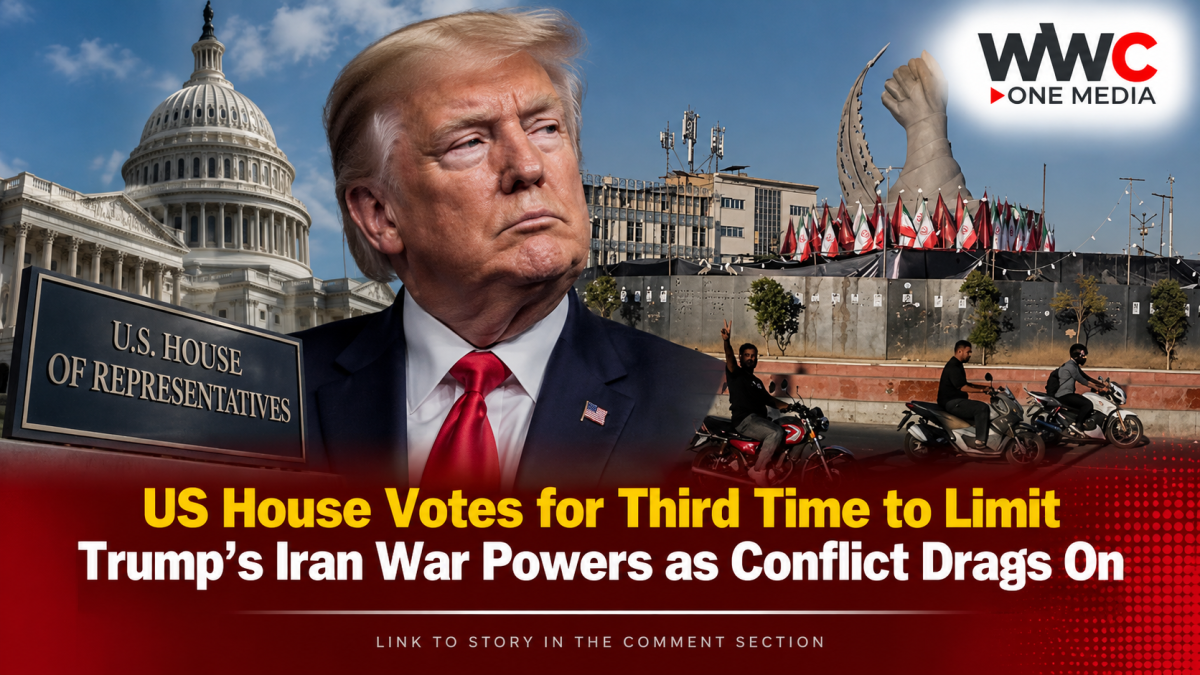
WASHINGTON — The U.S. House of Representatives has voted for the third time to curb President Donald Trump’s authority to continue U.S. military operations against Iran without congressional approval, underscoring the growing debate in Washington over the length and legal basis of the conflict.
The measure passed 220–204 late Tuesday, with seven Republicans joining most Democrats in support. The vote came as the conflict approaches its seventh month and as lawmakers confront questions over U.S. military involvement, congressional war powers and the financial costs of the operation.
House Makes Another Attempt to Restrict Military Action
The resolution invokes the War Powers Resolution, a 1973 law intended to establish congressional oversight of sustained U.S. military operations.
Supporters of the latest measure argue that continued military action requires authorization from Congress. The Trump administration, meanwhile, has maintained its position on the president’s authority to conduct military operations.
The House has already taken similar action twice this summer. Neither previous effort ultimately resulted in a measure reaching the president for enactment.
The latest vote therefore represents another congressional attempt to assert a role in determining how long the United States remains militarily involved in the conflict.
Seven Republicans Break With Trump
The 220–204 vote included seven Republicans who joined Democrats in supporting the resolution, giving the latest effort somewhat broader Republican support than earlier House attempts.
The bipartisan defections highlight disagreements within Congress over the scope of presidential war powers and the continuing U.S. military presence in the region.
Rep. Seth Moulton, D-Mass., who helped push the resolution, argued that Congress should exercise its constitutional role in decisions involving sustained military action. His comments reflected the position of lawmakers seeking greater congressional control over the conflict.
Other lawmakers have taken a different view, arguing that Iran continues to pose a security threat and that the administration needs flexibility to respond to developments in the region.
Senate Holds the Next Key
The House vote does not automatically end U.S. military action.
The resolution would still need to move through the Senate, where its prospects remain uncertain. A similar House war-powers measure approved in July has not advanced in the Senate, while earlier congressional efforts have faced procedural and political obstacles.
The White House has also opposed congressional efforts to restrict the president’s military authority, meaning the resolution faces additional hurdles even if it advances through Congress.
Conflict Continues to Carry Political and Economic Costs
The latest congressional vote comes as the Iran conflict continues to affect U.S. politics and the economy.
The Congressional Budget Office has estimated that U.S. military costs connected to the conflict had reached more than $38 billion by August 1, according to reporting published this week. Rising energy costs and concerns about inflation have also become part of the domestic debate surrounding the operation.
The conflict is also emerging as an issue ahead of the November 2026 U.S. midterm elections, adding another layer to the congressional debate.
A Battle Over Who Controls the War
The latest House vote is therefore about more than a single resolution.
At its core is an ongoing constitutional and political dispute over how much authority the president should have to conduct sustained military operations without a new authorization from Congress.
For now, the House has again voted to place limits on Trump’s Iran-related military authority. But with the Senate’s next move uncertain, the vote does not itself bring the conflict to an end.
The House has spoken for a third time. The bigger question is whether the Senate — and ultimately the White House — will act on it.
WWC ONE MEDIA G.A




Leave a Reply