
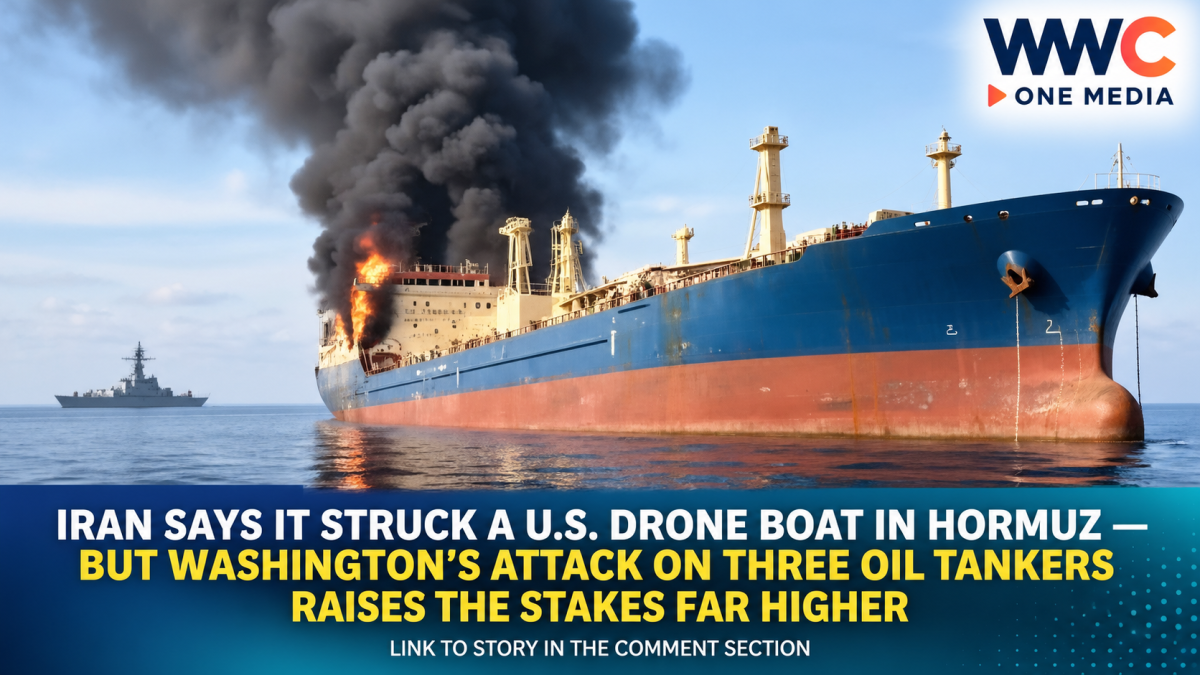
TEHRAN/WASHINGTON — The battle between Iran and the United States is moving deeper into the waters that carry some of the world’s most important energy supplies.
Iran’s Islamic Revolutionary Guard Corps said Sunday that its naval forces attacked a U.S. military unmanned surface vessel attempting to enter what Tehran described as a protected area of the Strait of Hormuz.
In simpler terms, Iran says it attacked an American military drone boat.
That claim came only hours after one of the sharpest maritime escalations of the conflict yet.
The U.S. military says it struck three Iranian crude-oil tankers on Sept. 5 after the IRGC launched ballistic missiles toward an American aircraft carrier and a guided-missile destroyer.
CENTCOM says the U.S. warships avoided the attacks and no American personnel were injured.
Iran disputes that version, claiming its missiles struck American vessels.
Those Iranian damage claims have not been independently verified.
Now, with tanker strikes followed by a claimed attack on an unmanned U.S. naval vessel, the conflict is increasingly centered on a chokepoint that once handled roughly a fifth of the world’s oil supply.
And that is why what happens next in the Strait of Hormuz could matter far beyond Iran and the United States.
The U.S. did not simply threaten the tankers — it hit them
U.S. Central Command publicly identified all three Iranian vessels.
The first was the M/T Downy, which CENTCOM says was permanently disabled off Kharg Island.
The second was the M/T Stark 1, struck near Jask, east of the Strait of Hormuz.
The third was the M/T Kylo, also known as Noxen, an empty crude carrier operating in the Gulf of Oman. CENTCOM says its crew was directed to abandon the ship before U.S. forces struck it repeatedly and rendered it inoperable.
Associated Press reported that two of the tankers were permanently disabled while the empty third tanker was destroyed.
There were no immediately reported crew fatalities from the American strikes.
Iranian media said crews aboard affected vessels were evacuated.
Why did Washington attack commercial-looking oil tankers?
The American justification goes beyond ordinary maritime retaliation.
CENTCOM claims all three vessels were part of a multibillion-dollar shadow shipping network supporting Iran’s Revolutionary Guard and allied armed groups.
That characterization matters.
Washington is effectively arguing that the vessels were not merely civilian components of Iran’s petroleum industry but part of the financial infrastructure sustaining the IRGC.
Adm. Brad Cooper, CENTCOM commander, warned that attacking American ships would bring increasingly severe economic consequences.
CENTCOM went even further, saying the U.S. could target additional elements of Iran’s oil fleet if necessary.
That turns Iran’s tanker fleet itself into a potential battlefield.
What happened before the tanker strikes?
According to the United States, the immediate trigger was an Iranian ballistic-missile attack.
CENTCOM says the IRGC fired missiles toward two U.S. Navy warships operating in regional waters — an aircraft carrier and a guided-missile destroyer.
The American military says both ships successfully evaded multiple attacks.
Iran, however, claims its missiles actually struck the ships and forced them to withdraw.
There is currently no independently verified evidence supporting Tehran’s damage claim.
That distinction is important.
It is accurate to write:
“Iran says it hit U.S. warships.”
It is not yet accurate to write:
“Iran damaged a U.S. carrier and destroyer.”
Tehran then announced its own tanker attacks
After Washington hit the Iranian vessels, Tehran said its naval forces had targeted three oil tankers traveling through what Iran called an unauthorized route in the Strait of Hormuz, plus three vessels it described as connected to the United States elsewhere in the region.
Iran also warned other ships against using routes it has not approved.
Those Iranian strike claims were not independently verified at the time of reporting.
AP similarly reported that Iranian state television said Tehran had targeted three tankers and three American vessels but noted that the assertion could not immediately be confirmed.
That uncertainty should remain in any headline or social-media caption.
Then came the U.S. drone-boat claim
By Sunday, Iran announced yet another engagement.
The IRGC said its navy had attacked an American “military unmanned surface vessel” — also described as a remotely operated vessel — which Tehran said was attempting to enter a restricted area of the Strait of Hormuz.
This is the source of the “naval drone” language appearing in some reports.
The phrase can create confusion because most readers associate “drone” with an aircraft.
This was reportedly a surface craft operating on the water, not a flying drone.
Iran has not publicly provided independently verifiable evidence establishing the extent of damage.
More importantly, AP reported that U.S. Central Command had not confirmed the incident or immediately responded to its request for comment.
The strongest publishable wording is therefore:
“Iran claims it attacked a U.S. unmanned naval vessel.”
Not:
“Iran destroyed a U.S. naval drone.”
The fight is increasingly about Iran’s economic survival
These exchanges are not occurring only for military reasons.
Oil is at the center of the confrontation.
Before the current conflict, roughly 90% of Iranian crude exports passed through Kharg Island, according to Reuters. Iran is also one of OPEC’s largest producers.
That explains why Kharg is strategically sensitive.
Destroying export capacity there would not simply damage military infrastructure.
It could directly undermine the Iranian government’s ability to generate foreign currency.
The U.S. naval blockade and financial sanctions have already placed enormous pressure on Iranian oil exports and the wider economy. Reuters reported this week that Tehran’s access to foreign currency and international financing has become increasingly constrained.
The tanker attacks deepen that strategy.
Instead of merely sanctioning vessels on paper, Washington has demonstrated that it is prepared to physically disable some of them.
Kharg Island may be the most dangerous name in this story
One of the tankers hit Saturday was operating near Kharg Island, Iran’s principal petroleum-export hub.
President Donald Trump had already attracted attention on Aug. 31 by posting an AI-generated video showing Kharg being destroyed and saying the island was being “blown to smithereens.”
Reuters found no military confirmation at that time that such an attack on the main terminal had actually occurred.
Iran has repeatedly warned that any major attack on Kharg would produce a severe response.
That means striking a tanker near the island is especially provocative even though it is not the same thing as destroying the terminal itself.
If U.S. operations escalate from Iranian ships to the core petroleum infrastructure on Kharg, the economic stakes could rise dramatically.
Hormuz traffic is already collapsing
The reason the world is paying so much attention to this fight can be seen in the shipping numbers.
Before the war began on Feb. 28, roughly 125 large commercial vessels crossed the Strait of Hormuz each day, including crude tankers, gas carriers, container ships and bulk vessels.
On Thursday, Reuters reported that only four commodity vessels made the transit.
That was down from nine the previous day and far below the recent 10-day average of about 15.
Some vessels may travel with their Automatic Identification System signals switched off and therefore avoid detection, so the tracking numbers are not a perfect census.
But the overall collapse in visible traffic is unmistakable.
A waterway once crowded with global energy shipments is operating at a fraction of normal activity.
Why the Strait of Hormuz matters to everyone
The Strait sits between Iran and Oman and provides the maritime gateway from the Persian Gulf to the Arabian Sea.
Before the current conflict, about one-fifth of global oil supply moved through the chokepoint.
Exports from major producers including Saudi Arabia, Iraq, Kuwait, the UAE, Qatar and Iran depend heavily on routes through or connected to the strait.
That means even ships that have nothing to do with Washington or Tehran face risk when military forces begin launching missiles, drones and strikes in nearby waters.
Insurance costs rise.
Shipowners reroute or delay vessels.
Cargoes become harder to move.
And fuel prices increase thousands of kilometers away.
Oil markets have already reacted
The latest military escalation helped push international crude prices sharply higher.
Brent crude finished Friday at $96.28 a barrel, its highest closing level since late July, while U.S. West Texas Intermediate ended at $91.48.
For the week:
Brent gained 7.6%.
WTI rose nearly 10%.
Reuters also reported that average U.S. diesel prices reached a record $5.85 per gallon amid supply disruptions linked to Middle Eastern fighting and attacks on Russian refining infrastructure.
That demonstrates how rapidly a naval exchange thousands of kilometers away can turn into an inflation problem.
Higher petroleum prices feed into:
transportation,
air fares,
shipping,
agriculture,
manufacturing,
electricity in some countries,
and ultimately consumer prices.
This conflict was supposed to have entered a quieter phase
The renewed maritime fighting is especially striking because Washington and Tehran had previously reached an interim agreement.
The broader conflict began after U.S. and Israeli attacks on Iran on Feb. 28.
A ceasefire arrangement was announced in June.
But it never produced a permanent settlement.
Military exchanges continued intermittently, and negotiations over Iran’s nuclear program subsequently broke down.
After approximately a month of relative calm, major fighting resumed last week.
The U.S. struck Iranian military targets.
Iran retaliated against U.S. forces and Washington’s regional allies.
And now direct attacks against warships and tankers are again escalating.
Civilians have already been caught in the renewed fighting
The latest naval exchanges cannot be separated from the civilian toll ashore.
AP reported that at least five people were killed earlier in the week during U.S. strikes in southern Iran.
Iranian authorities say one attack struck near a wedding celebration, injuring children and other civilians. AP reporters interviewed injured teenagers being treated in hospital.
Washington has separately said it was reviewing reports concerning the wedding strike.
The renewed escalation therefore carries consequences far beyond ships and oil infrastructure.
Every additional round of retaliation increases the possibility of more civilian casualties, regional attacks and accidental escalation.
Diplomacy appears increasingly distant
The original dispute between Washington and Tehran centered heavily on Iran’s nuclear program.
Those issues remain unresolved.
AP reports that U.S.-Iran negotiations collapsed after a mid-June memorandum of understanding, while Western governments are considering renewed action through the United Nations over Iran’s nuclear obligations.
Vice President JD Vance said this week that Washington sees little prospect for renewed talks while Iranian attacks on shipping continue.
Iran, meanwhile, argues that Washington’s blockade, sanctions and military strikes amount to aggression and economic warfare.
Neither government currently appears prepared to make the concessions demanded by the other.
That leaves both sides increasingly relying on pressure instead.
For Washington:
sanctions, a blockade and military strikes.
For Tehran:
missile attacks, maritime threats and control over access through Hormuz.
The biggest danger is no longer one tanker or one drone boat
The individual incidents are dramatic.
Three Iranian tankers hit.
Two American warships targeted.
Three additional tankers reportedly attacked by Iran.
A U.S. unmanned vessel allegedly struck.
But the larger danger comes from the pattern.
Each side is now establishing a retaliatory logic:
you hit our ships, we hit more of yours.
That makes every new engagement potentially more severe than the last.
And unlike an isolated battlefield deep inside one country, the Strait of Hormuz is an international commercial artery surrounded by civilian shipping and energy infrastructure.
A missile intended for one military target can hit something else.
A tanker can burn.
A ship can sink in a narrow route.
An attack can be misidentified.
And a limited exchange can rapidly become something much larger.
The next confirmation matters
At the moment, one fact should dominate responsible coverage of Sunday’s development:
Iran says it hit the American drone boat. The United States has not publicly confirmed that claim.
Washington’s destruction or disabling of the three Iranian tankers is much more firmly established because CENTCOM itself announced the operation, identified the vessels and released video.
Tehran’s retaliation claims require more caution.
That does not mean they should be dismissed.
It means they should be attributed.
The difference between “Iran struck” and “Iran says it struck” is only three words.
In an active war, those three words matter enormously.
Because the bigger story is no longer simply who hit what on Saturday or Sunday.
The United States is attacking the shipping infrastructure that finances Iran.
Iran is threatening the shipping corridor that helps fuel much of the world.
And if either side decides the latest retaliation was not enough, the next target could make three damaged oil tankers look like the beginning — not the climax — of this escalation.
WWC ONE MEDUA M.J.E



Leave a Reply