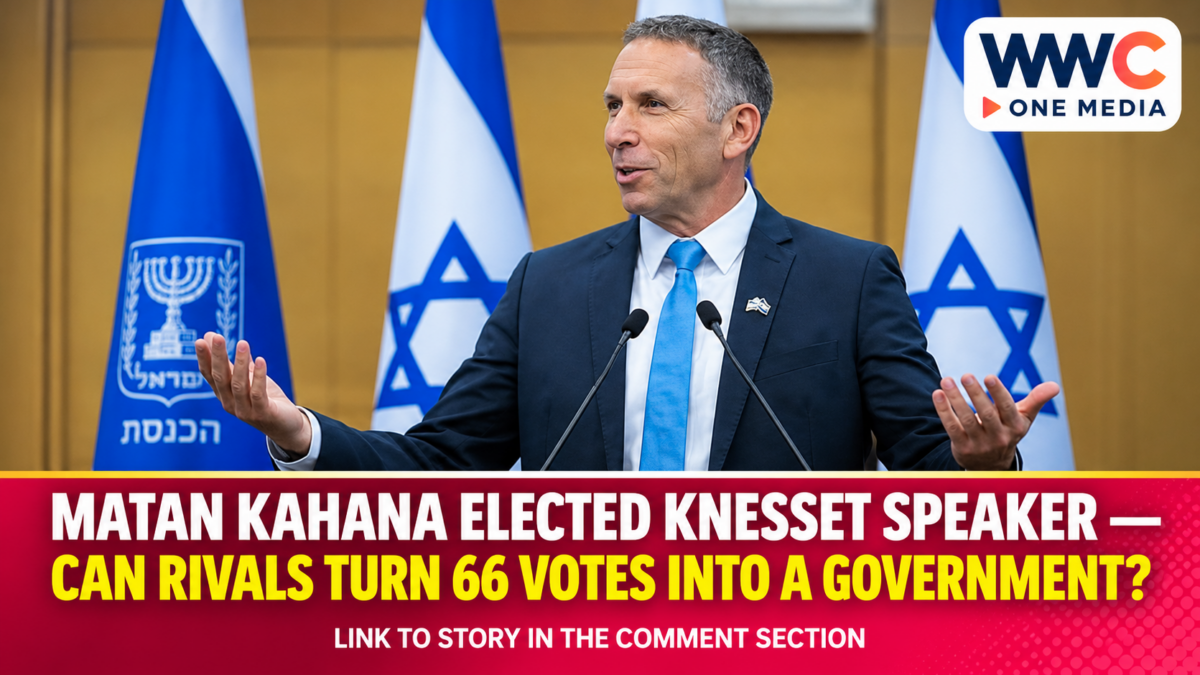
JERUSALEM — Israel’s parliament elected Matan Kahana as Knesset speaker on Nov. 17, 2026, with 66 lawmakers supporting him against 52 for rival candidate Ofir Katz. The Knesset speaker election gives a lawmaker from Gadi Eisenkot’s Yashar party a central parliamentary office while Eisenkot tries to assemble a government to replace Benjamin Netanyahu.
The result changes who chairs the legislature, but not who leads the executive. President Isaac Herzog has assigned Eisenkot the task of forming a government; the speaker’s election neither completes that task nor determines which parties will join a coalition.
Knesset Speaker Election: The Official Vote
The Knesset’s announcement, published late on Nov. 17, records 66 votes for Kahana and 52 for Katz after an extended parliamentary debate. Katz was the competing candidate, while Kahana takes the chair of the 26th Knesset from Amir Ohana.
Kahana’s first address emphasised that the parliament represents all of Israel’s citizens. The commitment is significant as a statement of how he intends to perform the role, but its practical effect will depend on parliamentary decisions.
The final count is a vote for a legislative office, not a confidence vote in a new cabinet. It therefore cannot be translated into proof that all 66 Kahana supporters would back the same prime minister, programme or ministers.
Analysis: The vote is an institutional success for Netanyahu’s opponents. It shows that a majority of those participating could agree on a speaker even though building a governing coalition involves more difficult commitments.
Why the Speaker’s Office Matters
Israel’s Basic Law: The Knesset provides for members to elect their speaker and deputy speakers. It also establishes rules for the speaker’s suspension or dismissal and permits the Knesset to organise its work through parliamentary procedures.
The speaker presides over proceedings and helps administer parliamentary business. The post can affect how lawmakers move through debates and votes, but it does not give its holder unilateral power to enact laws.
This distinction is important for the legislative proposals now facing the new parliament. Even a group capable of choosing its presiding officer must still follow the applicable procedures for legislation and committee work.
WWC previously described the opposition’s proposals to reverse changes to Israel’s judicial and governing institutions. The speaker result changes the political setting for those proposals but does not prove that any particular bill has passed.
Eisenkot’s Mandate Is a Separate Decision
On Nov. 8, President Isaac Herzog formally tasked Yashar leader Gadi Eisenkot with forming Israel’s next government. In explaining the decision, Herzog recorded recommendations from factions representing 67 lawmakers for Eisenkot, 46 for Netanyahu and seven who recommended neither.
A recommendation to the president is not the same as a signed coalition agreement. The president’s selection gives a nominated lawmaker the opportunity to negotiate a government capable of winning parliamentary confidence.
Israel’s official description of government formation sets an initial period of 28 days for the candidate to complete that work. Until the necessary process is completed, the current prime minister remains in office under the applicable caretaker arrangements.
WWC’s earlier report on Herzog’s decision to give Eisenkot the first opportunity to form a government explains the distinction between parliamentary recommendations and the numbers needed to govern.
Analysis: Kahana’s election may help Eisenkot’s allies organise parliamentary work. It does not remove the need to agree on cabinet responsibilities, legislation and a programme acceptable to parties with competing priorities.
What the Election Results Reveal
The official results of the Oct. 27, 2026, general election led to the 26th Knesset, whose 120 members took their seats in November. Israel’s political system requires cooperation among parties when no single grouping can form a viable government on its own.
The president’s consultation figures illustrate that problem. Support for asking Eisenkot to negotiate was broader than the support offered to Netanyahu, but negotiations can change once parties must decide whether to serve in a cabinet or support it from outside.
In particular, the role of Arab-led parliamentary factions has become central to discussions about possible cooperation. The question is not whether their elected lawmakers are entitled to participate in the Knesset; it is which arrangements different parties are prepared to accept when forming a government.
WWC previously examined how Arab-led parties’ recommendations affected Eisenkot’s path to a governing majority. Those earlier recommendations help explain the political arithmetic without proving that a coalition agreement has been finalised.
Parliamentary Power Is Not Executive Power
The election of a speaker can change how parliament functions before a new cabinet is appointed. Yet the separate offices of speaker and prime minister are not interchangeable: one concerns legislative proceedings, while the other concerns government leadership.
Nor should the vote be presented as a referendum on every policy adopted by Netanyahu’s previous governing alliance. Lawmakers who support the same speaker may take different positions on judicial rules, national security, religious policy or public spending.
Analysis: This is precisely why the 66–52 result deserves careful description. It confirms agreement on an officeholder and establishes a change in parliamentary leadership. It does not settle future votes on divisive legislation or guarantee a stable executive majority.
An accurate assessment will require the text and voting history of any legislation that follows, as well as formal announcements about government formation. Neither optimistic nor pessimistic assumptions can replace those records.
What Happens Next
Attention now shifts to parliamentary scheduling, committee decisions and negotiations under the mandate issued to Eisenkot. The official record of future votes will show whether the same coalition of lawmakers continues to cooperate beyond the speaker election.
The immediate political result is clear: Kahana holds the speakership after a recorded 66–52 vote. Whether that result becomes the foundation of a new Israeli government remains unresolved as of Nov. 18.
Frequently Asked Questions
Who was elected speaker of Israel’s Knesset?
Matan Kahana was elected on Nov. 17, 2026, after receiving 66 votes against 52 for Ofir Katz.
Did Kahana replace Benjamin Netanyahu?
No. Kahana replaced the Knesset’s presiding officer, not the prime minister. Netanyahu remained the incumbent while government-formation negotiations continued.
Who is trying to form Israel’s next government?
President Isaac Herzog tasked Gadi Eisenkot with forming a government on Nov. 8, 2026.
Does the speaker vote guarantee Eisenkot a majority to govern?
No. The vote selected a speaker. A new government requires its own political agreement and parliamentary support.
How long does Eisenkot initially have to form a government?
Israel’s official government-formation framework specifies an initial 28-day period after the presidential mandate.