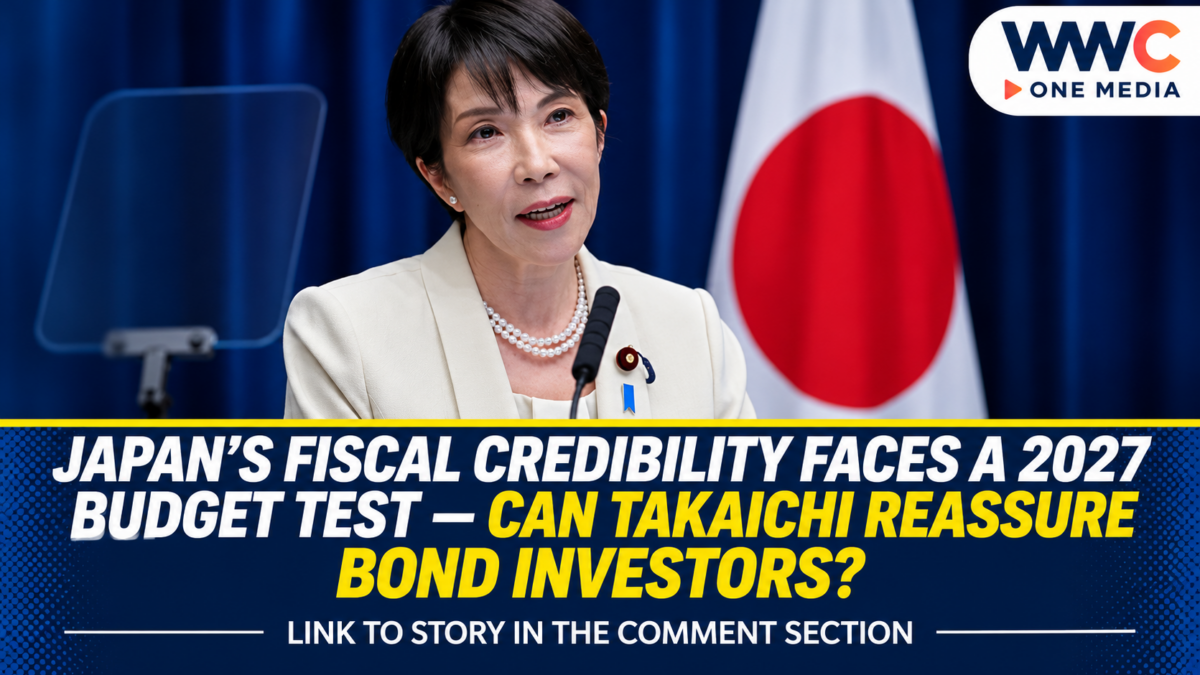
Japan’s government is preparing its fiscal 2027 budget under renewed scrutiny of public borrowing and confidence in government bonds. The Finance Ministry’s Fiscal System Council discussed a draft budget recommendation on Nov. 13, 2026, while an earlier Cabinet Office meeting documented a call to balance growth measures with sustainable public finances.
The challenge facing Prime Minister Sanae Takaichi is not simply how much the government spends. It is whether a credible explanation of funding, priorities and future debt can reassure investors while supporting households and longer-term economic investment.
Japan fiscal credibility becomes a budget question
The Fiscal System Council’s published Nov. 13 agenda identifies deliberations toward final recommendations on budget preparation. Its listing refers to a draft recommendation, but the publicly available meeting index reviewed for this report does not establish that a final recommendation was adopted on Nov. 18.
A separate Nov. 11 Council on Economic and Fiscal Policy briefing provides a confirmed account of the government’s position. The Cabinet Office reported that private-sector council members had stressed both economic growth and fiscal sustainability, while Takaichi emphasised raising real incomes and productivity.
The government also outlined a shift towards predictable spending centred on the initial annual budget, rather than relying heavily on later supplementary allocations. The intended result is clearer planning for public and private investment.
Why it matters: Investors can evaluate a published budget and financing plan more precisely than a political statement. Until the government identifies costs, funding and bond-issuance plans, confidence in the feasibility of competing commitments remains open to assessment.
Official debt figures show the size of the task
Japan’s Ministry of Finance reported ¥1,214.8 trillion in outstanding government bonds as of Sept. 30, 2026. Its broader total of government bonds, borrowings and financing bills was ¥1,323.4 trillion. These are distinct categories and should not be added together or described as identical debt totals.
The ministry separately projects that outstanding ordinary government bonds will reach ¥1,145 trillion at the end of fiscal 2026. That projection also uses a narrower category than the comprehensive debt table.
Debt figures do not, by themselves, tell readers whether a country can meet its obligations. The size of the economy, interest rates, maturity structure, tax receipts and future spending all influence debt sustainability.
WWC earlier examined Takaichi’s assurances to bond investors. The newer official figures give that discussion a concrete reference point, but do not prove an immediate fiscal crisis or an imminent default.
What Tokyo has promised about sustainable spending
In an October statement delivered at international financial meetings, Finance Minister Satsuki Katayama committed to maintaining market confidence while pursuing economic growth and a downward trend in the government debt-to-GDP ratio.
The administration’s budget discussions have likewise linked higher productivity and private investment with restraint in the growth of debt relative to economic output. These are stated policy aims, not evidence that every fiscal target has already been achieved.
A September Cabinet Office account identified a desire to clarify multi-year spending arrangements, review expenditures and revenues and communicate consistently with financial-market participants. Those decisions matter because a multi-year programme needs financing beyond its first announcement.
Analysis: Debt relative to GDP can decline even while the absolute stock of debt rises, provided the denominator grows sufficiently and other conditions cooperate. But faster growth is an assumption that must be tested, not a guaranteed substitute for budget discipline.
Tax relief raises a separate funding problem
Japan’s government has advanced temporary food-consumption-tax relief as part of its economic policy. Lower taxes can support purchasing power, yet a tax reduction also affects public revenue unless offset elsewhere.
WWC’s earlier examination of the food-tax financing debate explored the tension between immediate household assistance and borrowing. The current fiscal-policy issue is broader: whether all proposed measures fit within a transparent annual budget and credible multi-year framework.
The final effect of tax relief depends on legislative approval, the measure’s actual design and the way retailers price eligible goods. A proposal should not be treated as a completed reduction in prices or as guaranteed additional consumption.
Officials and lawmakers must also distinguish a temporary fiscal measure from permanent commitments, which carry different implications for long-term financing.
Why bond markets and the yen matter
Bond investors generally require compensation for lending over different periods, and the yields they demand can change with inflation expectations, monetary policy and perceptions of fiscal risk. Higher yields on newly issued bonds can increase future financing expenses, although existing fixed-rate debt is not repriced all at once.
The yen is influenced by many forces beyond the budget, including relative interest rates, international trade and global capital flows. It would therefore be inaccurate to attribute a particular currency movement solely to a draft fiscal-council recommendation.
WWC has separately covered Takaichi’s discussion of yen confidence and growth. That currency issue complements the budget debate without establishing a mechanical relationship between one government statement and exchange-rate movements.
Analysis: Fiscal credibility depends partly on the consistency between promises and published numbers. Investors may welcome productive spending while still questioning the timetable and cost of funding it. The practical test is whether detailed budgets support the government’s stated goals.
What happens next
The next meaningful documents are the Fiscal System Council’s final published recommendation, the government’s fiscal 2027 budget framework and official bond-issuance plans. Any new tax measures will require the appropriate legislative process before their legal and fiscal consequences can be described as final.
The available primary record supports a government debate over growth, spending discipline and market confidence. It does not authenticate a purported Nov. 18 quotation from a final council recommendation or establish that investors have lost confidence as a measured fact.
For the Philippines and other regional economies, Japan’s fiscal direction is relevant to financial conditions and investment planning. Any specific effect on peso borrowing costs or Philippine trade, however, would need separate evidence.
FAQ
What is Japan’s fiscal credibility debate about?
It concerns whether the government can pursue growth and household-support policies while controlling borrowing and maintaining confidence among government-bond investors.
How much government debt has Japan reported?
The Finance Ministry recorded ¥1,214.8 trillion in outstanding government bonds as of Sept. 30, 2026. Its broader debt table uses additional categories.
Did a Japanese fiscal panel issue a final warning on Nov. 18?
The reviewed official record confirms a Nov. 13 meeting to discuss draft recommendations. A final Nov. 18 recommendation and its exact wording were not independently authenticated.
Does higher government debt automatically weaken the yen?
No. Exchange rates respond to multiple factors. A direct causal claim about a specific yen movement requires evidence beyond the level of outstanding debt.