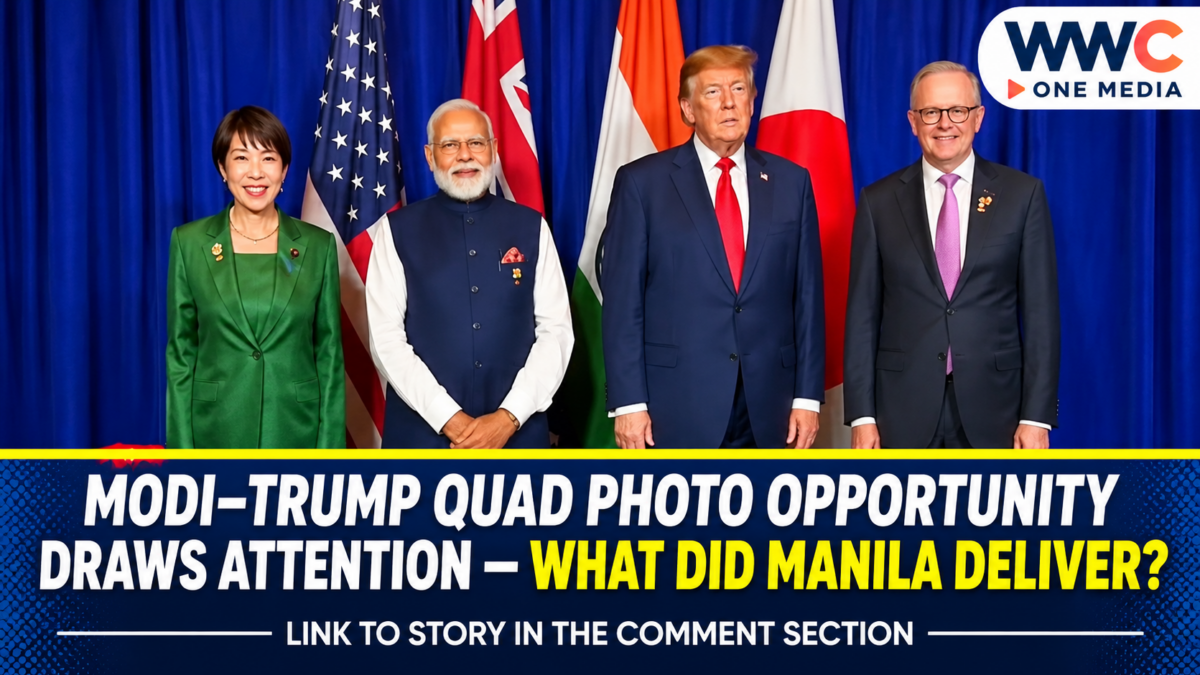
MANILA — US President Donald Trump and Indian Prime Minister Narendra Modi joined the leaders of Australia and Japan for a Quad summit in Manila on Nov. 17, 2026, alongside a photo opportunity documented in an official White House recording. The Quad Manila summit produced a joint statement on maritime surveillance, cybersecurity and regional business links, although the official materials reviewed do not establish that any apparent attempt to end the photo session reflected a diplomatic disagreement.
The distinction matters because a fleeting public interaction cannot substitute for a record of what four governments agreed. Their commitments, published after the meeting, offer a more reliable test of the gathering than assumptions about a leader’s expression or motive.
Quad Manila Summit: What the Public Record Confirms
The White House published separate video pages for the leaders’ photo opportunity and their multilateral meeting, both dated Nov. 17. The accompanying official pages identify the events but do not provide a usable verbatim transcript of the photo-op exchange.
The four participants were Trump, Modi, Australian Prime Minister Anthony Albanese and Japanese Prime Minister Sanae Takaichi. Their joint statement confirms that they met in Manila and presented a programme covering maritime cooperation, critical supply chains, emerging technologies and regional connectivity.
Descriptions of Modi trying to end the photo opportunity have circulated in outside coverage. The official documents reviewed, however, do not establish his intentions or a disagreement among the leaders. Nor do they establish that the exchange delayed negotiations or altered any official commitment.
Analysis: Public-event footage can be interpreted differently depending on camera angle and editing. Without a verifiable full transcript and context, it would be irresponsible to turn a brief interaction into a claim about damaged diplomatic relations.
Maritime Surveillance Moves From Language to Planning
A major element of the joint statement is the Indo-Pacific Maritime Surveillance Collaboration, intended to improve information sharing and awareness of activity at sea. The leaders said their respective P-8 and P-3C patrol aircraft are scheduled to take part in a Quad maritime exercise in 2027.
That is a planned exercise, not one that has already occurred. The document does not identify the Philippines as a participant or confirm that Manila will receive new equipment through the initiative.
The governments also opposed destabilising unilateral actions and reiterated support for freedom of navigation and overflight. These positions are statements of shared policy rather than the establishment of a collective-defence treaty.
WWC has already examined the Quad’s maritime and technology announcements in Manila. This account concentrates on what can actually be confirmed about the photo opportunity and why it should not overshadow the official agenda.
Cybersecurity, Cables and Business Plans Also Featured
The leaders announced enhanced Quad cybersecurity cooperation and welcomed work on more resilient communications infrastructure. Their statement mentioned planned undersea cable projects in the Indian Ocean and an expanded Australian contribution to cable connectivity that includes electricity cables.
They also announced an inaugural Quad Business Leaders’ Forum scheduled for early 2027. The forum is intended to bring together private-sector representatives, government officials and policy specialists to explore business relationships.
The document refers to a technology accelerator for trusted advanced AI systems. These are areas of future work, not a tally of contracts already signed or investments already delivered to Philippine businesses.
Analysis: Project-level details will determine the eventual value of these commitments. A named initiative helps clarify direction, but funding, implementation partners, locations and results require later announcements.
India’s Own Manila Agenda Went Beyond the Quad
India’s prime ministerial office published a separate account of Modi’s Nov. 17 meeting with Philippine President Ferdinand Marcos Jr. It identified discussion of defence and maritime security, space, railway infrastructure, financial technology, trade and investment.
The Indian account also referred to the strategic partnership established during Marcos’s August 2025 state visit to India. That bilateral relationship is separate from the four-country Quad framework.
India’s published list of Manila visit outcomes included an ASEAN–India maritime cooperation plan, a joint cyber-forensics training programme and initiatives involving space, critical minerals, scholarships and tourism visas. Listing an initiative does not mean all of its activities have already begun.
WWC previously covered Marcos’s participation in the BRICS summit hosted by India. The documented Manila bilateral meeting provides a newer benchmark for evaluating cooperation between the two countries, independently of any speculation about Trump and Modi’s body language.
A Photo Opportunity Cannot Measure US–India Relations
Washington and New Delhi share interests in maritime security, technology and economic resilience, but those common objectives do not resolve every bilateral commercial issue. A short photo session cannot show whether negotiations on tariffs or market access have advanced.
The Quad’s Nov. 17 joint statement did not announce a final bilateral US–India trade agreement. Nor did it identify a new tariff schedule agreed by Trump and Modi during the photo opportunity.
WWC has separately examined the unresolved US–India trade negotiations. Whether the governments later announce a binding trade instrument should be judged from published terms, rather than inferred from jokes, smiles or an effort to move to the next event.
Analysis: The most meaningful indicators of cooperation are signed commitments, scheduled exercises and actions by the responsible agencies. A potentially awkward public moment does not independently prove a rupture, just as a friendly photograph does not prove agreement on difficult policy questions.
What Happens Next
The next concrete milestones include the proposed 2027 maritime patrol aircraft exercise, the planned Quad Business Leaders’ Forum and further details of cybersecurity and connectivity initiatives. India and the Philippines may also publish implementation steps under their separate bilateral and ASEAN-related programmes.
An official transcript or complete, accessible video record with sufficient context would be needed to verify a precise interpretation of the exchange at the photo opportunity. Until then, the summit’s published commitments—not an inferred personal disagreement—remain the dependable news.
Frequently Asked Questions
Did Modi and Trump meet at the Quad summit in Manila?
Yes. The official joint statement confirms that Modi, Trump, Albanese and Takaichi met on Nov. 17, 2026.
Did Modi try to stop Trump’s photo-op remarks?
That interpretation appeared in outside coverage, but the official pages reviewed do not provide a transcript sufficient to establish Modi’s intent or a diplomatic dispute.
What did the Quad leaders announce?
Their joint statement outlined maritime surveillance cooperation, a planned 2027 aircraft exercise, cybersecurity work, connectivity measures and an early-2027 business forum.
Is the Philippines a member of the Quad?
No. The Quad consists of Australia, India, Japan and the United States. Hosting the meeting did not make the Philippines a member.
Did the leaders finalise a US–India trade deal in Manila?
No such agreement is announced in the Nov. 17 Quad joint statement. Any bilateral deal would require its own verifiable terms and announcement.